

heteroatom such as phosphorus or sulfur [133] or possess axial or planar chirality
involving sp
2 - or sp-carbon atoms [134], respectively (Scheme 1.3). The use of the
Three-Point Attachment Rule is described as follows (Figs. 1.4–1.6):
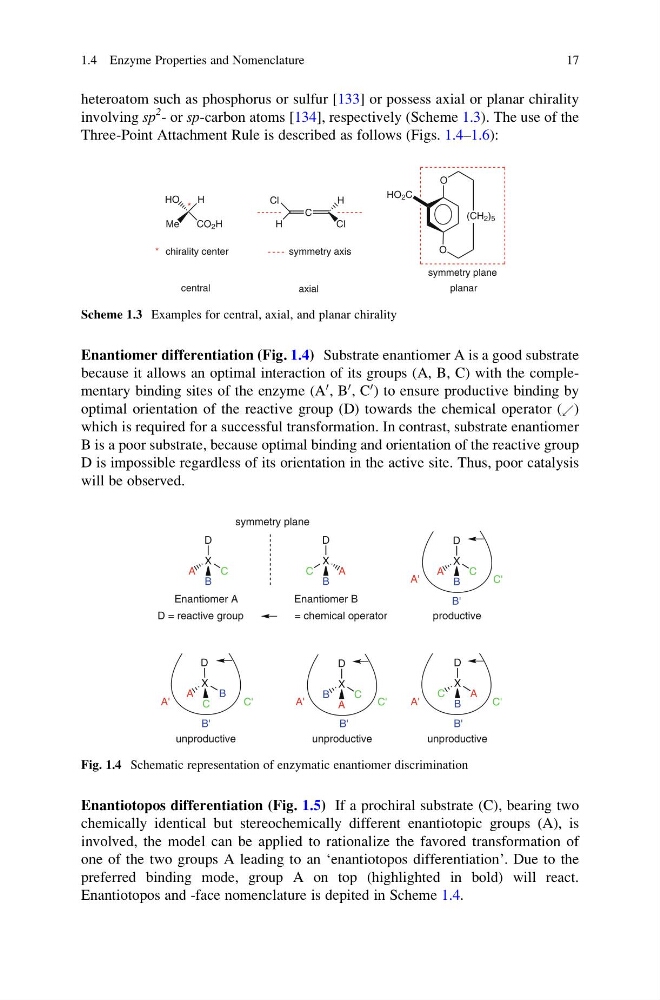
Enantiomer differentiation (Fig. 1.4) Substrate enantiomer A is a good substrate
because it allows an optimal interaction of its groups (A, B, C) with the complementary binding sites of the enzyme (A
0 , B
0 , C
0 ) to ensure productive binding by
optimal orientation of the reactive group (D) towards the chemical operator (.)
which is required for a successful transformation. In contrast, substrate enantiomer
B is a poor substrate, because optimal binding and orientation of the reactive group
D is impossible regardless of its orientation in the active site. Thus, poor catalysis
will be observed.
Enantiotopos differentiation (Fig. 1.5) If a prochiral substrate (C), bearing two
chemically identical but stereochemically different enantiotopic groups (A), is
involved, the model can be applied to rationalize the favored transformation of
one of the two groups A leading to an ‘enantiotopos differentiation’. Due to the
preferred binding mode, group A on top (highlighted in bold) will react.
Enantiotopos and -face nomenclature is depited in Scheme 1.4.
Me
HO
CO 2 H
H
Cl
H
C
H
Cl
(CH 2 ) 5
O
O
HO 2 C
*
central
axial
planar
chirality center
symmetry axis
symmetry plane
*
Scheme 1.3 Examples for central, axial, and planar chirality
B
A
C
D
X
B
A
C
D
X
B
C
A
D
X
B
A
C
D
X
B
A
C
D
X
C
A
B
D
X
Enantiomer B
Enantiomer A
C'
A'
B'
C'
A'
B'
C'
A'
B'
C'
A'
B'
symmetry plane
productive
unproductive
D = reactive group
unproductive
unproductive
= chemical operator
Fig. 1.4 Schematic representation of enzymatic enantiomer discrimination
1.4 Enzyme Properties and Nomenclature
17
involving sp
2 - or sp-carbon atoms [134], respectively (Scheme 1.3). The use of the
Three-Point Attachment Rule is described as follows (Figs. 1.4–1.6):
Enantiomer differentiation (Fig. 1.4) Substrate enantiomer A is a good substrate
because it allows an optimal interaction of its groups (A, B, C) with the complementary binding sites of the enzyme (A
0 , B
0 , C
0 ) to ensure productive binding by
optimal orientation of the reactive group (D) towards the chemical operator (.)
which is required for a successful transformation. In contrast, substrate enantiomer
B is a poor substrate, because optimal binding and orientation of the reactive group
D is impossible regardless of its orientation in the active site. Thus, poor catalysis
will be observed.
Enantiotopos differentiation (Fig. 1.5) If a prochiral substrate (C), bearing two
chemically identical but stereochemically different enantiotopic groups (A), is
involved, the model can be applied to rationalize the favored transformation of
one of the two groups A leading to an ‘enantiotopos differentiation’. Due to the
preferred binding mode, group A on top (highlighted in bold) will react.
Enantiotopos and -face nomenclature is depited in Scheme 1.4.
Me
HO
CO 2 H
H
Cl
H
C
H
Cl
(CH 2 ) 5
O
O
HO 2 C
*
central
axial
planar
chirality center
symmetry axis
symmetry plane
*
Scheme 1.3 Examples for central, axial, and planar chirality
B
A
C
D
X
B
A
C
D
X
B
C
A
D
X
B
A
C
D
X
B
A
C
D
X
C
A
B
D
X
Enantiomer B
Enantiomer A
C'
A'
B'
C'
A'
B'
C'
A'
B'
C'
A'
B'
symmetry plane
productive
unproductive
D = reactive group
unproductive
unproductive
= chemical operator
Fig. 1.4 Schematic representation of enzymatic enantiomer discrimination
1.4 Enzyme Properties and Nomenclature
17