

both of the enantiomeric substrates A and B (Fig. 1.4) or the two forms of mirror-image
orientation of a prochiral substrate involving its enantiotopic groups or faces (Figs. 1.5
and 1.6) compete for the active site of the enzyme. Due to the chiral environment of the
active site, diastereomeric enzyme-substrate complexes [EnzA] and [EnzB] are
formed, which possess different values of free energy (ΔG) for their respective
transition states [EnzA]
6
¼ and [EnzB]
6
¼ . The result is a difference in activation energy
(ΔΔG
6
¼ ) of enantiomers or the ‘enantiomeric orientations’ of prochiral compounds,
respectively. As a consequence, one enantiomer (or orientation) will be transformed
faster than the other. This process is generally referred to as ‘chiral recognition’.
The value of this difference in free energy, expressed as ΔΔG
6 ¼ , is a direct
measure for the selectivity of the reaction which in turn determines the ratio of the
individual reaction rates (v A , v B ) of enantiomeric substrates A and B (or the two
enantiotopic faces or groups competing for the active site of the enzyme, Fig. 1.8).
20
These values are of great importance since they determine the optical purity of the
product. ΔΔG
6 ¼ is composed of an enthalpy (ΔΔH
6 ¼ ) and an entropy term (ΔΔS
6 ¼
).
The enthalpy of activation is usually dominated by the breakage and formation of
bonds when the substrate is transformed into the product. The entropy contribution
includes the energy balance from the ‘order’ of the system, i.e., orienting the
reactants, changes in conformational flexibility during the ‘induced-fit’, and various
concentration and solvatation effects.
Enz + P
[EnzS]
Enz + S
k cat
v ~ k cat • [EnzS] ~
1
=
[Enz] • [S]
[EnzS]
K =
k cat
+Enz
S
-
[EnzS]
-
E a (cat)
E a (uncat)
[EnzS]
Reaction coordinate
enzyme catalyzed
uncatalyzed
K M
K M
K
S
P
P
ΔG
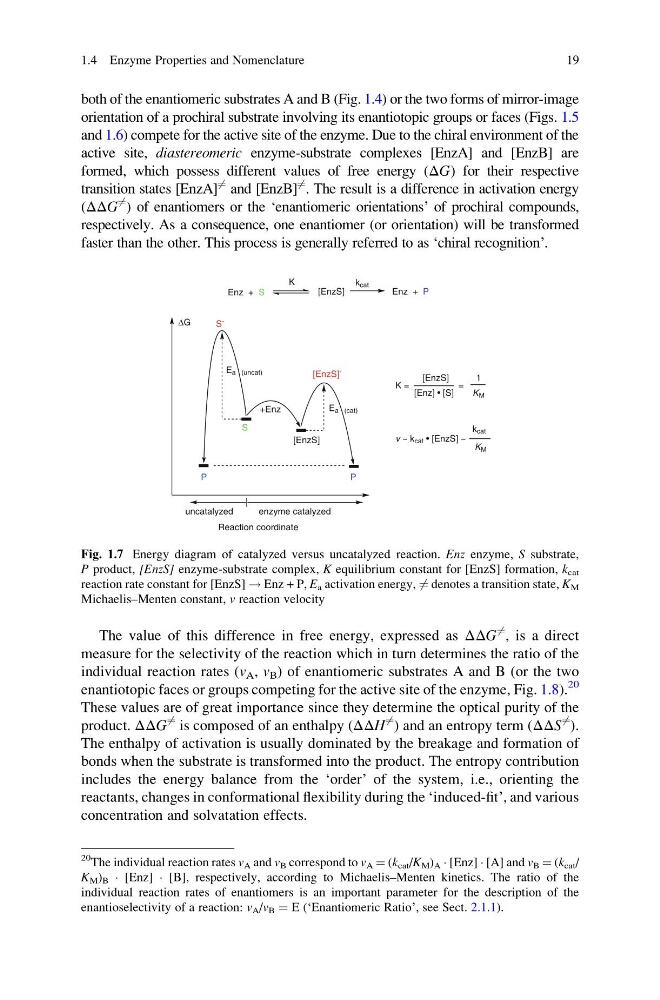
Fig. 1.7 Energy diagram of catalyzed versus uncatalyzed reaction. Enz enzyme, S substrate,
P product, [EnzS] enzyme-substrate complex, K equilibrium constant for [EnzS] formation, k cat
reaction rate constant for [EnzS] ! Enz + P, E a activation energy, 6 ¼ denotes a transition state, K M
Michaelis–Menten constant, v reaction velocity
20 The individual reaction rates v A and v B correspond to v A ¼ (k cat /K M ) A Á [Enz] Á [A] and v B ¼ (k cat /
K M ) B Á [Enz] Á [B], respectively, according to Michaelis–Menten kinetics. The ratio of the
individual reaction rates of enantiomers is an important parameter for the description of the
enantioselectivity of a reaction: v A /v B ¼ E (‘Enantiomeric Ratio’, see Sect. 2.1.1).
1.4 Enzyme Properties and Nomenclature
19
orientation of a prochiral substrate involving its enantiotopic groups or faces (Figs. 1.5
and 1.6) compete for the active site of the enzyme. Due to the chiral environment of the
active site, diastereomeric enzyme-substrate complexes [EnzA] and [EnzB] are
formed, which possess different values of free energy (ΔG) for their respective
transition states [EnzA]
6
¼ and [EnzB]
6
¼ . The result is a difference in activation energy
(ΔΔG
6
¼ ) of enantiomers or the ‘enantiomeric orientations’ of prochiral compounds,
respectively. As a consequence, one enantiomer (or orientation) will be transformed
faster than the other. This process is generally referred to as ‘chiral recognition’.
The value of this difference in free energy, expressed as ΔΔG
6 ¼ , is a direct
measure for the selectivity of the reaction which in turn determines the ratio of the
individual reaction rates (v A , v B ) of enantiomeric substrates A and B (or the two
enantiotopic faces or groups competing for the active site of the enzyme, Fig. 1.8).
20
These values are of great importance since they determine the optical purity of the
product. ΔΔG
6 ¼ is composed of an enthalpy (ΔΔH
6 ¼ ) and an entropy term (ΔΔS
6 ¼
).
The enthalpy of activation is usually dominated by the breakage and formation of
bonds when the substrate is transformed into the product. The entropy contribution
includes the energy balance from the ‘order’ of the system, i.e., orienting the
reactants, changes in conformational flexibility during the ‘induced-fit’, and various
concentration and solvatation effects.
Enz + P
[EnzS]
Enz + S
k cat
v ~ k cat • [EnzS] ~
1
=
[Enz] • [S]
[EnzS]
K =
k cat
+Enz
S
-
[EnzS]
-
E a (cat)
E a (uncat)
[EnzS]
Reaction coordinate
enzyme catalyzed
uncatalyzed
K M
K M
K
S
P
P
ΔG
Fig. 1.7 Energy diagram of catalyzed versus uncatalyzed reaction. Enz enzyme, S substrate,
P product, [EnzS] enzyme-substrate complex, K equilibrium constant for [EnzS] formation, k cat
reaction rate constant for [EnzS] ! Enz + P, E a activation energy, 6 ¼ denotes a transition state, K M
Michaelis–Menten constant, v reaction velocity
20 The individual reaction rates v A and v B correspond to v A ¼ (k cat /K M ) A Á [Enz] Á [A] and v B ¼ (k cat /
K M ) B Á [Enz] Á [B], respectively, according to Michaelis–Menten kinetics. The ratio of the
individual reaction rates of enantiomers is an important parameter for the description of the
enantioselectivity of a reaction: v A /v B ¼ E (‘Enantiomeric Ratio’, see Sect. 2.1.1).
1.4 Enzyme Properties and Nomenclature
19