

Halogenation of Alkynes
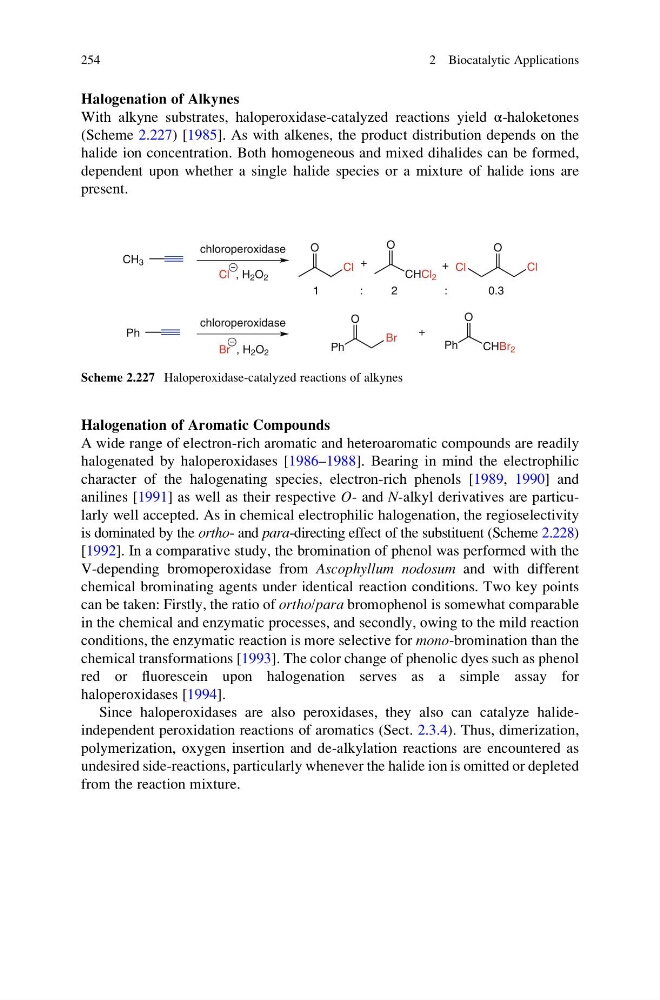
With alkyne substrates, haloperoxidase-catalyzed reactions yield α-haloketones
(Scheme 2.227) [1985]. As with alkenes, the product distribution depends on the
halide ion concentration. Both homogeneous and mixed dihalides can be formed,
dependent upon whether a single halide species or a mixture of halide ions are
present.
Halogenation of Aromatic Compounds
A wide range of electron-rich aromatic and heteroaromatic compounds are readily
halogenated by haloperoxidases [1986–1988]. Bearing in mind the electrophilic
character of the halogenating species, electron-rich phenols [1989, 1990] and
anilines [1991] as well as their respective O- and N-alkyl derivatives are particularly well accepted. As in chemical electrophilic halogenation, the regioselectivity
is dominated by the ortho- and para-directing effect of the substituent (Scheme 2.228)
[1992]. In a comparative study, the bromination of phenol was performed with the
V-depending bromoperoxidase from Ascophyllum nodosum and with different
chemical brominating agents under identical reaction conditions. Two key points
can be taken: Firstly, the ratio of ortho/para bromophenol is somewhat comparable
in the chemical and enzymatic processes, and secondly, owing to the mild reaction
conditions, the enzymatic reaction is more selective for mono-bromination than the
chemical transformations [1993]. The color change of phenolic dyes such as phenol
red or fluorescein upon halogenation serves as a simple assay for
haloperoxidases [1994].
Since haloperoxidases are also peroxidases, they also can catalyze halideindependent peroxidation reactions of aromatics (Sect. 2.3.4). Thus, dimerization,
polymerization, oxygen insertion and de-alkylation reactions are encountered as
undesired side-reactions, particularly whenever the halide ion is omitted or depleted
from the reaction mixture.
CHBr 2
O
Ph
Cl
O
Cl
O
CHCl 2
O
Br
Ph
O
Cl
Ph
CH 3
1
:
2
:
0.3
+
+
+
Br , H 2 O 2
chloroperoxidase
Cl , H 2 O 2
chloroperoxidase
Scheme 2.227 Haloperoxidase-catalyzed reactions of alkynes
254
2 Biocatalytic Applications
With alkyne substrates, haloperoxidase-catalyzed reactions yield α-haloketones
(Scheme 2.227) [1985]. As with alkenes, the product distribution depends on the
halide ion concentration. Both homogeneous and mixed dihalides can be formed,
dependent upon whether a single halide species or a mixture of halide ions are
present.
Halogenation of Aromatic Compounds
A wide range of electron-rich aromatic and heteroaromatic compounds are readily
halogenated by haloperoxidases [1986–1988]. Bearing in mind the electrophilic
character of the halogenating species, electron-rich phenols [1989, 1990] and
anilines [1991] as well as their respective O- and N-alkyl derivatives are particularly well accepted. As in chemical electrophilic halogenation, the regioselectivity
is dominated by the ortho- and para-directing effect of the substituent (Scheme 2.228)
[1992]. In a comparative study, the bromination of phenol was performed with the
V-depending bromoperoxidase from Ascophyllum nodosum and with different
chemical brominating agents under identical reaction conditions. Two key points
can be taken: Firstly, the ratio of ortho/para bromophenol is somewhat comparable
in the chemical and enzymatic processes, and secondly, owing to the mild reaction
conditions, the enzymatic reaction is more selective for mono-bromination than the
chemical transformations [1993]. The color change of phenolic dyes such as phenol
red or fluorescein upon halogenation serves as a simple assay for
haloperoxidases [1994].
Since haloperoxidases are also peroxidases, they also can catalyze halideindependent peroxidation reactions of aromatics (Sect. 2.3.4). Thus, dimerization,
polymerization, oxygen insertion and de-alkylation reactions are encountered as
undesired side-reactions, particularly whenever the halide ion is omitted or depleted
from the reaction mixture.
CHBr 2
O
Ph
Cl
O
Cl
O
CHCl 2
O
Br
Ph
O
Cl
Ph
CH 3
1
:
2
:
0.3
+
+
+
Br , H 2 O 2
chloroperoxidase
Cl , H 2 O 2
chloroperoxidase
Scheme 2.227 Haloperoxidase-catalyzed reactions of alkynes
254
2 Biocatalytic Applications