

Functional groups present in the alkene can lead to products other than the
expected halohydrin (pathway A) by competing with hydroxyl anion for the
halonium intermediate. Unsaturated carboxylic acids, for instance, are transformed
into the corresponding halolactones due to the nucleophilicity of the carboxylate
group (pathway B) affording a halolactonization [1975, 1976]. Similarly, in presence of elevated concentrations of halide, 1,2-dihalides are formed (pathway C)
[1977]. This latter transformation offers the unique possibility of introducing
fluorine, which is not oxidized by haloperoxidases, into the substrate. Furthermore,
migration of functional groups such as halogen [1978] and loss of carboncontaining units such as acetate and formaldehyde may occur, particularly when
an oxygen substituent is attached to the C¼C bond [1979, 1980].
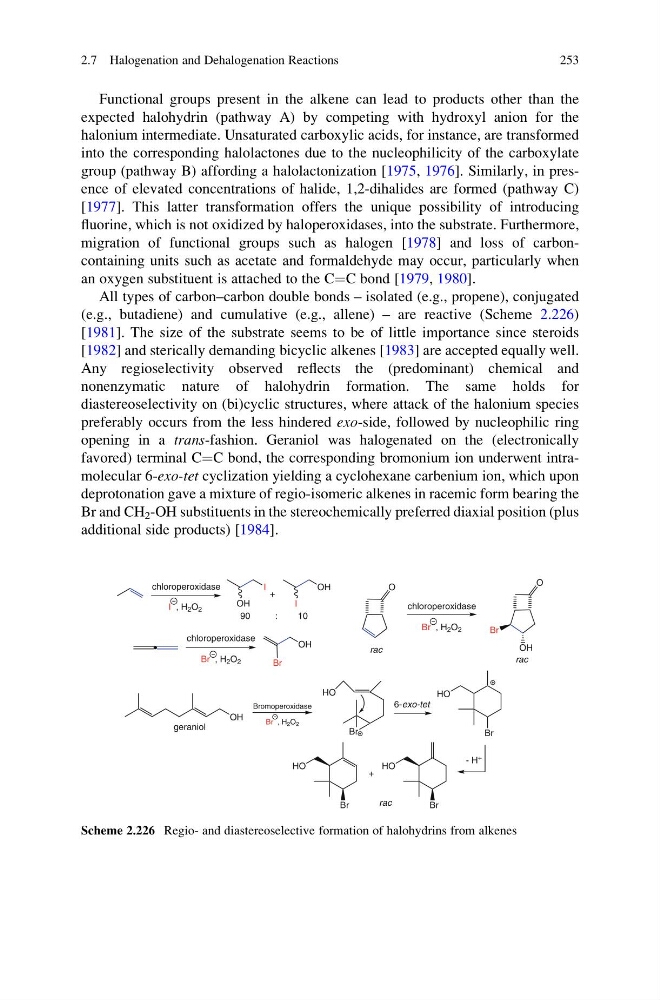
All types of carbon–carbon double bonds – isolated (e.g., propene), conjugated
(e.g., butadiene) and cumulative (e.g., allene) – are reactive (Scheme 2.226)
[1981]. The size of the substrate seems to be of little importance since steroids
[1982] and sterically demanding bicyclic alkenes [1983] are accepted equally well.
Any regioselectivity observed reflects the (predominant) chemical and
nonenzymatic nature of halohydrin formation. The same holds for
diastereoselectivity on (bi)cyclic structures, where attack of the halonium species
preferably occurs from the less hindered exo-side, followed by nucleophilic ring
opening in a trans-fashion. Geraniol was halogenated on the (electronically
favored) terminal C¼C bond, the corresponding bromonium ion underwent intramolecular 6-exo-tet cyclization yielding a cyclohexane carbenium ion, which upon
deprotonation gave a mixture of regio-isomeric alkenes in racemic form bearing the
Br and CH 2 -OH substituents in the stereochemically preferred diaxial position (plus
additional side products) [1984].
I
OH
OH
I
.
Br
OH
O
Br
OH
O
Br , H 2 O 2
Br , H 2 O 2
90
:
10
+
I , H 2 O 2
chloroperoxidase
chloroperoxidase
chloroperoxidase
rac
rac
Br , H2O2
Bromoperoxidase
OH
geraniol
Br
HO
Br
HO
Br
HO
Br
HO
6-exo-tet
+
- H
+
rac
Scheme 2.226 Regio- and diastereoselective formation of halohydrins from alkenes
2.7 Halogenation and Dehalogenation Reactions
253
expected halohydrin (pathway A) by competing with hydroxyl anion for the
halonium intermediate. Unsaturated carboxylic acids, for instance, are transformed
into the corresponding halolactones due to the nucleophilicity of the carboxylate
group (pathway B) affording a halolactonization [1975, 1976]. Similarly, in presence of elevated concentrations of halide, 1,2-dihalides are formed (pathway C)
[1977]. This latter transformation offers the unique possibility of introducing
fluorine, which is not oxidized by haloperoxidases, into the substrate. Furthermore,
migration of functional groups such as halogen [1978] and loss of carboncontaining units such as acetate and formaldehyde may occur, particularly when
an oxygen substituent is attached to the C¼C bond [1979, 1980].
All types of carbon–carbon double bonds – isolated (e.g., propene), conjugated
(e.g., butadiene) and cumulative (e.g., allene) – are reactive (Scheme 2.226)
[1981]. The size of the substrate seems to be of little importance since steroids
[1982] and sterically demanding bicyclic alkenes [1983] are accepted equally well.
Any regioselectivity observed reflects the (predominant) chemical and
nonenzymatic nature of halohydrin formation. The same holds for
diastereoselectivity on (bi)cyclic structures, where attack of the halonium species
preferably occurs from the less hindered exo-side, followed by nucleophilic ring
opening in a trans-fashion. Geraniol was halogenated on the (electronically
favored) terminal C¼C bond, the corresponding bromonium ion underwent intramolecular 6-exo-tet cyclization yielding a cyclohexane carbenium ion, which upon
deprotonation gave a mixture of regio-isomeric alkenes in racemic form bearing the
Br and CH 2 -OH substituents in the stereochemically preferred diaxial position (plus
additional side products) [1984].
I
OH
OH
I
.
Br
OH
O
Br
OH
O
Br , H 2 O 2
Br , H 2 O 2
90
:
10
+
I , H 2 O 2
chloroperoxidase
chloroperoxidase
chloroperoxidase
rac
rac
Br , H2O2
Bromoperoxidase
OH
geraniol
Br
HO
Br
HO
Br
HO
Br
HO
6-exo-tet
+
- H
+
rac
Scheme 2.226 Regio- and diastereoselective formation of halohydrins from alkenes
2.7 Halogenation and Dehalogenation Reactions
253