

Bearing in mind their unique position as halogenating enzymes and the large
variety of structurally different halometabolites produced by them, it is not surprising that the majority of haloperoxidases are characterized by a low product selectivity and wide substrate tolerance.
The most intensively studied haloperoxidases are the chloroperoxidase from the
mold Caldariomyces fumago [1473] and bromoperoxidases from algae [1967] and
bacteria such as Pseudomonas aureofaciens [1968], Ps. pyrrocinia [1969], and
Streptomyces sp. [1970]. The only iodoperoxidase of preparative use is isolated
from horseradish root [1971].
Halogenation of Alkenes
Haloperoxidases transform alkenes by a formal addition of hypohalous acid to
produce halohydrins. The mechanism is identical to that of chemical halohydrin
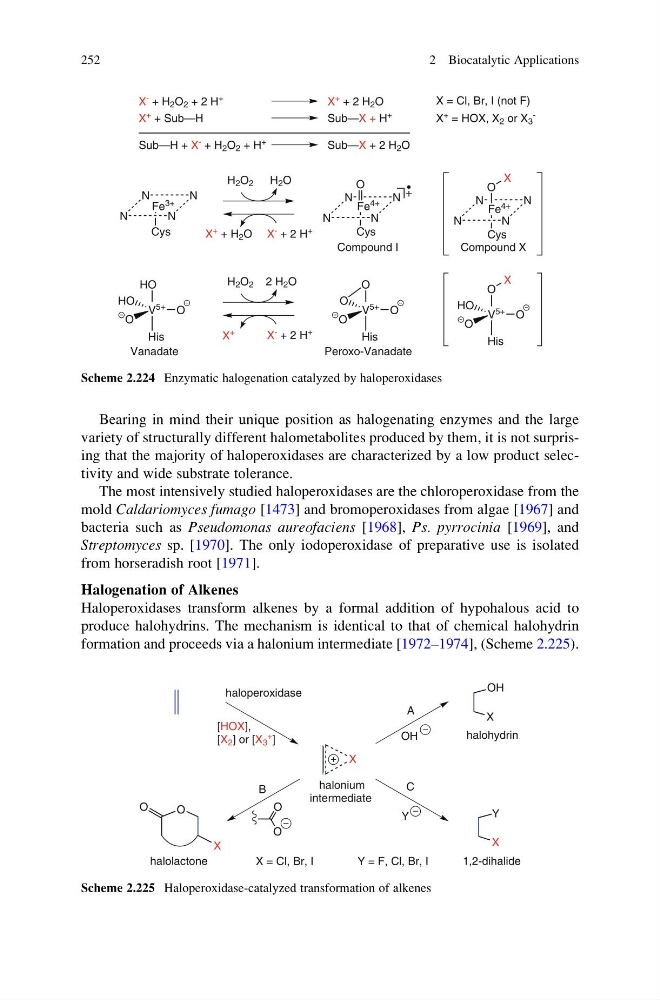
formation and proceeds via a halonium intermediate [1972–1974], (Scheme 2.225).
X
- + H 2 O 2 + 2 H
+
X
+ + 2 H 2 O
X + + Sub—H
Sub—X + H +
X = Cl, Br, I (not F)
X + = HOX, X 2 or X 3
-
Sub—H + X - + H 2 O 2 + H +
Sub—X + 2 H 2 O
Cys
Fe
3+
Compound I
•
+
H 2 O
H 2 O 2
N
N
N
N
Cys
Fe 4+
N
N
N
N
O
X - + 2 H +
X + + H 2 O
Compound X
Cys
Fe
4+
N
N
N
N
O
X
His
V
5+
2 H 2 O
H 2 O 2
X
- + 2 H
+
HO
O
HO
O
His
V
5+
O
O
O
O
X +
His
V
5+
O
O
HO
O
X
Vanadate
Peroxo-Vanadate
Scheme 2.224 Enzymatic halogenation catalyzed by haloperoxidases
O
O
X
O
O
X
Y
X
OH
X
halonium
intermediate
X = Cl, Br, I
Y = F, Cl, Br, I
halolactone
1,2-dihalide
halohydrin
haloperoxidase
Y
C
B
A
OH
[HOX],
[X 2 ] or [X 3
+
]
Scheme 2.225 Haloperoxidase-catalyzed transformation of alkenes
252
2 Biocatalytic Applications
variety of structurally different halometabolites produced by them, it is not surprising that the majority of haloperoxidases are characterized by a low product selectivity and wide substrate tolerance.
The most intensively studied haloperoxidases are the chloroperoxidase from the
mold Caldariomyces fumago [1473] and bromoperoxidases from algae [1967] and
bacteria such as Pseudomonas aureofaciens [1968], Ps. pyrrocinia [1969], and
Streptomyces sp. [1970]. The only iodoperoxidase of preparative use is isolated
from horseradish root [1971].
Halogenation of Alkenes
Haloperoxidases transform alkenes by a formal addition of hypohalous acid to
produce halohydrins. The mechanism is identical to that of chemical halohydrin
formation and proceeds via a halonium intermediate [1972–1974], (Scheme 2.225).
X
- + H 2 O 2 + 2 H
+
X
+ + 2 H 2 O
X + + Sub—H
Sub—X + H +
X = Cl, Br, I (not F)
X + = HOX, X 2 or X 3
-
Sub—H + X - + H 2 O 2 + H +
Sub—X + 2 H 2 O
Cys
Fe
3+
Compound I
•
+
H 2 O
H 2 O 2
N
N
N
N
Cys
Fe 4+
N
N
N
N
O
X - + 2 H +
X + + H 2 O
Compound X
Cys
Fe
4+
N
N
N
N
O
X
His
V
5+
2 H 2 O
H 2 O 2
X
- + 2 H
+
HO
O
HO
O
His
V
5+
O
O
O
O
X +
His
V
5+
O
O
HO
O
X
Vanadate
Peroxo-Vanadate
Scheme 2.224 Enzymatic halogenation catalyzed by haloperoxidases
O
O
X
O
O
X
Y
X
OH
X
halonium
intermediate
X = Cl, Br, I
Y = F, Cl, Br, I
halolactone
1,2-dihalide
halohydrin
haloperoxidase
Y
C
B
A
OH
[HOX],
[X 2 ] or [X 3
+
]
Scheme 2.225 Haloperoxidase-catalyzed transformation of alkenes
252
2 Biocatalytic Applications