

Glyco-Synthases
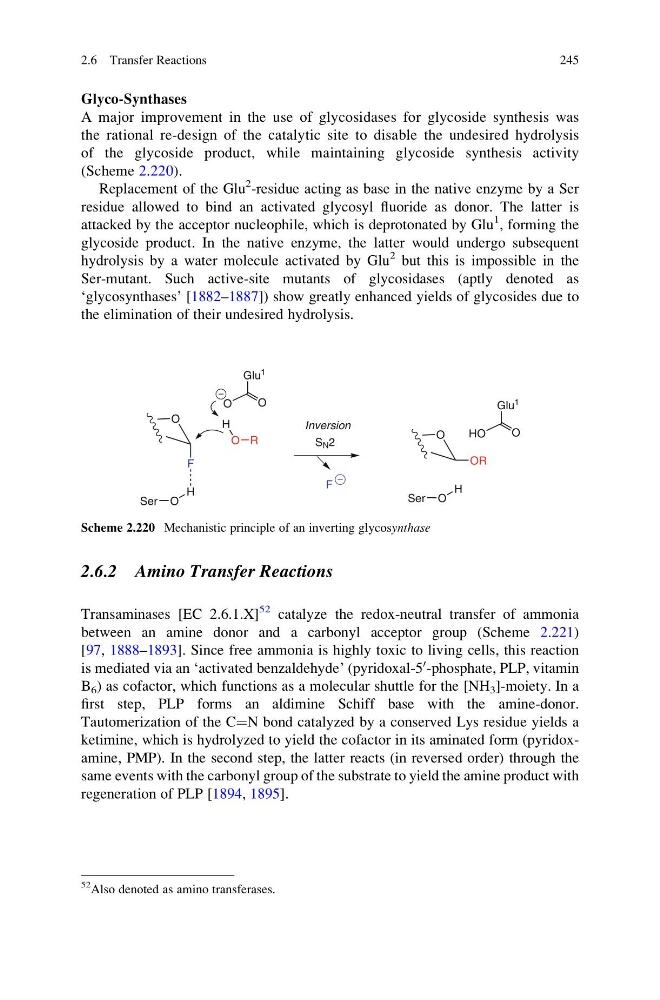
A major improvement in the use of glycosidases for glycoside synthesis was
the rational re-design of the catalytic site to disable the undesired hydrolysis
of the glycoside product, while maintaining glycoside synthesis activity
(Scheme 2.220).
Replacement of the Glu
2 -residue acting as base in the native enzyme by a Ser
residue allowed to bind an activated glycosyl fluoride as donor. The latter is
attacked by the acceptor nucleophile, which is deprotonated by Glu
1 , forming the
glycoside product. In the native enzyme, the latter would undergo subsequent
hydrolysis by a water molecule activated by Glu
2 but this is impossible in the
Ser-mutant. Such active-site mutants of glycosidases (aptly denoted as
‘glycosynthases’ [1882–1887]) show greatly enhanced yields of glycosides due to
the elimination of their undesired hydrolysis.
2.6.2 Amino Transfer Reactions
Transaminases [EC 2.6.1.X]
52 catalyze the redox-neutral transfer of ammonia
between an amine donor and a carbonyl acceptor group (Scheme 2.221)
[97, 1888–1893]. Since free ammonia is highly toxic to living cells, this reaction
is mediated via an ‘activated benzaldehyde’ (pyridoxal-5
0 -phosphate, PLP, vitamin
B 6 ) as cofactor, which functions as a molecular shuttle for the [NH 3 ]-moiety. In a
first step, PLP forms an aldimine Schiff base with the amine-donor.
Tautomerization of the C¼N bond catalyzed by a conserved Lys residue yields a
ketimine, which is hydrolyzed to yield the cofactor in its aminated form (pyridoxamine, PMP). In the second step, the latter reacts (in reversed order) through the
same events with the carbonyl group of the substrate to yield the amine product with
regeneration of PLP [1894, 1895].
O
O
Glu
1
R
O
H
Ser
O
F
H
O
O
HO
Glu 1
Ser
H
O
OR
O
Inversion
S N 2
F
Scheme 2.220 Mechanistic principle of an inverting glycosynthase
52 Also denoted as amino transferases.
2.6 Transfer Reactions
245
A major improvement in the use of glycosidases for glycoside synthesis was
the rational re-design of the catalytic site to disable the undesired hydrolysis
of the glycoside product, while maintaining glycoside synthesis activity
(Scheme 2.220).
Replacement of the Glu
2 -residue acting as base in the native enzyme by a Ser
residue allowed to bind an activated glycosyl fluoride as donor. The latter is
attacked by the acceptor nucleophile, which is deprotonated by Glu
1 , forming the
glycoside product. In the native enzyme, the latter would undergo subsequent
hydrolysis by a water molecule activated by Glu
2 but this is impossible in the
Ser-mutant. Such active-site mutants of glycosidases (aptly denoted as
‘glycosynthases’ [1882–1887]) show greatly enhanced yields of glycosides due to
the elimination of their undesired hydrolysis.
2.6.2 Amino Transfer Reactions
Transaminases [EC 2.6.1.X]
52 catalyze the redox-neutral transfer of ammonia
between an amine donor and a carbonyl acceptor group (Scheme 2.221)
[97, 1888–1893]. Since free ammonia is highly toxic to living cells, this reaction
is mediated via an ‘activated benzaldehyde’ (pyridoxal-5
0 -phosphate, PLP, vitamin
B 6 ) as cofactor, which functions as a molecular shuttle for the [NH 3 ]-moiety. In a
first step, PLP forms an aldimine Schiff base with the amine-donor.
Tautomerization of the C¼N bond catalyzed by a conserved Lys residue yields a
ketimine, which is hydrolyzed to yield the cofactor in its aminated form (pyridoxamine, PMP). In the second step, the latter reacts (in reversed order) through the
same events with the carbonyl group of the substrate to yield the amine product with
regeneration of PLP [1894, 1895].
O
O
Glu
1
R
O
H
Ser
O
F
H
O
O
HO
Glu 1
Ser
H
O
OR
O
Inversion
S N 2
F
Scheme 2.220 Mechanistic principle of an inverting glycosynthase
52 Also denoted as amino transferases.
2.6 Transfer Reactions
245