

Although transaminases were discovered already half a century ago
[1896, 1897], their use for the biocatalytic synthesis of (nonnatural) amines was
initially impeded by two obstacles: (i) The majority of transaminases available were
only active on α-amino/α-ketoacids as substrates and (ii) techniques to shift the
equilibrium towards amine formation had to be developed. The first significant
advances in transamination for organic synthesis were achieved by Celgene Co.,
who employed transaminases for the synthesis of nonracemic amines, preferentially
via (less efficient) kinetic resolution of rac-amines by enantioselective
de-amination [1898, 1899]. Within the last decade, several breakthroughs with
respect to the (commercial) availability of stereo-complementary transaminases
possessing a broad substrate spectrum and a set of techniques to shift the equilibrium of transamination in favor of amine synthesis were accomplished, which make
enzymatic transamination nowadays a reliable technique for the industrial-scale
asymmetric synthesis of amines [1900, 1901].
On a genomic level, transaminases are classified into subgroups [1902–1904].
α-Transaminases are very specific, as they only act on α-amino acids yielding the
corresponding α-keto acids. In contrast, ω-transaminases (ω-TA) are more flexible
and accept substrates bearing a distant carboxylate moiety (such as lysine, ornithine, β-alanine, and ω-aminobutyrate). Since they also accept prim-amines lacking
a carboxylate group (e.g. i-Pr-NH 2 , 2-Bu-NH 2 ), they are also referred to as ‘amine
transaminases [1905].
In view to access both stereoisomers of a chiral amine via transamination by
choice of an appropriate (R)- or (S)-selective ω-TA, screening studies were
O
R
2
R
1
O
OH
NH 2
N
O
OH
CH=O
N
NH 2
R''
R'
O
R''
R'
NH 2
R
2
R
1
O
R''
R'
NH 2
R''
R'
CH=O
H
H
R''
R'
N
H
R''
R'
H
N
NH 2
* newly formed stereocenter
= phosphate
Pyridoxamine
Pyridoxal-5'-phosphate
(PLP)
(PMP)
Transaminase
*
Tautomer
Ketimine
Aldimine
(PMP)
(PLP)
P
P
P
H 2 O
H 2 O
Donor
Acceptor
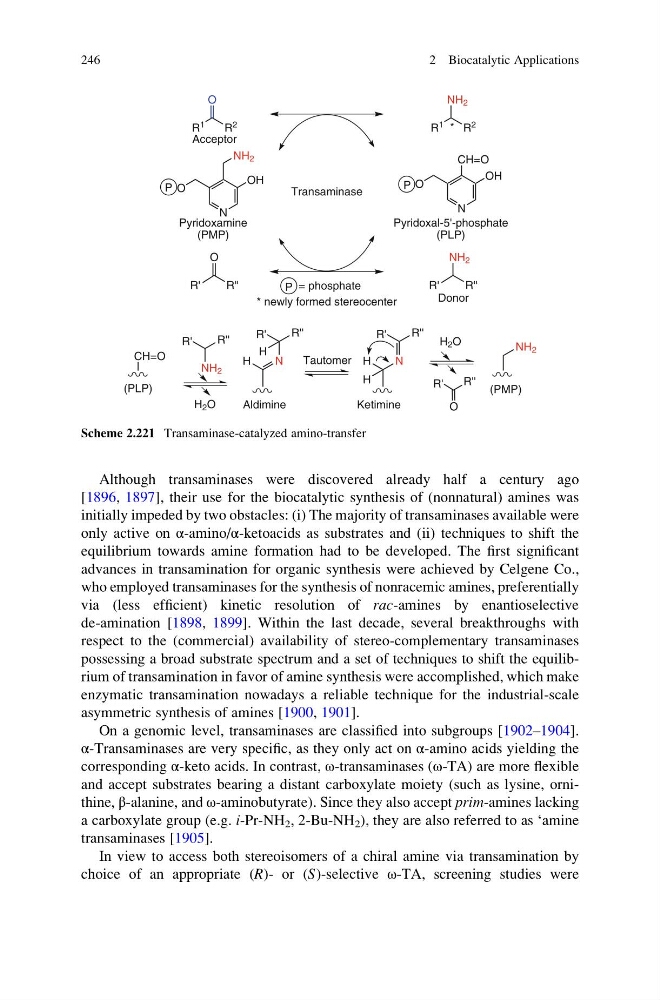
Scheme 2.221 Transaminase-catalyzed amino-transfer
246
2 Biocatalytic Applications
[1896, 1897], their use for the biocatalytic synthesis of (nonnatural) amines was
initially impeded by two obstacles: (i) The majority of transaminases available were
only active on α-amino/α-ketoacids as substrates and (ii) techniques to shift the
equilibrium towards amine formation had to be developed. The first significant
advances in transamination for organic synthesis were achieved by Celgene Co.,
who employed transaminases for the synthesis of nonracemic amines, preferentially
via (less efficient) kinetic resolution of rac-amines by enantioselective
de-amination [1898, 1899]. Within the last decade, several breakthroughs with
respect to the (commercial) availability of stereo-complementary transaminases
possessing a broad substrate spectrum and a set of techniques to shift the equilibrium of transamination in favor of amine synthesis were accomplished, which make
enzymatic transamination nowadays a reliable technique for the industrial-scale
asymmetric synthesis of amines [1900, 1901].
On a genomic level, transaminases are classified into subgroups [1902–1904].
α-Transaminases are very specific, as they only act on α-amino acids yielding the
corresponding α-keto acids. In contrast, ω-transaminases (ω-TA) are more flexible
and accept substrates bearing a distant carboxylate moiety (such as lysine, ornithine, β-alanine, and ω-aminobutyrate). Since they also accept prim-amines lacking
a carboxylate group (e.g. i-Pr-NH 2 , 2-Bu-NH 2 ), they are also referred to as ‘amine
transaminases [1905].
In view to access both stereoisomers of a chiral amine via transamination by
choice of an appropriate (R)- or (S)-selective ω-TA, screening studies were
O
R
2
R
1
O
OH
NH 2
N
O
OH
CH=O
N
NH 2
R''
R'
O
R''
R'
NH 2
R
2
R
1
O
R''
R'
NH 2
R''
R'
CH=O
H
H
R''
R'
N
H
R''
R'
H
N
NH 2
* newly formed stereocenter
= phosphate
Pyridoxamine
Pyridoxal-5'-phosphate
(PLP)
(PMP)
Transaminase
*
Tautomer
Ketimine
Aldimine
(PMP)
(PLP)
P
P
P
H 2 O
H 2 O
Donor
Acceptor
Scheme 2.221 Transaminase-catalyzed amino-transfer
246
2 Biocatalytic Applications