

For instance, when the α-anomer of methyl-D-glucoside was used as acceptor
and p-nitrophenyl-β-N-acetyl-D-galactosaminide as donor in a trans-glycosylation
reaction catalyzed by β-galactosidase from Aspergillus oryzae, two transfer products possessing a 1,4- and 1,6-linkage were formed in a ratio of ~5:1, respectively.
On the other hand, when using the β-anomer of the acceptor, the corresponding 1,3and 1,4-glucosides were formed instead (ratio ~4:1) [1873].
Besides the synthesis of natural glycosides, a considerable number of nonnatural
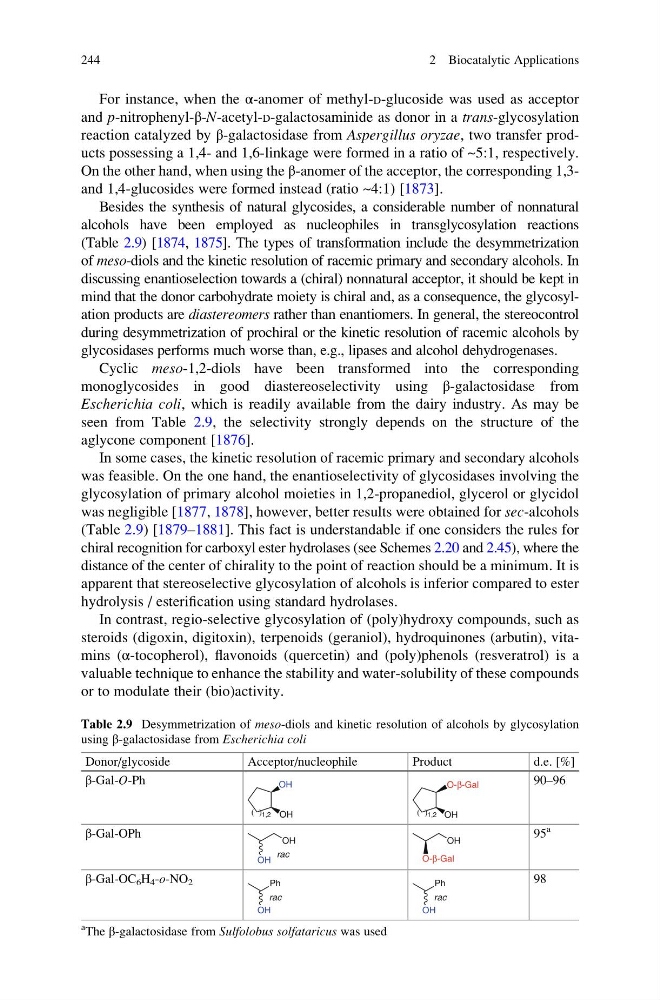
alcohols have been employed as nucleophiles in transglycosylation reactions
(Table 2.9) [1874, 1875]. The types of transformation include the desymmetrization
of meso-diols and the kinetic resolution of racemic primary and secondary alcohols. In
discussing enantioselection towards a (chiral) nonnatural acceptor, it should be kept in
mind that the donor carbohydrate moiety is chiral and, as a consequence, the glycosylation products are diastereomers rather than enantiomers. In general, the stereocontrol
during desymmetrization of prochiral or the kinetic resolution of racemic alcohols by
glycosidases performs much worse than, e.g., lipases and alcohol dehydrogenases.
Cyclic meso-1,2-diols have been transformed into the corresponding
monoglycosides in good diastereoselectivity using β-galactosidase from
Escherichia coli, which is readily available from the dairy industry. As may be
seen from Table 2.9, the selectivity strongly depends on the structure of the
aglycone component [1876].
In some cases, the kinetic resolution of racemic primary and secondary alcohols
was feasible. On the one hand, the enantioselectivity of glycosidases involving the
glycosylation of primary alcohol moieties in 1,2-propanediol, glycerol or glycidol
was negligible [1877, 1878], however, better results were obtained for sec-alcohols
(Table 2.9) [1879–1881]. This fact is understandable if one considers the rules for
chiral recognition for carboxyl ester hydrolases (see Schemes 2.20 and 2.45), where the
distance of the center of chirality to the point of reaction should be a minimum. It is
apparent that stereoselective glycosylation of alcohols is inferior compared to ester
hydrolysis / esterification using standard hydrolases.
In contrast, regio-selective glycosylation of (poly)hydroxy compounds, such as
steroids (digoxin, digitoxin), terpenoids (geraniol), hydroquinones (arbutin), vitamins (α-tocopherol), flavonoids (quercetin) and (poly)phenols (resveratrol) is a
valuable technique to enhance the stability and water-solubility of these compounds
or to modulate their (bio)activity.
Table 2.9 Desymmetrization of meso-diols and kinetic resolution of alcohols by glycosylation
using β-galactosidase from Escherichia coli
Donor/glycoside
Acceptor/nucleophile
Product
d.e. [%]
β-Gal-O-Ph
OH
OH
( ) 1,2
OH
O-β-Gal
( ) 1,2
90–96
β-Gal-OPh
OH
OH
rac
O-β-Gal
OH
95
a
β-Gal-OC 6 H 4 -o-NO 2
OH
Ph
rac
OH
Ph
rac
98
a
The β-galactosidase from Sulfolobus solfataricus was used
244
2 Biocatalytic Applications
and p-nitrophenyl-β-N-acetyl-D-galactosaminide as donor in a trans-glycosylation
reaction catalyzed by β-galactosidase from Aspergillus oryzae, two transfer products possessing a 1,4- and 1,6-linkage were formed in a ratio of ~5:1, respectively.
On the other hand, when using the β-anomer of the acceptor, the corresponding 1,3and 1,4-glucosides were formed instead (ratio ~4:1) [1873].
Besides the synthesis of natural glycosides, a considerable number of nonnatural
alcohols have been employed as nucleophiles in transglycosylation reactions
(Table 2.9) [1874, 1875]. The types of transformation include the desymmetrization
of meso-diols and the kinetic resolution of racemic primary and secondary alcohols. In
discussing enantioselection towards a (chiral) nonnatural acceptor, it should be kept in
mind that the donor carbohydrate moiety is chiral and, as a consequence, the glycosylation products are diastereomers rather than enantiomers. In general, the stereocontrol
during desymmetrization of prochiral or the kinetic resolution of racemic alcohols by
glycosidases performs much worse than, e.g., lipases and alcohol dehydrogenases.
Cyclic meso-1,2-diols have been transformed into the corresponding
monoglycosides in good diastereoselectivity using β-galactosidase from
Escherichia coli, which is readily available from the dairy industry. As may be
seen from Table 2.9, the selectivity strongly depends on the structure of the
aglycone component [1876].
In some cases, the kinetic resolution of racemic primary and secondary alcohols
was feasible. On the one hand, the enantioselectivity of glycosidases involving the
glycosylation of primary alcohol moieties in 1,2-propanediol, glycerol or glycidol
was negligible [1877, 1878], however, better results were obtained for sec-alcohols
(Table 2.9) [1879–1881]. This fact is understandable if one considers the rules for
chiral recognition for carboxyl ester hydrolases (see Schemes 2.20 and 2.45), where the
distance of the center of chirality to the point of reaction should be a minimum. It is
apparent that stereoselective glycosylation of alcohols is inferior compared to ester
hydrolysis / esterification using standard hydrolases.
In contrast, regio-selective glycosylation of (poly)hydroxy compounds, such as
steroids (digoxin, digitoxin), terpenoids (geraniol), hydroquinones (arbutin), vitamins (α-tocopherol), flavonoids (quercetin) and (poly)phenols (resveratrol) is a
valuable technique to enhance the stability and water-solubility of these compounds
or to modulate their (bio)activity.
Table 2.9 Desymmetrization of meso-diols and kinetic resolution of alcohols by glycosylation
using β-galactosidase from Escherichia coli
Donor/glycoside
Acceptor/nucleophile
Product
d.e. [%]
β-Gal-O-Ph
OH
OH
( ) 1,2
OH
O-β-Gal
( ) 1,2
90–96
β-Gal-OPh
OH
OH
rac
O-β-Gal
OH
95
a
β-Gal-OC 6 H 4 -o-NO 2
OH
Ph
rac
OH
Ph
rac
98
a
The β-galactosidase from Sulfolobus solfataricus was used
244
2 Biocatalytic Applications