

causing its degradation (Fig. 2.19, pathway C), the success of this procedure as a
preparative method depends on the following crucial parameters:
• Transglycosylation must be faster than glycoside hydrolysis
• The rate of hydrolysis of the product being slower than that of the glycosyl donor
In practice these conditions can be attained readily. It should be emphasized that
an analogous situation can be found in enzymatic peptide synthesis using proteases
(Sect. 3.1.4). The primary advantages of using glycosidases in comparison to
glycosyl transferases is that expensive activated sugar nucleosides are not required
and glycosidases generally are more readily available than glycosyl transferases.
Furthermore, there is total control over the α/β-configuration at the newly generated
anomeric center.
The major drawbacks, however, are incomplete yields and the frequent formation of product mixtures due to the limited selectivity of glycosidases with respect
to the glycosidic acceptor, in particular due to the formation of undesired
1,6-linkages. The regio- and stereoselectivity of transglycosylation reactions is
influenced by a number of parameters such as reaction temperature [1868], concentration of organic cosolvent, the reactivity of the activated donor [1869], the
nature of the aglycone [1870, 1871], and the anomeric configuration of the acceptor
glycoside [1872] (Table 2.8).
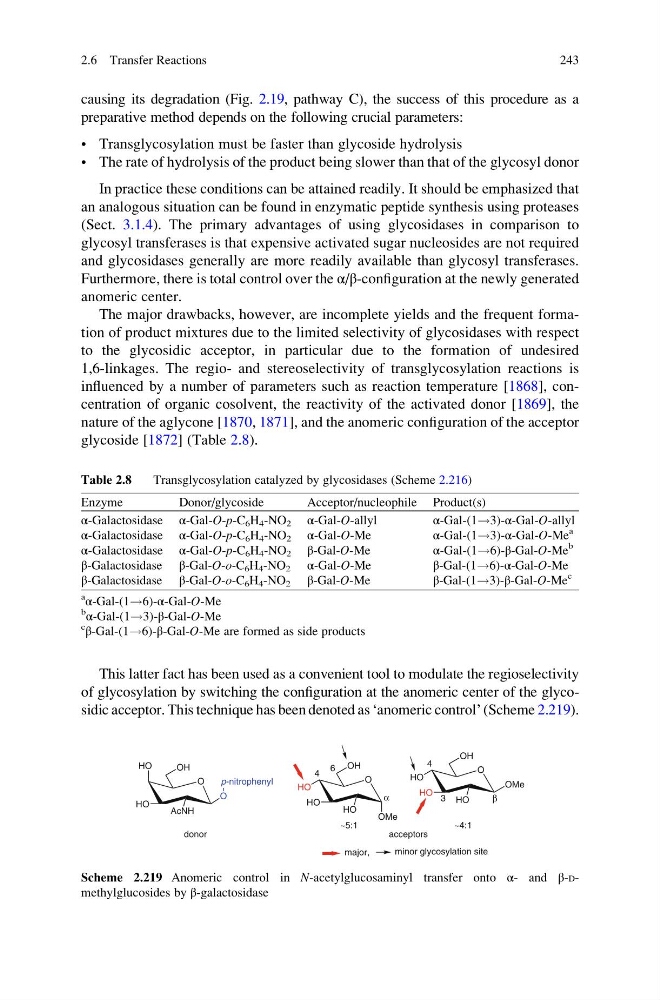
This latter fact has been used as a convenient tool to modulate the regioselectivity
of glycosylation by switching the configuration at the anomeric center of the glycosidic acceptor. This technique has been denoted as ‘anomeric control’ (Scheme 2.219).
Table 2.8
Transglycosylation catalyzed by glycosidases (Scheme 2.216)
Enzyme
Donor/glycoside
Acceptor/nucleophile Product(s)
α-Galactosidase α-Gal-O-p-C 6 H 4 -NO 2 α-Gal-O-allyl
α-Gal-(1!3)-α-Gal-O-allyl
α-Galactosidase α-Gal-O-p-C 6 H 4 -NO 2 α-Gal-O-Me
α-Gal-(1!3)-α-Gal-O-Me
a
α-Galactosidase α-Gal-O-p-C 6 H 4 -NO 2 β-Gal-O-Me
α-Gal-(1!6)-β-Gal-O-Me
b
β-Galactosidase β-Gal-O-o-C 6 H 4 -NO 2 α-Gal-O-Me
β-Gal-(1!6)-α-Gal-O-Me
β-Galactosidase β-Gal-O-o-C 6 H 4 -NO 2 β-Gal-O-Me
β-Gal-(1!3)-β-Gal-O-Me
c
a
α-Gal-(1!6)-α-Gal-O-Me
b
α-Gal-(1!3)-β-Gal-O-Me
c
β-Gal-(1!6)-β-Gal-O-Me are formed as side products
p-nitrophenyl
HO
O
AcNH
HO
OH
O
OH
HO
HO
HO
OMe
O
OMe
OH
HO
HO
HO
O
acceptors
donor
6
4
α
~5:1
3
4
β
~4:1
major,
minor glycosylation site
Scheme 2.219 Anomeric control in N-acetylglucosaminyl transfer onto α- and β-Dmethylglucosides by β-galactosidase
2.6 Transfer Reactions
243
preparative method depends on the following crucial parameters:
• Transglycosylation must be faster than glycoside hydrolysis
• The rate of hydrolysis of the product being slower than that of the glycosyl donor
In practice these conditions can be attained readily. It should be emphasized that
an analogous situation can be found in enzymatic peptide synthesis using proteases
(Sect. 3.1.4). The primary advantages of using glycosidases in comparison to
glycosyl transferases is that expensive activated sugar nucleosides are not required
and glycosidases generally are more readily available than glycosyl transferases.
Furthermore, there is total control over the α/β-configuration at the newly generated
anomeric center.
The major drawbacks, however, are incomplete yields and the frequent formation of product mixtures due to the limited selectivity of glycosidases with respect
to the glycosidic acceptor, in particular due to the formation of undesired
1,6-linkages. The regio- and stereoselectivity of transglycosylation reactions is
influenced by a number of parameters such as reaction temperature [1868], concentration of organic cosolvent, the reactivity of the activated donor [1869], the
nature of the aglycone [1870, 1871], and the anomeric configuration of the acceptor
glycoside [1872] (Table 2.8).
This latter fact has been used as a convenient tool to modulate the regioselectivity
of glycosylation by switching the configuration at the anomeric center of the glycosidic acceptor. This technique has been denoted as ‘anomeric control’ (Scheme 2.219).
Table 2.8
Transglycosylation catalyzed by glycosidases (Scheme 2.216)
Enzyme
Donor/glycoside
Acceptor/nucleophile Product(s)
α-Galactosidase α-Gal-O-p-C 6 H 4 -NO 2 α-Gal-O-allyl
α-Gal-(1!3)-α-Gal-O-allyl
α-Galactosidase α-Gal-O-p-C 6 H 4 -NO 2 α-Gal-O-Me
α-Gal-(1!3)-α-Gal-O-Me
a
α-Galactosidase α-Gal-O-p-C 6 H 4 -NO 2 β-Gal-O-Me
α-Gal-(1!6)-β-Gal-O-Me
b
β-Galactosidase β-Gal-O-o-C 6 H 4 -NO 2 α-Gal-O-Me
β-Gal-(1!6)-α-Gal-O-Me
β-Galactosidase β-Gal-O-o-C 6 H 4 -NO 2 β-Gal-O-Me
β-Gal-(1!3)-β-Gal-O-Me
c
a
α-Gal-(1!6)-α-Gal-O-Me
b
α-Gal-(1!3)-β-Gal-O-Me
c
β-Gal-(1!6)-β-Gal-O-Me are formed as side products
p-nitrophenyl
HO
O
AcNH
HO
OH
O
OH
HO
HO
HO
OMe
O
OMe
OH
HO
HO
HO
O
acceptors
donor
6
4
α
~5:1
3
4
β
~4:1
major,
minor glycosylation site
Scheme 2.219 Anomeric control in N-acetylglucosaminyl transfer onto α- and β-Dmethylglucosides by β-galactosidase
2.6 Transfer Reactions
243