

Reverse Hydrolysis
Glycosidases can be used for the synthesis of glycosides in two modes. The
thermodynamic approach is the reversal of glycoside hydrolysis by shifting the
equilibrium of the reaction from hydrolysis to synthesis. This procedure uses a free
(nonactivated) monosaccharide as substrate and it has been referred to as ‘direct
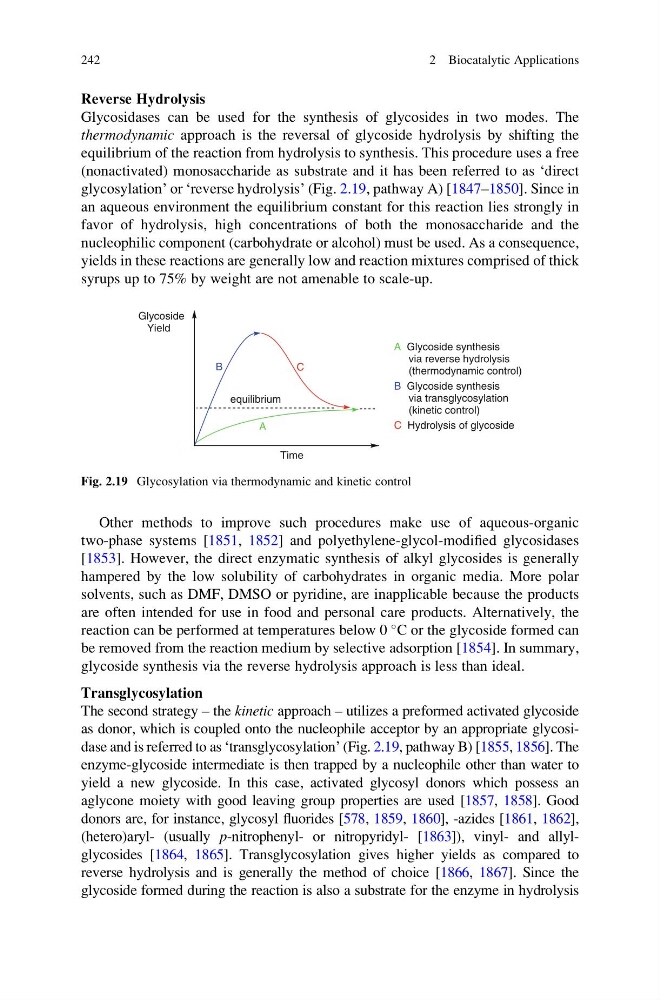
glycosylation’ or ‘reverse hydrolysis’ (Fig. 2.19, pathway A) [1847–1850]. Since in
an aqueous environment the equilibrium constant for this reaction lies strongly in
favor of hydrolysis, high concentrations of both the monosaccharide and the
nucleophilic component (carbohydrate or alcohol) must be used. As a consequence,
yields in these reactions are generally low and reaction mixtures comprised of thick
syrups up to 75% by weight are not amenable to scale-up.
Other methods to improve such procedures make use of aqueous-organic
two-phase systems [1851, 1852] and polyethylene-glycol-modified glycosidases
[1853]. However, the direct enzymatic synthesis of alkyl glycosides is generally
hampered by the low solubility of carbohydrates in organic media. More polar
solvents, such as DMF, DMSO or pyridine, are inapplicable because the products
are often intended for use in food and personal care products. Alternatively, the
reaction can be performed at temperatures below 0
C or the glycoside formed can
be removed from the reaction medium by selective adsorption [1854]. In summary,
glycoside synthesis via the reverse hydrolysis approach is less than ideal.
Transglycosylation
The second strategy – the kinetic approach – utilizes a preformed activated glycoside
as donor, which is coupled onto the nucleophile acceptor by an appropriate glycosidase and is referred to as ‘transglycosylation’ (Fig. 2.19, pathway B) [1855, 1856]. The
enzyme-glycoside intermediate is then trapped by a nucleophile other than water to
yield a new glycoside. In this case, activated glycosyl donors which possess an
aglycone moiety with good leaving group properties are used [1857, 1858]. Good
donors are, for instance, glycosyl fluorides [578, 1859, 1860], -azides [1861, 1862],
(hetero)aryl- (usually p-nitrophenyl- or nitropyridyl- [1863]), vinyl- and allylglycosides [1864, 1865]. Transglycosylation gives higher yields as compared to
reverse hydrolysis and is generally the method of choice [1866, 1867]. Since the
glycoside formed during the reaction is also a substrate for the enzyme in hydrolysis
Time
Glycoside
Yield
equilibrium
A Glycoside synthesis
via reverse hydrolysis
(thermodynamic control)
B Glycoside synthesis
via transglycosylation
(kinetic control)
C Hydrolysis of glycoside
A
B
C
Fig. 2.19 Glycosylation via thermodynamic and kinetic control
242
2 Biocatalytic Applications
Glycosidases can be used for the synthesis of glycosides in two modes. The
thermodynamic approach is the reversal of glycoside hydrolysis by shifting the
equilibrium of the reaction from hydrolysis to synthesis. This procedure uses a free
(nonactivated) monosaccharide as substrate and it has been referred to as ‘direct
glycosylation’ or ‘reverse hydrolysis’ (Fig. 2.19, pathway A) [1847–1850]. Since in
an aqueous environment the equilibrium constant for this reaction lies strongly in
favor of hydrolysis, high concentrations of both the monosaccharide and the
nucleophilic component (carbohydrate or alcohol) must be used. As a consequence,
yields in these reactions are generally low and reaction mixtures comprised of thick
syrups up to 75% by weight are not amenable to scale-up.
Other methods to improve such procedures make use of aqueous-organic
two-phase systems [1851, 1852] and polyethylene-glycol-modified glycosidases
[1853]. However, the direct enzymatic synthesis of alkyl glycosides is generally
hampered by the low solubility of carbohydrates in organic media. More polar
solvents, such as DMF, DMSO or pyridine, are inapplicable because the products
are often intended for use in food and personal care products. Alternatively, the
reaction can be performed at temperatures below 0
C or the glycoside formed can
be removed from the reaction medium by selective adsorption [1854]. In summary,
glycoside synthesis via the reverse hydrolysis approach is less than ideal.
Transglycosylation
The second strategy – the kinetic approach – utilizes a preformed activated glycoside
as donor, which is coupled onto the nucleophile acceptor by an appropriate glycosidase and is referred to as ‘transglycosylation’ (Fig. 2.19, pathway B) [1855, 1856]. The
enzyme-glycoside intermediate is then trapped by a nucleophile other than water to
yield a new glycoside. In this case, activated glycosyl donors which possess an
aglycone moiety with good leaving group properties are used [1857, 1858]. Good
donors are, for instance, glycosyl fluorides [578, 1859, 1860], -azides [1861, 1862],
(hetero)aryl- (usually p-nitrophenyl- or nitropyridyl- [1863]), vinyl- and allylglycosides [1864, 1865]. Transglycosylation gives higher yields as compared to
reverse hydrolysis and is generally the method of choice [1866, 1867]. Since the
glycoside formed during the reaction is also a substrate for the enzyme in hydrolysis
Time
Glycoside
Yield
equilibrium
A Glycoside synthesis
via reverse hydrolysis
(thermodynamic control)
B Glycoside synthesis
via transglycosylation
(kinetic control)
C Hydrolysis of glycoside
A
B
C
Fig. 2.19 Glycosylation via thermodynamic and kinetic control
242
2 Biocatalytic Applications