

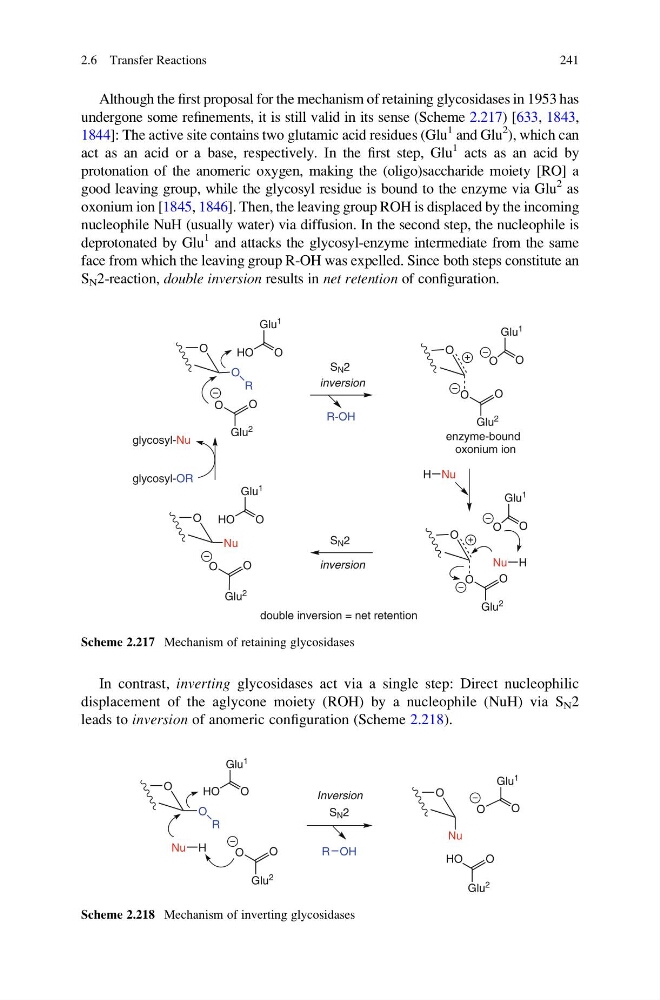
Although the first proposal for the mechanism of retaining glycosidases in 1953 has
undergone some refinements, it is still valid in its sense (Scheme 2.217) [633, 1843,
1844]: The active site contains two glutamic acid residues (Glu
1 and Glu
2
), which can
act as an acid or a base, respectively. In the first step, Glu
1 acts as an acid by
protonation of the anomeric oxygen, making the (oligo)saccharide moiety [RO] a
good leaving group, while the glycosyl residue is bound to the enzyme via Glu
2 as
oxonium ion [1845, 1846]. Then, the leaving group ROH is displaced by the incoming
nucleophile NuH (usually water) via diffusion. In the second step, the nucleophile is
deprotonated by Glu
1 and attacks the glycosyl-enzyme intermediate from the same
face from which the leaving group R-OH was expelled. Since both steps constitute an
S N 2-reaction, double inversion results in net retention of configuration.
In contrast, inverting glycosidases act via a single step: Direct nucleophilic
displacement of the aglycone moiety (ROH) by a nucleophile (NuH) via S N 2
leads to inversion of anomeric configuration (Scheme 2.218).
Glu
1
O
O
O
Glu
2
O
O
Glu
2
O
O
Nu
O
Glu 1
O
HO
Glu
1
O
HO
Glu
2
O
O
R
O
O
O
Glu
2
O
O
Glu
1
O
O
Nu
H
H
Nu
inversion
inversion
double inversion = net retention
enzyme-bound
oxonium ion
glycosyl-Nu
glycosyl-OR
R-OH
S N 2
S N 2
Scheme 2.217 Mechanism of retaining glycosidases
O
O
Glu
1
OH
R
Glu 2
O
O
R
O
O
O
HO
Glu
1
HO
Glu
2
O
Nu
O
H
Nu
Inversion
S N 2
Scheme 2.218 Mechanism of inverting glycosidases
2.6 Transfer Reactions
241
undergone some refinements, it is still valid in its sense (Scheme 2.217) [633, 1843,
1844]: The active site contains two glutamic acid residues (Glu
1 and Glu
2
), which can
act as an acid or a base, respectively. In the first step, Glu
1 acts as an acid by
protonation of the anomeric oxygen, making the (oligo)saccharide moiety [RO] a
good leaving group, while the glycosyl residue is bound to the enzyme via Glu
2 as
oxonium ion [1845, 1846]. Then, the leaving group ROH is displaced by the incoming
nucleophile NuH (usually water) via diffusion. In the second step, the nucleophile is
deprotonated by Glu
1 and attacks the glycosyl-enzyme intermediate from the same
face from which the leaving group R-OH was expelled. Since both steps constitute an
S N 2-reaction, double inversion results in net retention of configuration.
In contrast, inverting glycosidases act via a single step: Direct nucleophilic
displacement of the aglycone moiety (ROH) by a nucleophile (NuH) via S N 2
leads to inversion of anomeric configuration (Scheme 2.218).
Glu
1
O
O
O
Glu
2
O
O
Glu
2
O
O
Nu
O
Glu 1
O
HO
Glu
1
O
HO
Glu
2
O
O
R
O
O
O
Glu
2
O
O
Glu
1
O
O
Nu
H
H
Nu
inversion
inversion
double inversion = net retention
enzyme-bound
oxonium ion
glycosyl-Nu
glycosyl-OR
R-OH
S N 2
S N 2
Scheme 2.217 Mechanism of retaining glycosidases
O
O
Glu
1
OH
R
Glu 2
O
O
R
O
O
O
HO
Glu
1
HO
Glu
2
O
Nu
O
H
Nu
Inversion
S N 2
Scheme 2.218 Mechanism of inverting glycosidases
2.6 Transfer Reactions
241