

2.6.1.3 Glycosidases
A glycosidic bond is more stable than a phosphate ester or peptide bond, with a halflife of ~10
7 years at room temperature [1828]. Hence, its hydrolytic cleavage requires
exceptionally proficient enzymes: Glycosidases (also termed ‘glycohydrolases’
[1829]) are independent of any cofactor and show k cat values of ~10
2 s
À1
, which
translates into a rate acceleration of ~10
17
. In general, glycosidases show high (but
not absolute) specificity for both the glycosyl moiety and the nature of the glycosidic
linkage, but little if any specificity for the aglycone component which acts as a
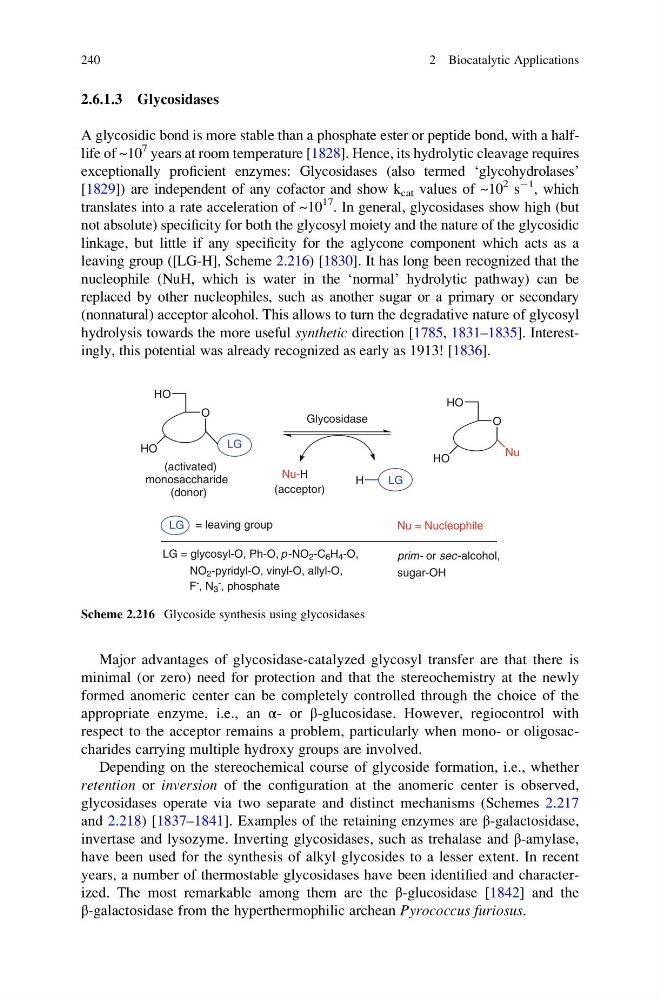
leaving group ([LG-H], Scheme 2.216) [1830]. It has long been recognized that the
nucleophile (NuH, which is water in the ‘normal’ hydrolytic pathway) can be
replaced by other nucleophiles, such as another sugar or a primary or secondary
(nonnatural) acceptor alcohol. This allows to turn the degradative nature of glycosyl
hydrolysis towards the more useful synthetic direction [1785, 1831–1835]. Interestingly, this potential was already recognized as early as 1913! [1836].
Major advantages of glycosidase-catalyzed glycosyl transfer are that there is
minimal (or zero) need for protection and that the stereochemistry at the newly
formed anomeric center can be completely controlled through the choice of the
appropriate enzyme, i.e., an α- or β-glucosidase. However, regiocontrol with
respect to the acceptor remains a problem, particularly when mono- or oligosaccharides carrying multiple hydroxy groups are involved.
Depending on the stereochemical course of glycoside formation, i.e., whether
retention or inversion of the configuration at the anomeric center is observed,
glycosidases operate via two separate and distinct mechanisms (Schemes 2.217
and 2.218) [1837–1841]. Examples of the retaining enzymes are β-galactosidase,
invertase and lysozyme. Inverting glycosidases, such as trehalase and β-amylase,
have been used for the synthesis of alkyl glycosides to a lesser extent. In recent
years, a number of thermostable glycosidases have been identified and characterized. The most remarkable among them are the β-glucosidase [1842] and the
β-galactosidase from the hyperthermophilic archean Pyrococcus furiosus.
HO
Nu
HO
O
HO
H
O
HO
NO 2 -pyridyl-O, vinyl-O, allyl-O,
(acceptor)
Nu = Nucleophile
LG = glycosyl-O, Ph-O, p -NO 2 -C 6 H 4 -O,
Glycosidase
Nu-H
= leaving group
LG
LG
LG
(activated)
monosaccharide
(donor)
prim- or sec-alcohol,
F
- , N 3
- , phosphate
sugar-OH
Scheme 2.216 Glycoside synthesis using glycosidases
240
2 Biocatalytic Applications
A glycosidic bond is more stable than a phosphate ester or peptide bond, with a halflife of ~10
7 years at room temperature [1828]. Hence, its hydrolytic cleavage requires
exceptionally proficient enzymes: Glycosidases (also termed ‘glycohydrolases’
[1829]) are independent of any cofactor and show k cat values of ~10
2 s
À1
, which
translates into a rate acceleration of ~10
17
. In general, glycosidases show high (but
not absolute) specificity for both the glycosyl moiety and the nature of the glycosidic
linkage, but little if any specificity for the aglycone component which acts as a
leaving group ([LG-H], Scheme 2.216) [1830]. It has long been recognized that the
nucleophile (NuH, which is water in the ‘normal’ hydrolytic pathway) can be
replaced by other nucleophiles, such as another sugar or a primary or secondary
(nonnatural) acceptor alcohol. This allows to turn the degradative nature of glycosyl
hydrolysis towards the more useful synthetic direction [1785, 1831–1835]. Interestingly, this potential was already recognized as early as 1913! [1836].
Major advantages of glycosidase-catalyzed glycosyl transfer are that there is
minimal (or zero) need for protection and that the stereochemistry at the newly
formed anomeric center can be completely controlled through the choice of the
appropriate enzyme, i.e., an α- or β-glucosidase. However, regiocontrol with
respect to the acceptor remains a problem, particularly when mono- or oligosaccharides carrying multiple hydroxy groups are involved.
Depending on the stereochemical course of glycoside formation, i.e., whether
retention or inversion of the configuration at the anomeric center is observed,
glycosidases operate via two separate and distinct mechanisms (Schemes 2.217
and 2.218) [1837–1841]. Examples of the retaining enzymes are β-galactosidase,
invertase and lysozyme. Inverting glycosidases, such as trehalase and β-amylase,
have been used for the synthesis of alkyl glycosides to a lesser extent. In recent
years, a number of thermostable glycosidases have been identified and characterized. The most remarkable among them are the β-glucosidase [1842] and the
β-galactosidase from the hyperthermophilic archean Pyrococcus furiosus.
HO
Nu
HO
O
HO
H
O
HO
NO 2 -pyridyl-O, vinyl-O, allyl-O,
(acceptor)
Nu = Nucleophile
LG = glycosyl-O, Ph-O, p -NO 2 -C 6 H 4 -O,
Glycosidase
Nu-H
= leaving group
LG
LG
LG
(activated)
monosaccharide
(donor)
prim- or sec-alcohol,
F
- , N 3
- , phosphate
sugar-OH
Scheme 2.216 Glycoside synthesis using glycosidases
240
2 Biocatalytic Applications