

Glycoside synthesis is even more simple using trans-glycosidases, which use
cheap non-phosphorylated (di)saccharides as donor substrates. Interestingly, the
energy of the glycosidic bond in sucrose is of the same level as that of nucleotideactivated sugars, such as UDP-Glu. The major disadvantage is the small number of
available specificities, which is mainly limited to the transfer of α-glycosyl- and
β-fructosyl-groups [1824].
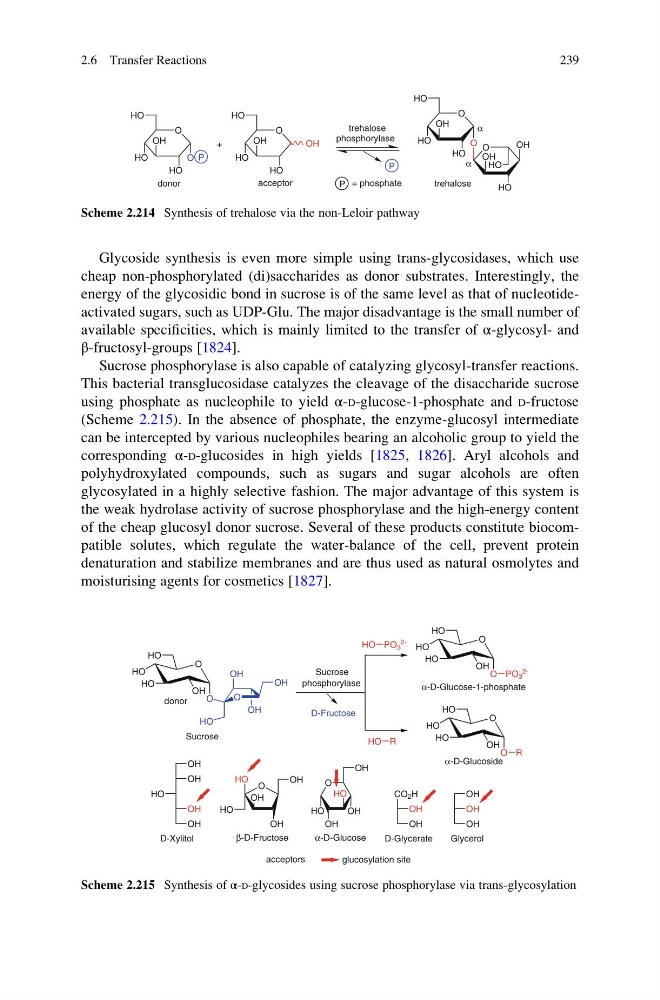
Sucrose phosphorylase is also capable of catalyzing glycosyl-transfer reactions.
This bacterial transglucosidase catalyzes the cleavage of the disaccharide sucrose
using phosphate as nucleophile to yield α-D-glucose-1-phosphate and D-fructose
(Scheme 2.215). In the absence of phosphate, the enzyme-glucosyl intermediate
can be intercepted by various nucleophiles bearing an alcoholic group to yield the
corresponding α-D-glucosides in high yields [1825, 1826]. Aryl alcohols and
polyhydroxylated compounds, such as sugars and sugar alcohols are often
glycosylated in a highly selective fashion. The major advantage of this system is
the weak hydrolase activity of sucrose phosphorylase and the high-energy content
of the cheap glucosyl donor sucrose. Several of these products constitute biocompatible solutes, which regulate the water-balance of the cell, prevent protein
denaturation and stabilize membranes and are thus used as natural osmolytes and
moisturising agents for cosmetics [1827].
O
HO
OH
HO
HO
O
HO
O
HO
OH
HO
HO
O
+
= phosphate
trehalose
phosphorylase
trehalose
P
P
P
donor
acceptor
O
HO
OH
OH
HO
OH
HO
HO
O
OH
α
α
Scheme 2.214 Synthesis of trehalose via the non-Leloir pathway
OH
OH
O
HO
O
HO
HO
HO
OH
O
OH
PO 3
2HO
R
HO
R
O
HO
HO
HO
OH
O
O
OH
HO
HO
HO
PO 3
2O
OH
OH
HO
OH
HO
O
HO
OH
OH
OH
HO
O
OH
OH
HO
OH
OH
OH
OH
CO 2 H
O H
OH
OH
phosphorylase
Sucrose
Sucrose
D-Fructose
α-D-Glucoside
α-D-Glucose-1-phosphate
D-Xylitol
β-D-Fructose
α-D-Glucose
Glycerol
D-Glycerate
glucosylation site
donor
acceptors
Scheme 2.215 Synthesis of α-D-glycosides using sucrose phosphorylase via trans-glycosylation
2.6 Transfer Reactions
239
cheap non-phosphorylated (di)saccharides as donor substrates. Interestingly, the
energy of the glycosidic bond in sucrose is of the same level as that of nucleotideactivated sugars, such as UDP-Glu. The major disadvantage is the small number of
available specificities, which is mainly limited to the transfer of α-glycosyl- and
β-fructosyl-groups [1824].
Sucrose phosphorylase is also capable of catalyzing glycosyl-transfer reactions.
This bacterial transglucosidase catalyzes the cleavage of the disaccharide sucrose
using phosphate as nucleophile to yield α-D-glucose-1-phosphate and D-fructose
(Scheme 2.215). In the absence of phosphate, the enzyme-glucosyl intermediate
can be intercepted by various nucleophiles bearing an alcoholic group to yield the
corresponding α-D-glucosides in high yields [1825, 1826]. Aryl alcohols and
polyhydroxylated compounds, such as sugars and sugar alcohols are often
glycosylated in a highly selective fashion. The major advantage of this system is
the weak hydrolase activity of sucrose phosphorylase and the high-energy content
of the cheap glucosyl donor sucrose. Several of these products constitute biocompatible solutes, which regulate the water-balance of the cell, prevent protein
denaturation and stabilize membranes and are thus used as natural osmolytes and
moisturising agents for cosmetics [1827].
O
HO
OH
HO
HO
O
HO
O
HO
OH
HO
HO
O
+
= phosphate
trehalose
phosphorylase
trehalose
P
P
P
donor
acceptor
O
HO
OH
OH
HO
OH
HO
HO
O
OH
α
α
Scheme 2.214 Synthesis of trehalose via the non-Leloir pathway
OH
OH
O
HO
O
HO
HO
HO
OH
O
OH
PO 3
2HO
R
HO
R
O
HO
HO
HO
OH
O
O
OH
HO
HO
HO
PO 3
2O
OH
OH
HO
OH
HO
O
HO
OH
OH
OH
HO
O
OH
OH
HO
OH
OH
OH
OH
CO 2 H
O H
OH
OH
phosphorylase
Sucrose
Sucrose
D-Fructose
α-D-Glucoside
α-D-Glucose-1-phosphate
D-Xylitol
β-D-Fructose
α-D-Glucose
Glycerol
D-Glycerate
glucosylation site
donor
acceptors
Scheme 2.215 Synthesis of α-D-glycosides using sucrose phosphorylase via trans-glycosylation
2.6 Transfer Reactions
239