

phosphoenol pyruvate. The overall yield of this sequence was in the range of 70%
when performed on a scale greater than 10 g.
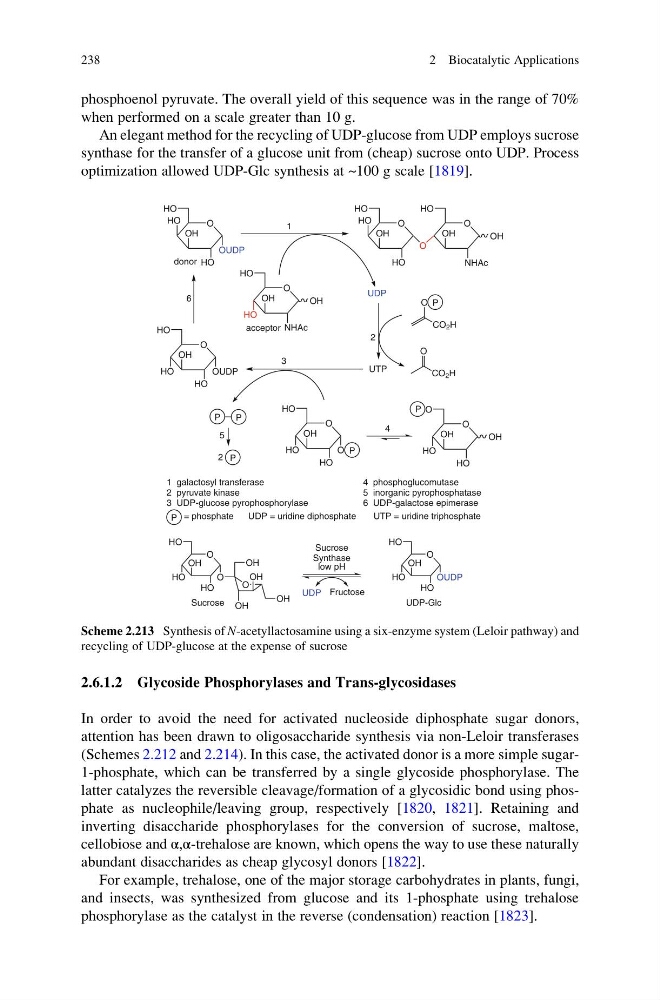
An elegant method for the recycling of UDP-glucose from UDP employs sucrose
synthase for the transfer of a glucose unit from (cheap) sucrose onto UDP. Process
optimization allowed UDP-Glc synthesis at ~100 g scale [1819].
2.6.1.2 Glycoside Phosphorylases and Trans-glycosidases
In order to avoid the need for activated nucleoside diphosphate sugar donors,
attention has been drawn to oligosaccharide synthesis via non-Leloir transferases
(Schemes 2.212 and 2.214). In this case, the activated donor is a more simple sugar1-phosphate, which can be transferred by a single glycoside phosphorylase. The
latter catalyzes the reversible cleavage/formation of a glycosidic bond using phosphate as nucleophile/leaving group, respectively [1820, 1821]. Retaining and
inverting disaccharide phosphorylases for the conversion of sucrose, maltose,
cellobiose and α,α-trehalose are known, which opens the way to use these naturally
abundant disaccharides as cheap glycosyl donors [1822].
For example, trehalose, one of the major storage carbohydrates in plants, fungi,
and insects, was synthesized from glucose and its 1-phosphate using trehalose
phosphorylase as the catalyst in the reverse (condensation) reaction [1823].
O
HO
OH
HO
HO
O
O
CO 2 H
O
CO 2 H
OH
NHAc
OH
HO
HO
O
HO
O
HO
OH
NHAc
O
HO
OH
HO
O
OH
OH
HO
OH
HO
O
O
OUDP
HO
OH
HO
HO
O
HO
OUDP
HO
OH
HO
O
UTP = uridine triphosphate
UDP = uridine diphosphate
= phosphate
4 phosphoglucomutase
5 inorganic pyrophosphatase
6 UDP-galactose epimerase
1 galactosyl transferase
2 pyruvate kinase
3 UDP-glucose pyrophosphorylase
6
5
4
3
2
1
2
UDP
P
P
P
P
P
P
P
UTP
donor
acceptor
OUDP
HO
OH
HO
HO
O
HO
OH
HO
HO
O
O
O
OH
OH
OH
OH
Sucrose
Sucrose
Synthase
low pH
UDP Fructose
UDP-Glc
Scheme 2.213 Synthesis of N-acetyllactosamine using a six-enzyme system (Leloir pathway) and
recycling of UDP-glucose at the expense of sucrose
238
2 Biocatalytic Applications
when performed on a scale greater than 10 g.
An elegant method for the recycling of UDP-glucose from UDP employs sucrose
synthase for the transfer of a glucose unit from (cheap) sucrose onto UDP. Process
optimization allowed UDP-Glc synthesis at ~100 g scale [1819].
2.6.1.2 Glycoside Phosphorylases and Trans-glycosidases
In order to avoid the need for activated nucleoside diphosphate sugar donors,
attention has been drawn to oligosaccharide synthesis via non-Leloir transferases
(Schemes 2.212 and 2.214). In this case, the activated donor is a more simple sugar1-phosphate, which can be transferred by a single glycoside phosphorylase. The
latter catalyzes the reversible cleavage/formation of a glycosidic bond using phosphate as nucleophile/leaving group, respectively [1820, 1821]. Retaining and
inverting disaccharide phosphorylases for the conversion of sucrose, maltose,
cellobiose and α,α-trehalose are known, which opens the way to use these naturally
abundant disaccharides as cheap glycosyl donors [1822].
For example, trehalose, one of the major storage carbohydrates in plants, fungi,
and insects, was synthesized from glucose and its 1-phosphate using trehalose
phosphorylase as the catalyst in the reverse (condensation) reaction [1823].
O
HO
OH
HO
HO
O
O
CO 2 H
O
CO 2 H
OH
NHAc
OH
HO
HO
O
HO
O
HO
OH
NHAc
O
HO
OH
HO
O
OH
OH
HO
OH
HO
O
O
OUDP
HO
OH
HO
HO
O
HO
OUDP
HO
OH
HO
O
UTP = uridine triphosphate
UDP = uridine diphosphate
= phosphate
4 phosphoglucomutase
5 inorganic pyrophosphatase
6 UDP-galactose epimerase
1 galactosyl transferase
2 pyruvate kinase
3 UDP-glucose pyrophosphorylase
6
5
4
3
2
1
2
UDP
P
P
P
P
P
P
P
UTP
donor
acceptor
OUDP
HO
OH
HO
HO
O
HO
OH
HO
HO
O
O
O
OH
OH
OH
OH
Sucrose
Sucrose
Synthase
low pH
UDP Fructose
UDP-Glc
Scheme 2.213 Synthesis of N-acetyllactosamine using a six-enzyme system (Leloir pathway) and
recycling of UDP-glucose at the expense of sucrose
238
2 Biocatalytic Applications