

which is catalyzed by a glycosyl transferase. The key building blocks serving as donors
are UDP-Glc, UDP-Gal, UDP-GlcNAc, UDP-GalNAc, UDP-Xyl, GDP-Man, GDP-Fuc
and CMP-sialic acid [1799]. Since each NDP-sugar requires a distinct group of glycosyl
transferases, a large number of highly specific glycosyl transferases are neccessary.
More than one hundred glycosyl transferases have been identified to date and each one
appears to specifically catalyze the formation of a unique glycosidic linkage [1800].
Chemists employ Leloir-enzymes to the synthesis of oligosaccharides and the
majority of synthetic reactions are performed by UDP-glycosyl transferases [1801–
1806]. Two requirements are currently limiting large-scale applications, namely the
availability of the sugar nucleoside phosphates at reasonable costs and the matching
glycosyl transferases. Only a few of these enzymes are commercially available,
because isolation of these membrane-bound (unstable) proteins is difficult, since
they are present only in low concentrations [1807, 1808]. The availability of
NDP-sugars is ensured by in-situ regeneration of the sugar nucleotide from the
released nucleoside phosphate via utilizing phosphorylating enzymes, which avoids
co-product inhibition caused by the released nucleoside diphosphate [1809]
(Scheme 2.213).
The point of interest to synthetic chemists is the range of acceptors and donors
that can be used in glycosyl transferase-catalyzed reactions. Fortunately, the specificity of glycosyl transferases is high but not absolute.
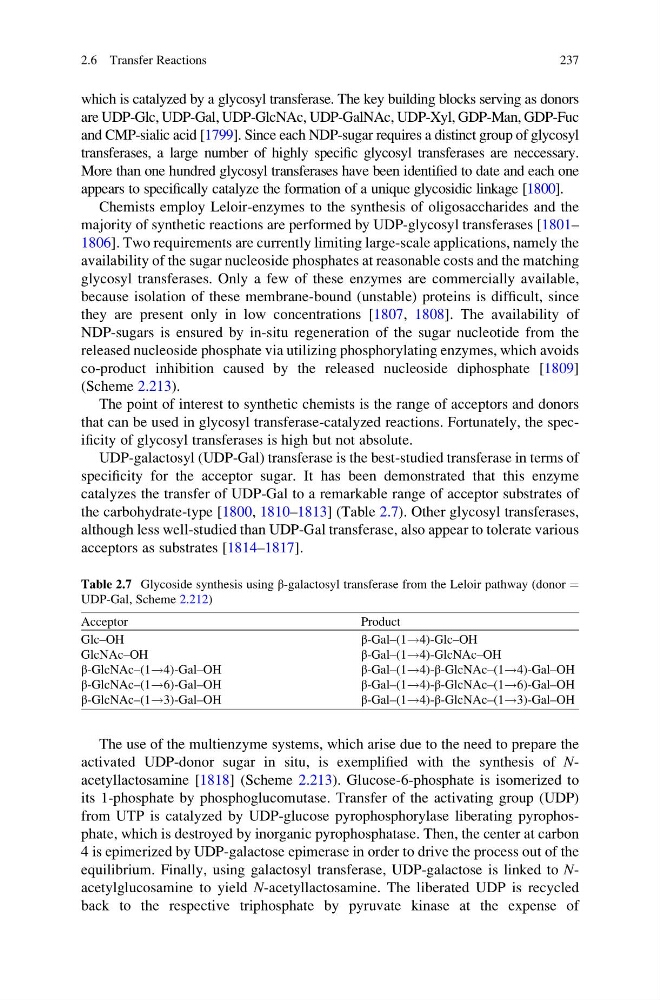
UDP-galactosyl (UDP-Gal) transferase is the best-studied transferase in terms of
specificity for the acceptor sugar. It has been demonstrated that this enzyme
catalyzes the transfer of UDP-Gal to a remarkable range of acceptor substrates of
the carbohydrate-type [1800, 1810–1813] (Table 2.7). Other glycosyl transferases,
although less well-studied than UDP-Gal transferase, also appear to tolerate various
acceptors as substrates [1814–1817].
The use of the multienzyme systems, which arise due to the need to prepare the
activated UDP-donor sugar in situ, is exemplified with the synthesis of Nacetyllactosamine [1818] (Scheme 2.213). Glucose-6-phosphate is isomerized to
its 1-phosphate by phosphoglucomutase. Transfer of the activating group (UDP)
from UTP is catalyzed by UDP-glucose pyrophosphorylase liberating pyrophosphate, which is destroyed by inorganic pyrophosphatase. Then, the center at carbon
4 is epimerized by UDP-galactose epimerase in order to drive the process out of the
equilibrium. Finally, using galactosyl transferase, UDP-galactose is linked to Nacetylglucosamine to yield N-acetyllactosamine. The liberated UDP is recycled
back to the respective triphosphate by pyruvate kinase at the expense of
Table 2.7 Glycoside synthesis using β-galactosyl transferase from the Leloir pathway (donor ¼
UDP-Gal, Scheme 2.212)
Acceptor
Product
Glc–OH
β-Gal–(1!4)-Glc–OH
GlcNAc–OH
β-Gal–(1!4)-GlcNAc–OH
β-GlcNAc–(1!4)-Gal–OH
β-Gal–(1!4)-β-GlcNAc–(1!4)-Gal–OH
β-GlcNAc–(1!6)-Gal–OH
β-Gal–(1!4)-β-GlcNAc–(1!6)-Gal–OH
β-GlcNAc–(1!3)-Gal–OH
β-Gal–(1!4)-β-GlcNAc–(1!3)-Gal–OH
2.6 Transfer Reactions
237
are UDP-Glc, UDP-Gal, UDP-GlcNAc, UDP-GalNAc, UDP-Xyl, GDP-Man, GDP-Fuc
and CMP-sialic acid [1799]. Since each NDP-sugar requires a distinct group of glycosyl
transferases, a large number of highly specific glycosyl transferases are neccessary.
More than one hundred glycosyl transferases have been identified to date and each one
appears to specifically catalyze the formation of a unique glycosidic linkage [1800].
Chemists employ Leloir-enzymes to the synthesis of oligosaccharides and the
majority of synthetic reactions are performed by UDP-glycosyl transferases [1801–
1806]. Two requirements are currently limiting large-scale applications, namely the
availability of the sugar nucleoside phosphates at reasonable costs and the matching
glycosyl transferases. Only a few of these enzymes are commercially available,
because isolation of these membrane-bound (unstable) proteins is difficult, since
they are present only in low concentrations [1807, 1808]. The availability of
NDP-sugars is ensured by in-situ regeneration of the sugar nucleotide from the
released nucleoside phosphate via utilizing phosphorylating enzymes, which avoids
co-product inhibition caused by the released nucleoside diphosphate [1809]
(Scheme 2.213).
The point of interest to synthetic chemists is the range of acceptors and donors
that can be used in glycosyl transferase-catalyzed reactions. Fortunately, the specificity of glycosyl transferases is high but not absolute.
UDP-galactosyl (UDP-Gal) transferase is the best-studied transferase in terms of
specificity for the acceptor sugar. It has been demonstrated that this enzyme
catalyzes the transfer of UDP-Gal to a remarkable range of acceptor substrates of
the carbohydrate-type [1800, 1810–1813] (Table 2.7). Other glycosyl transferases,
although less well-studied than UDP-Gal transferase, also appear to tolerate various
acceptors as substrates [1814–1817].
The use of the multienzyme systems, which arise due to the need to prepare the
activated UDP-donor sugar in situ, is exemplified with the synthesis of Nacetyllactosamine [1818] (Scheme 2.213). Glucose-6-phosphate is isomerized to
its 1-phosphate by phosphoglucomutase. Transfer of the activating group (UDP)
from UTP is catalyzed by UDP-glucose pyrophosphorylase liberating pyrophosphate, which is destroyed by inorganic pyrophosphatase. Then, the center at carbon
4 is epimerized by UDP-galactose epimerase in order to drive the process out of the
equilibrium. Finally, using galactosyl transferase, UDP-galactose is linked to Nacetylglucosamine to yield N-acetyllactosamine. The liberated UDP is recycled
back to the respective triphosphate by pyruvate kinase at the expense of
Table 2.7 Glycoside synthesis using β-galactosyl transferase from the Leloir pathway (donor ¼
UDP-Gal, Scheme 2.212)
Acceptor
Product
Glc–OH
β-Gal–(1!4)-Glc–OH
GlcNAc–OH
β-Gal–(1!4)-GlcNAc–OH
β-GlcNAc–(1!4)-Gal–OH
β-Gal–(1!4)-β-GlcNAc–(1!4)-Gal–OH
β-GlcNAc–(1!6)-Gal–OH
β-Gal–(1!4)-β-GlcNAc–(1!6)-Gal–OH
β-GlcNAc–(1!3)-Gal–OH
β-Gal–(1!4)-β-GlcNAc–(1!3)-Gal–OH
2.6 Transfer Reactions
237