

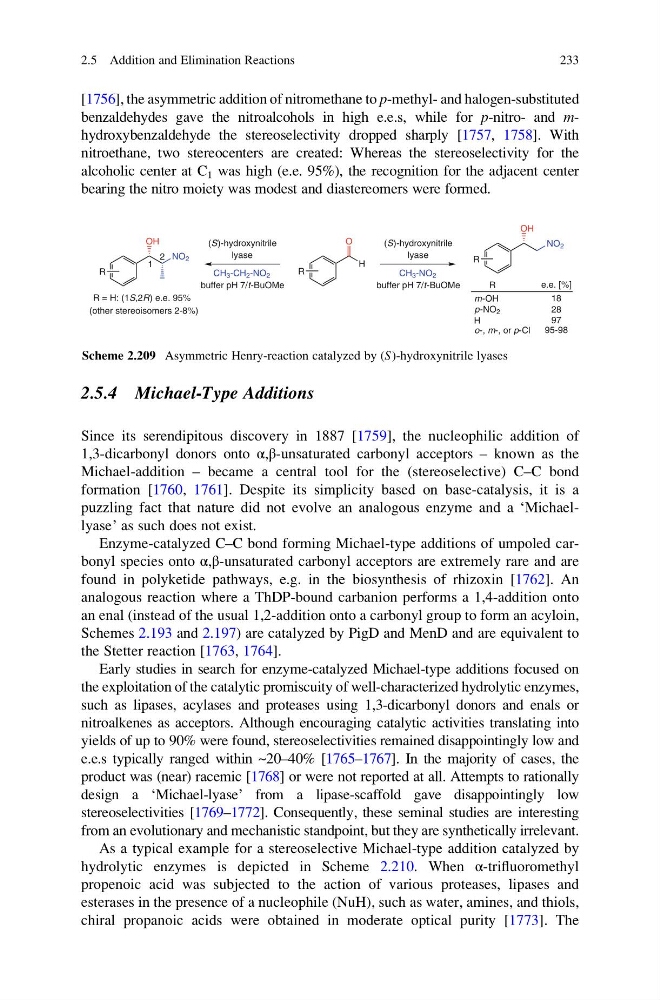
[1756], the asymmetric addition of nitromethane to p-methyl- and halogen-substituted
benzaldehydes gave the nitroalcohols in high e.e.s, while for p-nitro- and mhydroxybenzaldehyde the stereoselectivity dropped sharply [1757, 1758]. With
nitroethane, two stereocenters are created: Whereas the stereoselectivity for the
alcoholic center at C 1 was high (e.e. 95%), the recognition for the adjacent center
bearing the nitro moiety was modest and diastereomers were formed.
2.5.4 Michael-Type Additions
Since its serendipitous discovery in 1887 [1759], the nucleophilic addition of
1,3-dicarbonyl donors onto α,β-unsaturated carbonyl acceptors – known as the
Michael-addition – became a central tool for the (stereoselective) C–C bond
formation [1760, 1761]. Despite its simplicity based on base-catalysis, it is a
puzzling fact that nature did not evolve an analogous enzyme and a ‘Michaellyase’ as such does not exist.
Enzyme-catalyzed C–C bond forming Michael-type additions of umpoled carbonyl species onto α,β-unsaturated carbonyl acceptors are extremely rare and are
found in polyketide pathways, e.g. in the biosynthesis of rhizoxin [1762]. An
analogous reaction where a ThDP-bound carbanion performs a 1,4-addition onto
an enal (instead of the usual 1,2-addition onto a carbonyl group to form an acyloin,
Schemes 2.193 and 2.197) are catalyzed by PigD and MenD and are equivalent to
the Stetter reaction [1763, 1764].
Early studies in search for enzyme-catalyzed Michael-type additions focused on
the exploitation of the catalytic promiscuity of well-characterized hydrolytic enzymes,
such as lipases, acylases and proteases using 1,3-dicarbonyl donors and enals or
nitroalkenes as acceptors. Although encouraging catalytic activities translating into
yields of up to 90% were found, stereoselectivities remained disappointingly low and
e.e.s typically ranged within ~20–40% [1765–1767]. In the majority of cases, the
product was (near) racemic [1768] or were not reported at all. Attempts to rationally
design a ‘Michael-lyase’ from a lipase-scaffold gave disappointingly low
stereoselectivities [1769–1772]. Consequently, these seminal studies are interesting
from an evolutionary and mechanistic standpoint, but they are synthetically irrelevant.
As a typical example for a stereoselective Michael-type addition catalyzed by
hydrolytic enzymes is depicted in Scheme 2.210. When α-trifluoromethyl
propenoic acid was subjected to the action of various proteases, lipases and
esterases in the presence of a nucleophile (NuH), such as water, amines, and thiols,
chiral propanoic acids were obtained in moderate optical purity [1773]. The
O
H
OH
NO 2
OH
NO 2
(S)-hydroxynitrile
lyase
buffer pH 7/t-BuOMe
(S)-hydroxynitrile
lyase
buffer pH 7/t-BuOMe
1
2
R = H: (1S,2R) e.e. 95%
(other stereoisomers 2-8%)
CH 3 -CH 2 -NO 2
CH 3 -NO 2
R
R
R
R
e.e. [%]
H
97
o-, m-, or p-Cl
95-98
p-NO 2
28
m-OH
18
Scheme 2.209 Asymmetric Henry-reaction catalyzed by (S)-hydroxynitrile lyases
2.5 Addition and Elimination Reactions
233
benzaldehydes gave the nitroalcohols in high e.e.s, while for p-nitro- and mhydroxybenzaldehyde the stereoselectivity dropped sharply [1757, 1758]. With
nitroethane, two stereocenters are created: Whereas the stereoselectivity for the
alcoholic center at C 1 was high (e.e. 95%), the recognition for the adjacent center
bearing the nitro moiety was modest and diastereomers were formed.
2.5.4 Michael-Type Additions
Since its serendipitous discovery in 1887 [1759], the nucleophilic addition of
1,3-dicarbonyl donors onto α,β-unsaturated carbonyl acceptors – known as the
Michael-addition – became a central tool for the (stereoselective) C–C bond
formation [1760, 1761]. Despite its simplicity based on base-catalysis, it is a
puzzling fact that nature did not evolve an analogous enzyme and a ‘Michaellyase’ as such does not exist.
Enzyme-catalyzed C–C bond forming Michael-type additions of umpoled carbonyl species onto α,β-unsaturated carbonyl acceptors are extremely rare and are
found in polyketide pathways, e.g. in the biosynthesis of rhizoxin [1762]. An
analogous reaction where a ThDP-bound carbanion performs a 1,4-addition onto
an enal (instead of the usual 1,2-addition onto a carbonyl group to form an acyloin,
Schemes 2.193 and 2.197) are catalyzed by PigD and MenD and are equivalent to
the Stetter reaction [1763, 1764].
Early studies in search for enzyme-catalyzed Michael-type additions focused on
the exploitation of the catalytic promiscuity of well-characterized hydrolytic enzymes,
such as lipases, acylases and proteases using 1,3-dicarbonyl donors and enals or
nitroalkenes as acceptors. Although encouraging catalytic activities translating into
yields of up to 90% were found, stereoselectivities remained disappointingly low and
e.e.s typically ranged within ~20–40% [1765–1767]. In the majority of cases, the
product was (near) racemic [1768] or were not reported at all. Attempts to rationally
design a ‘Michael-lyase’ from a lipase-scaffold gave disappointingly low
stereoselectivities [1769–1772]. Consequently, these seminal studies are interesting
from an evolutionary and mechanistic standpoint, but they are synthetically irrelevant.
As a typical example for a stereoselective Michael-type addition catalyzed by
hydrolytic enzymes is depicted in Scheme 2.210. When α-trifluoromethyl
propenoic acid was subjected to the action of various proteases, lipases and
esterases in the presence of a nucleophile (NuH), such as water, amines, and thiols,
chiral propanoic acids were obtained in moderate optical purity [1773]. The
O
H
OH
NO 2
OH
NO 2
(S)-hydroxynitrile
lyase
buffer pH 7/t-BuOMe
(S)-hydroxynitrile
lyase
buffer pH 7/t-BuOMe
1
2
R = H: (1S,2R) e.e. 95%
(other stereoisomers 2-8%)
CH 3 -CH 2 -NO 2
CH 3 -NO 2
R
R
R
R
e.e. [%]
H
97
o-, m-, or p-Cl
95-98
p-NO 2
28
m-OH
18
Scheme 2.209 Asymmetric Henry-reaction catalyzed by (S)-hydroxynitrile lyases
2.5 Addition and Elimination Reactions
233