

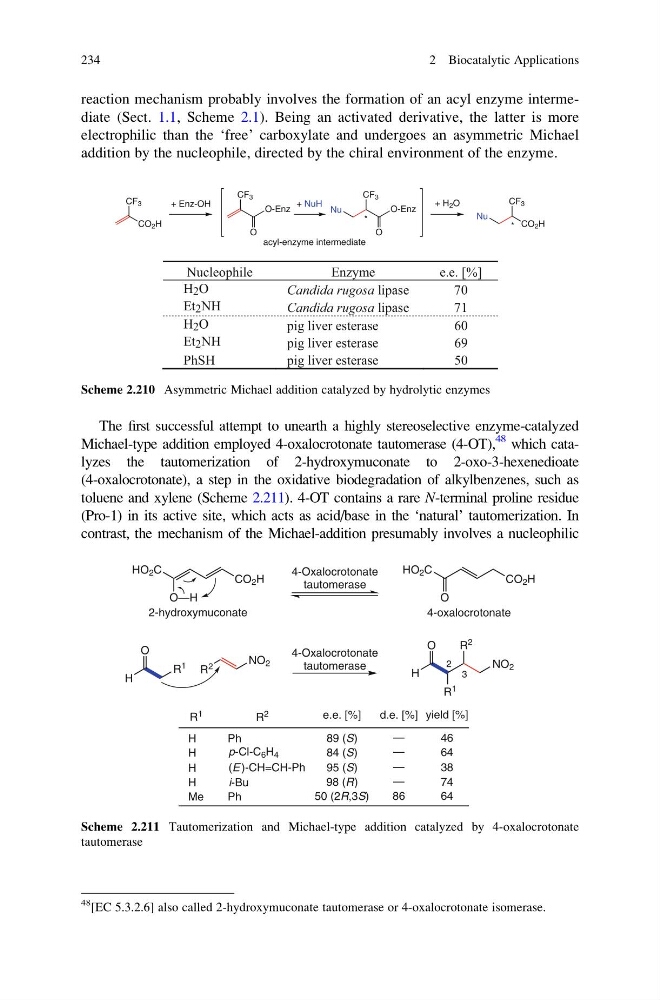
reaction mechanism probably involves the formation of an acyl enzyme intermediate (Sect. 1.1, Scheme 2.1). Being an activated derivative, the latter is more
electrophilic than the ‘free’ carboxylate and undergoes an asymmetric Michael
addition by the nucleophile, directed by the chiral environment of the enzyme.
The first successful attempt to unearth a highly stereoselective enzyme-catalyzed
Michael-type addition employed 4-oxalocrotonate tautomerase (4-OT),
48 which catalyzes the tautomerization of 2-hydroxymuconate to 2-oxo-3-hexenedioate
(4-oxalocrotonate), a step in the oxidative biodegradation of alkylbenzenes, such as
toluene and xylene (Scheme 2.211). 4-OT contains a rare N-terminal proline residue
(Pro-1) in its active site, which acts as acid/base in the ‘natural’ tautomerization. In
contrast, the mechanism of the Michael-addition presumably involves a nucleophilic
O
O-Enz
CF 3
CF 3
CO 2 H
O
O-Enz
CF 3
Nu
CF 3
CO 2 H
Nu
acyl-enzyme intermediate
+ H 2 O
+ NuH
+ Enz-OH
*
*
Nucleophile
Enzyme
e.e. [%]
H 2 O
Candida rugosa lipase
70
Et 2 NH
Candida rugosa lipase
71
H 2 O
pig liver esterase
60
Et 2 NH
pig liver esterase
69
PhSH
pig liver esterase
50
Scheme 2.210 Asymmetric Michael addition catalyzed by hydrolytic enzymes
HO 2 C
CO 2 H
O—H
4-Oxalocrotonate
tautomerase
HO 2 C
CO 2 H
O
4-oxalocrotonate
2-hydroxymuconate
R 2
NO 2
2
3
4-Oxalocrotonate
tautomerase
R 1
R 2
e.e. [%]
d.e. [%] yield [%]
H
H
H
H
Me
Ph
p-Cl-C 6 H 4
(E )-CH=CH-Ph
i-Bu
Ph
89 (S)
95 (S)
84 (S)
98 (R)
50 (2R,3S)
—
—
—
—
86
46
64
38
74
64
H
R
1
O
H
NO 2
O
R
1
R
2
Scheme 2.211 Tautomerization and Michael-type addition catalyzed by 4-oxalocrotonate
tautomerase
48 [EC 5.3.2.6] also called 2-hydroxymuconate tautomerase or 4-oxalocrotonate isomerase.
234
2 Biocatalytic Applications
electrophilic than the ‘free’ carboxylate and undergoes an asymmetric Michael
addition by the nucleophile, directed by the chiral environment of the enzyme.
The first successful attempt to unearth a highly stereoselective enzyme-catalyzed
Michael-type addition employed 4-oxalocrotonate tautomerase (4-OT),
48 which catalyzes the tautomerization of 2-hydroxymuconate to 2-oxo-3-hexenedioate
(4-oxalocrotonate), a step in the oxidative biodegradation of alkylbenzenes, such as
toluene and xylene (Scheme 2.211). 4-OT contains a rare N-terminal proline residue
(Pro-1) in its active site, which acts as acid/base in the ‘natural’ tautomerization. In
contrast, the mechanism of the Michael-addition presumably involves a nucleophilic
O
O-Enz
CF 3
CF 3
CO 2 H
O
O-Enz
CF 3
Nu
CF 3
CO 2 H
Nu
acyl-enzyme intermediate
+ H 2 O
+ NuH
+ Enz-OH
*
*
Nucleophile
Enzyme
e.e. [%]
H 2 O
Candida rugosa lipase
70
Et 2 NH
Candida rugosa lipase
71
H 2 O
pig liver esterase
60
Et 2 NH
pig liver esterase
69
PhSH
pig liver esterase
50
Scheme 2.210 Asymmetric Michael addition catalyzed by hydrolytic enzymes
HO 2 C
CO 2 H
O—H
4-Oxalocrotonate
tautomerase
HO 2 C
CO 2 H
O
4-oxalocrotonate
2-hydroxymuconate
R 2
NO 2
2
3
4-Oxalocrotonate
tautomerase
R 1
R 2
e.e. [%]
d.e. [%] yield [%]
H
H
H
H
Me
Ph
p-Cl-C 6 H 4
(E )-CH=CH-Ph
i-Bu
Ph
89 (S)
95 (S)
84 (S)
98 (R)
50 (2R,3S)
—
—
—
—
86
46
64
38
74
64
H
R
1
O
H
NO 2
O
R
1
R
2
Scheme 2.211 Tautomerization and Michael-type addition catalyzed by 4-oxalocrotonate
tautomerase
48 [EC 5.3.2.6] also called 2-hydroxymuconate tautomerase or 4-oxalocrotonate isomerase.
234
2 Biocatalytic Applications