

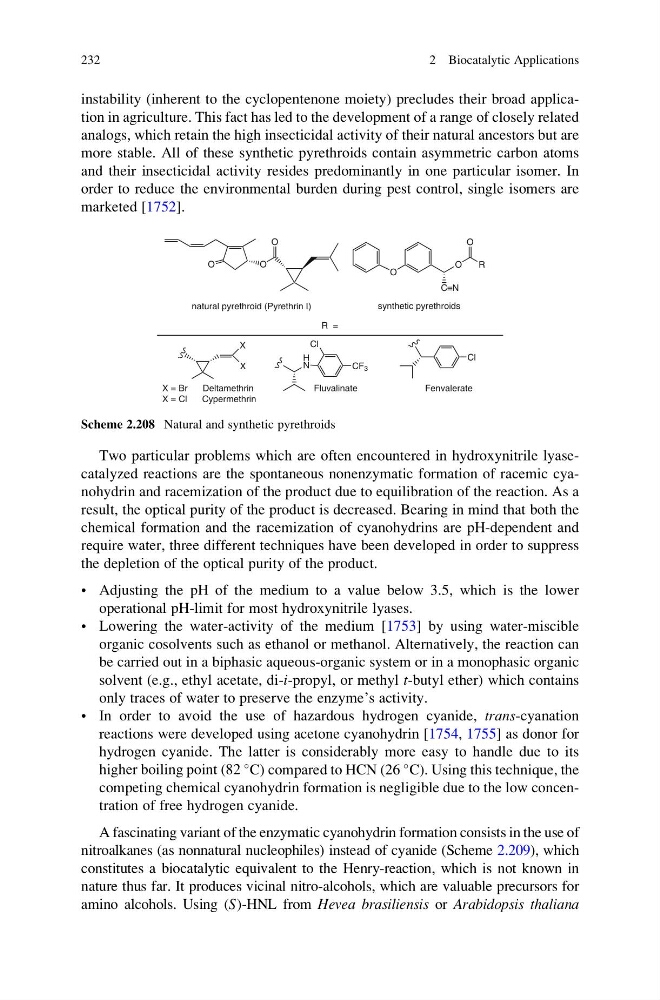
instability (inherent to the cyclopentenone moiety) precludes their broad application in agriculture. This fact has led to the development of a range of closely related
analogs, which retain the high insecticidal activity of their natural ancestors but are
more stable. All of these synthetic pyrethroids contain asymmetric carbon atoms
and their insecticidal activity resides predominantly in one particular isomer. In
order to reduce the environmental burden during pest control, single isomers are
marketed [1752].
Two particular problems which are often encountered in hydroxynitrile lyasecatalyzed reactions are the spontaneous nonenzymatic formation of racemic cyanohydrin and racemization of the product due to equilibration of the reaction. As a
result, the optical purity of the product is decreased. Bearing in mind that both the
chemical formation and the racemization of cyanohydrins are pH-dependent and
require water, three different techniques have been developed in order to suppress
the depletion of the optical purity of the product.
• Adjusting the pH of the medium to a value below 3.5, which is the lower
operational pH-limit for most hydroxynitrile lyases.
• Lowering the water-activity of the medium [1753] by using water-miscible
organic cosolvents such as ethanol or methanol. Alternatively, the reaction can
be carried out in a biphasic aqueous-organic system or in a monophasic organic
solvent (e.g., ethyl acetate, di-i-propyl, or methyl t-butyl ether) which contains
only traces of water to preserve the enzyme’s activity.
• In order to avoid the use of hazardous hydrogen cyanide, trans-cyanation
reactions were developed using acetone cyanohydrin [1754, 1755] as donor for
hydrogen cyanide. The latter is considerably more easy to handle due to its
higher boiling point (82
C) compared to HCN (26
C). Using this technique, the
competing chemical cyanohydrin formation is negligible due to the low concentration of free hydrogen cyanide.
A fascinating variant of the enzymatic cyanohydrin formation consists in the use of
nitroalkanes (as nonnatural nucleophiles) instead of cyanide (Scheme 2.209), which
constitutes a biocatalytic equivalent to the Henry-reaction, which is not known in
nature thus far. It produces vicinal nitro-alcohols, which are valuable precursors for
amino alcohols. Using (S)-HNL from Hevea brasiliensis or Arabidopsis thaliana
H
N
Cl
CF 3
Cl
X
X
C≡N
O
R
O
O
O
O
O
R =
Fluvalinate
Fenvalerate
X = Cl
Cypermethrin
X = Br
Deltamethrin
synthetic pyrethroids
natural pyrethroid (Pyrethrin I)
Scheme 2.208 Natural and synthetic pyrethroids
232
2 Biocatalytic Applications
analogs, which retain the high insecticidal activity of their natural ancestors but are
more stable. All of these synthetic pyrethroids contain asymmetric carbon atoms
and their insecticidal activity resides predominantly in one particular isomer. In
order to reduce the environmental burden during pest control, single isomers are
marketed [1752].
Two particular problems which are often encountered in hydroxynitrile lyasecatalyzed reactions are the spontaneous nonenzymatic formation of racemic cyanohydrin and racemization of the product due to equilibration of the reaction. As a
result, the optical purity of the product is decreased. Bearing in mind that both the
chemical formation and the racemization of cyanohydrins are pH-dependent and
require water, three different techniques have been developed in order to suppress
the depletion of the optical purity of the product.
• Adjusting the pH of the medium to a value below 3.5, which is the lower
operational pH-limit for most hydroxynitrile lyases.
• Lowering the water-activity of the medium [1753] by using water-miscible
organic cosolvents such as ethanol or methanol. Alternatively, the reaction can
be carried out in a biphasic aqueous-organic system or in a monophasic organic
solvent (e.g., ethyl acetate, di-i-propyl, or methyl t-butyl ether) which contains
only traces of water to preserve the enzyme’s activity.
• In order to avoid the use of hazardous hydrogen cyanide, trans-cyanation
reactions were developed using acetone cyanohydrin [1754, 1755] as donor for
hydrogen cyanide. The latter is considerably more easy to handle due to its
higher boiling point (82
C) compared to HCN (26
C). Using this technique, the
competing chemical cyanohydrin formation is negligible due to the low concentration of free hydrogen cyanide.
A fascinating variant of the enzymatic cyanohydrin formation consists in the use of
nitroalkanes (as nonnatural nucleophiles) instead of cyanide (Scheme 2.209), which
constitutes a biocatalytic equivalent to the Henry-reaction, which is not known in
nature thus far. It produces vicinal nitro-alcohols, which are valuable precursors for
amino alcohols. Using (S)-HNL from Hevea brasiliensis or Arabidopsis thaliana
H
N
Cl
CF 3
Cl
X
X
C≡N
O
R
O
O
O
O
O
R =
Fluvalinate
Fenvalerate
X = Cl
Cypermethrin
X = Br
Deltamethrin
synthetic pyrethroids
natural pyrethroid (Pyrethrin I)
Scheme 2.208 Natural and synthetic pyrethroids
232
2 Biocatalytic Applications