

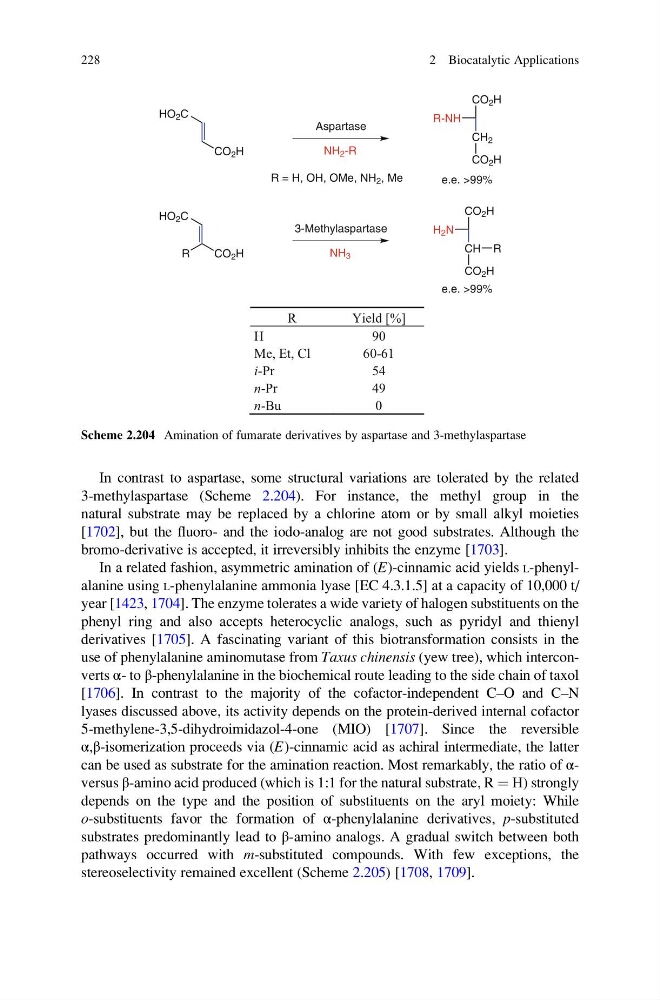
In contrast to aspartase, some structural variations are tolerated by the related
3-methylaspartase (Scheme 2.204). For instance, the methyl group in the
natural substrate may be replaced by a chlorine atom or by small alkyl moieties
[1702], but the fluoro- and the iodo-analog are not good substrates. Although the
bromo-derivative is accepted, it irreversibly inhibits the enzyme [1703].
In a related fashion, asymmetric amination of (E)-cinnamic acid yields L-phenylalanine using L-phenylalanine ammonia lyase [EC 4.3.1.5] at a capacity of 10,000 t/
year [1423, 1704]. The enzyme tolerates a wide variety of halogen substituents on the
phenyl ring and also accepts heterocyclic analogs, such as pyridyl and thienyl
derivatives [1705]. A fascinating variant of this biotransformation consists in the
use of phenylalanine aminomutase from Taxus chinensis (yew tree), which interconverts α- to β-phenylalanine in the biochemical route leading to the side chain of taxol
[1706]. In contrast to the majority of the cofactor-independent C–O and C–N
lyases discussed above, its activity depends on the protein-derived internal cofactor
5-methylene-3,5-dihydroimidazol-4-one (MIO) [1707]. Since the reversible
α,β-isomerization proceeds via (E)-cinnamic acid as achiral intermediate, the latter
can be used as substrate for the amination reaction. Most remarkably, the ratio of αversus β-amino acid produced (which is 1:1 for the natural substrate, R ¼ H) strongly
depends on the type and the position of substituents on the aryl moiety: While
o-substituents favor the formation of α-phenylalanine derivatives, p-substituted
substrates predominantly lead to β-amino analogs. A gradual switch between both
pathways occurred with m-substituted compounds. With few exceptions, the
stereoselectivity remained excellent (Scheme 2.205) [1708, 1709].
HO 2 C
R
CO 2 H
CO 2 H
HO 2 C
CO 2 H
R-NH
CH 2
CO 2 H
e.e. >99%
3-Methylaspartase
e.e. >99%
Aspartase
R = H, OH, OMe, NH 2 , Me
NH 3
NH 2 -R
CO 2 H
H 2 N
CH
CO 2 H
R
R
Yield [%]
H
9 0
Me, Et, Cl
60-61
i-Pr
54
n-Pr
49
n-Bu
0
Scheme 2.204 Amination of fumarate derivatives by aspartase and 3-methylaspartase
228
2 Biocatalytic Applications
3-methylaspartase (Scheme 2.204). For instance, the methyl group in the
natural substrate may be replaced by a chlorine atom or by small alkyl moieties
[1702], but the fluoro- and the iodo-analog are not good substrates. Although the
bromo-derivative is accepted, it irreversibly inhibits the enzyme [1703].
In a related fashion, asymmetric amination of (E)-cinnamic acid yields L-phenylalanine using L-phenylalanine ammonia lyase [EC 4.3.1.5] at a capacity of 10,000 t/
year [1423, 1704]. The enzyme tolerates a wide variety of halogen substituents on the
phenyl ring and also accepts heterocyclic analogs, such as pyridyl and thienyl
derivatives [1705]. A fascinating variant of this biotransformation consists in the
use of phenylalanine aminomutase from Taxus chinensis (yew tree), which interconverts α- to β-phenylalanine in the biochemical route leading to the side chain of taxol
[1706]. In contrast to the majority of the cofactor-independent C–O and C–N
lyases discussed above, its activity depends on the protein-derived internal cofactor
5-methylene-3,5-dihydroimidazol-4-one (MIO) [1707]. Since the reversible
α,β-isomerization proceeds via (E)-cinnamic acid as achiral intermediate, the latter
can be used as substrate for the amination reaction. Most remarkably, the ratio of αversus β-amino acid produced (which is 1:1 for the natural substrate, R ¼ H) strongly
depends on the type and the position of substituents on the aryl moiety: While
o-substituents favor the formation of α-phenylalanine derivatives, p-substituted
substrates predominantly lead to β-amino analogs. A gradual switch between both
pathways occurred with m-substituted compounds. With few exceptions, the
stereoselectivity remained excellent (Scheme 2.205) [1708, 1709].
HO 2 C
R
CO 2 H
CO 2 H
HO 2 C
CO 2 H
R-NH
CH 2
CO 2 H
e.e. >99%
3-Methylaspartase
e.e. >99%
Aspartase
R = H, OH, OMe, NH 2 , Me
NH 3
NH 2 -R
CO 2 H
H 2 N
CH
CO 2 H
R
R
Yield [%]
H
9 0
Me, Et, Cl
60-61
i-Pr
54
n-Pr
49
n-Bu
0
Scheme 2.204 Amination of fumarate derivatives by aspartase and 3-methylaspartase
228
2 Biocatalytic Applications