

of α,β-unsaturated butyrolactones with high enantioselectivity, furnishing
β-hydroxylactones in moderate yields [1688]. Furthermore, C¼C hydration reactions
are often not far from equilibrium, which requires sophisticated process engineering,
such as selective crystallization or the use of membrane technology.
2.5.2 Addition of Ammonia
The addition of ammonia across C¼C bonds is equivalent to a ‘hydroamination’
and is catalyzed by ammonia lyases [1689], such as aspartase [EC 4.3.1.1],
3-methylaspartase [1690], and phenylalanine ammonia lyase [EC 4.3.1.5].
The equilibrium can be shifted by high concentrations of ammonia
(~4–6 M) [1691].
Enzymatic amination of fumaric acid using aspartase is used for the production
of L-aspartic acid at a capacity of ~10,000 t/year (Scheme 2.204) [1692–
1695]. Although aspartase is one of the most specific enzymes known by accepting
only its natural substrate [1696–1698], some variations concerning the N-nucleophile are tolerated: Hydroxylamine, hydrazine, methoxyamine, and methylamine
are accepted and furnish the corresponding N-substituted L-aspartate derivatives
[1699–1701].
OH
O
O
Me 3 N
O
O
Me 3 N
OH
S-CoA
O
Me 3 N
S-CoA
O
Me 3 N
O
O
O OH
NH 2
N
N
N
N
HS
N
O
O
OH
N
O
L-Carnitine
Crotonobetain
L-Carnityl-Co-A
Hydratase
Crotonobetainyl-CoA
Crotonobetainyl-CoA
Synthetase
Crotonobetainyl-CoA
Thioesterase
AMP + PP i
ATP
= phosphate
pantoic acid
β-alanine
active SH
adenine
H 2 O
P
P
P
P
H
H
H 2 O
HS-CoA
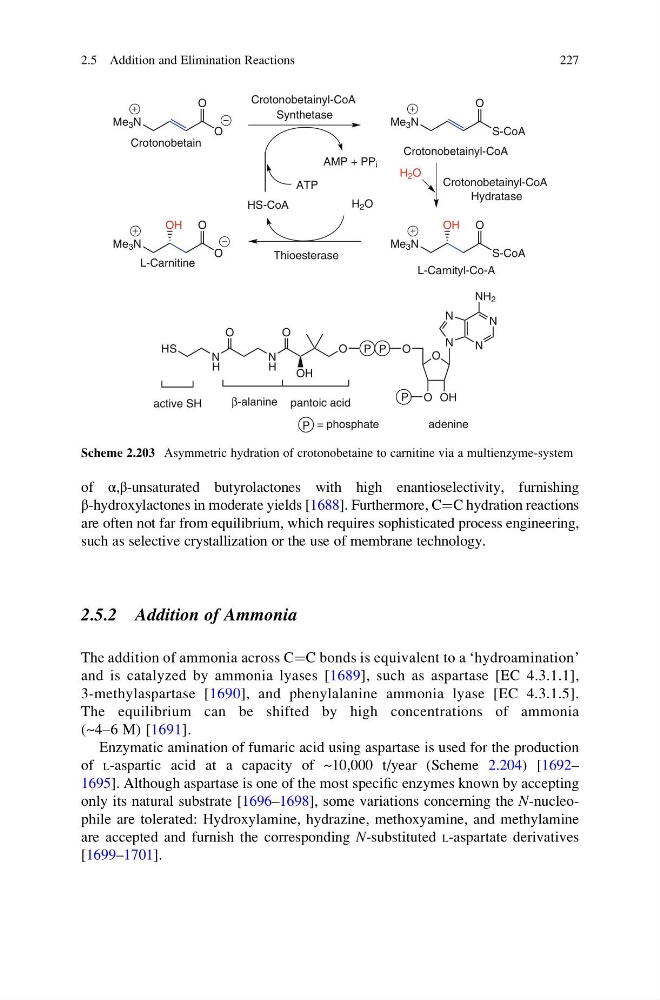
Scheme 2.203 Asymmetric hydration of crotonobetaine to carnitine via a multienzyme-system
2.5 Addition and Elimination Reactions
227
β-hydroxylactones in moderate yields [1688]. Furthermore, C¼C hydration reactions
are often not far from equilibrium, which requires sophisticated process engineering,
such as selective crystallization or the use of membrane technology.
2.5.2 Addition of Ammonia
The addition of ammonia across C¼C bonds is equivalent to a ‘hydroamination’
and is catalyzed by ammonia lyases [1689], such as aspartase [EC 4.3.1.1],
3-methylaspartase [1690], and phenylalanine ammonia lyase [EC 4.3.1.5].
The equilibrium can be shifted by high concentrations of ammonia
(~4–6 M) [1691].
Enzymatic amination of fumaric acid using aspartase is used for the production
of L-aspartic acid at a capacity of ~10,000 t/year (Scheme 2.204) [1692–
1695]. Although aspartase is one of the most specific enzymes known by accepting
only its natural substrate [1696–1698], some variations concerning the N-nucleophile are tolerated: Hydroxylamine, hydrazine, methoxyamine, and methylamine
are accepted and furnish the corresponding N-substituted L-aspartate derivatives
[1699–1701].
OH
O
O
Me 3 N
O
O
Me 3 N
OH
S-CoA
O
Me 3 N
S-CoA
O
Me 3 N
O
O
O OH
NH 2
N
N
N
N
HS
N
O
O
OH
N
O
L-Carnitine
Crotonobetain
L-Carnityl-Co-A
Hydratase
Crotonobetainyl-CoA
Crotonobetainyl-CoA
Synthetase
Crotonobetainyl-CoA
Thioesterase
AMP + PP i
ATP
= phosphate
pantoic acid
β-alanine
active SH
adenine
H 2 O
P
P
P
P
H
H
H 2 O
HS-CoA
Scheme 2.203 Asymmetric hydration of crotonobetaine to carnitine via a multienzyme-system
2.5 Addition and Elimination Reactions
227