

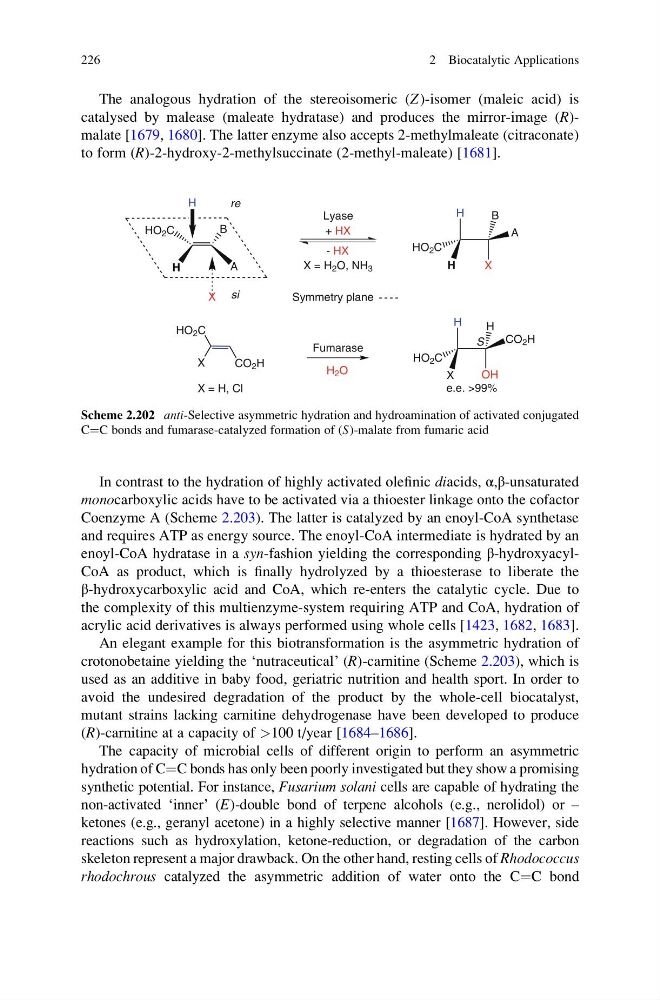
The analogous hydration of the stereoisomeric (Z )-isomer (maleic acid) is
catalysed by malease (maleate hydratase) and produces the mirror-image (R)malate [1679, 1680]. The latter enzyme also accepts 2-methylmaleate (citraconate)
to form (R)-2-hydroxy-2-methylsuccinate (2-methyl-maleate) [1681].
In contrast to the hydration of highly activated olefinic diacids, α,β-unsaturated
monocarboxylic acids have to be activated via a thioester linkage onto the cofactor
Coenzyme A (Scheme 2.203). The latter is catalyzed by an enoyl-CoA synthetase
and requires ATP as energy source. The enoyl-CoA intermediate is hydrated by an
enoyl-CoA hydratase in a syn-fashion yielding the corresponding β-hydroxyacylCoA as product, which is finally hydrolyzed by a thioesterase to liberate the
β-hydroxycarboxylic acid and CoA, which re-enters the catalytic cycle. Due to
the complexity of this multienzyme-system requiring ATP and CoA, hydration of
acrylic acid derivatives is always performed using whole cells [1423, 1682, 1683].
An elegant example for this biotransformation is the asymmetric hydration of
crotonobetaine yielding the ‘nutraceutical’ (R)-carnitine (Scheme 2.203), which is
used as an additive in baby food, geriatric nutrition and health sport. In order to
avoid the undesired degradation of the product by the whole-cell biocatalyst,
mutant strains lacking carnitine dehydrogenase have been developed to produce
(R)-carnitine at a capacity of >100 t/year [1684–1686].
The capacity of microbial cells of different origin to perform an asymmetric
hydration of C¼C bonds has only been poorly investigated but they show a promising
synthetic potential. For instance, Fusarium solani cells are capable of hydrating the
non-activated ‘inner’ (E)-double bond of terpene alcohols (e.g., nerolidol) or –
ketones (e.g., geranyl acetone) in a highly selective manner [1687]. However, side
reactions such as hydroxylation, ketone-reduction, or degradation of the carbon
skeleton represent a major drawback. On the other hand, resting cells of Rhodococcus
rhodochrous catalyzed the asymmetric addition of water onto the C¼C bond
H
HO 2 C
A
B
A
X
B
H
HO 2 C
H
X = H 2 O, NH 3
Lyase
+ HX
Symmetry plane
re
si
X
H
- HX
Fumarase
e.e. >99%
X = H, Cl
H 2 O
CO 2 H
X
HO 2 C
CO 2 H
OH
H
X
HO 2 C
H
S
Scheme 2.202 anti-Selective asymmetric hydration and hydroamination of activated conjugated
C¼C bonds and fumarase-catalyzed formation of (S)-malate from fumaric acid
226
2 Biocatalytic Applications
catalysed by malease (maleate hydratase) and produces the mirror-image (R)malate [1679, 1680]. The latter enzyme also accepts 2-methylmaleate (citraconate)
to form (R)-2-hydroxy-2-methylsuccinate (2-methyl-maleate) [1681].
In contrast to the hydration of highly activated olefinic diacids, α,β-unsaturated
monocarboxylic acids have to be activated via a thioester linkage onto the cofactor
Coenzyme A (Scheme 2.203). The latter is catalyzed by an enoyl-CoA synthetase
and requires ATP as energy source. The enoyl-CoA intermediate is hydrated by an
enoyl-CoA hydratase in a syn-fashion yielding the corresponding β-hydroxyacylCoA as product, which is finally hydrolyzed by a thioesterase to liberate the
β-hydroxycarboxylic acid and CoA, which re-enters the catalytic cycle. Due to
the complexity of this multienzyme-system requiring ATP and CoA, hydration of
acrylic acid derivatives is always performed using whole cells [1423, 1682, 1683].
An elegant example for this biotransformation is the asymmetric hydration of
crotonobetaine yielding the ‘nutraceutical’ (R)-carnitine (Scheme 2.203), which is
used as an additive in baby food, geriatric nutrition and health sport. In order to
avoid the undesired degradation of the product by the whole-cell biocatalyst,
mutant strains lacking carnitine dehydrogenase have been developed to produce
(R)-carnitine at a capacity of >100 t/year [1684–1686].
The capacity of microbial cells of different origin to perform an asymmetric
hydration of C¼C bonds has only been poorly investigated but they show a promising
synthetic potential. For instance, Fusarium solani cells are capable of hydrating the
non-activated ‘inner’ (E)-double bond of terpene alcohols (e.g., nerolidol) or –
ketones (e.g., geranyl acetone) in a highly selective manner [1687]. However, side
reactions such as hydroxylation, ketone-reduction, or degradation of the carbon
skeleton represent a major drawback. On the other hand, resting cells of Rhodococcus
rhodochrous catalyzed the asymmetric addition of water onto the C¼C bond
H
HO 2 C
A
B
A
X
B
H
HO 2 C
H
X = H 2 O, NH 3
Lyase
+ HX
Symmetry plane
re
si
X
H
- HX
Fumarase
e.e. >99%
X = H, Cl
H 2 O
CO 2 H
X
HO 2 C
CO 2 H
OH
H
X
HO 2 C
H
S
Scheme 2.202 anti-Selective asymmetric hydration and hydroamination of activated conjugated
C¼C bonds and fumarase-catalyzed formation of (S)-malate from fumaric acid
226
2 Biocatalytic Applications