

For biotransformations, hydratases acting on isolated olefins are developed to a
lesser extent, although a few have gained industrial importance.
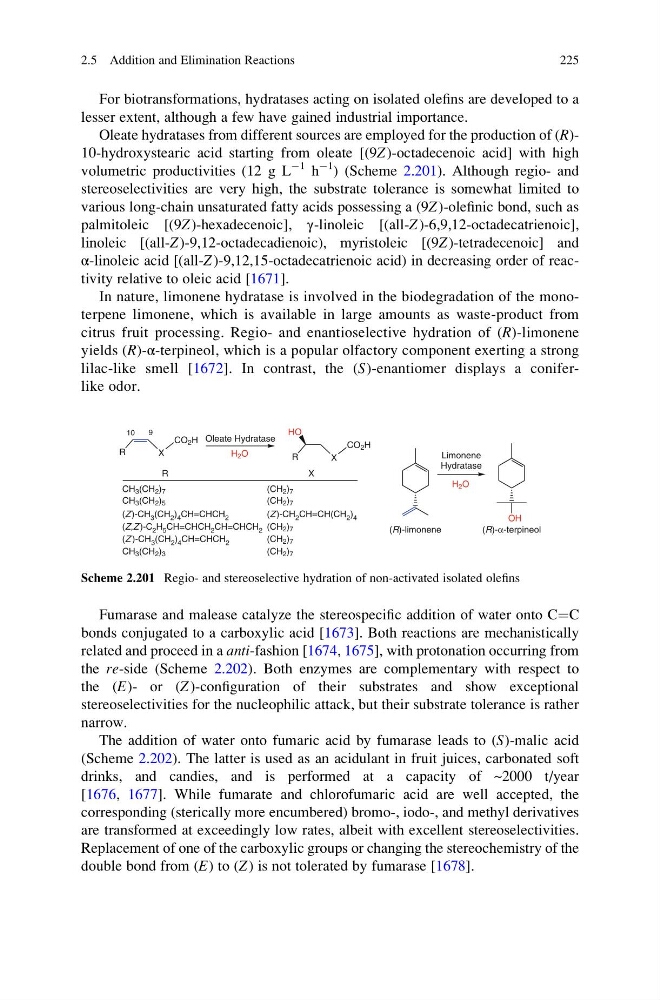
Oleate hydratases from different sources are employed for the production of (R)10-hydroxystearic acid starting from oleate [(9Z)-octadecenoic acid] with high
volumetric productivities (12 g L
À1 h
À1 ) (Scheme 2.201). Although regio- and
stereoselectivities are very high, the substrate tolerance is somewhat limited to
various long-chain unsaturated fatty acids possessing a (9Z )-olefinic bond, such as
palmitoleic [(9Z )-hexadecenoic], γ-linoleic [(all-Z )-6,9,12-octadecatrienoic],
linoleic [(all-Z )-9,12-octadecadienoic), myristoleic [(9Z )-tetradecenoic] and
α-linoleic acid [(all-Z )-9,12,15-octadecatrienoic acid) in decreasing order of reactivity relative to oleic acid [1671].
In nature, limonene hydratase is involved in the biodegradation of the monoterpene limonene, which is available in large amounts as waste-product from
citrus fruit processing. Regio- and enantioselective hydration of (R)-limonene
yields (R)-α-terpineol, which is a popular olfactory component exerting a strong
lilac-like smell [1672]. In contrast, the (S)-enantiomer displays a coniferlike odor.
Fumarase and malease catalyze the stereospecific addition of water onto C¼C
bonds conjugated to a carboxylic acid [1673]. Both reactions are mechanistically
related and proceed in a anti-fashion [1674, 1675], with protonation occurring from
the re-side (Scheme 2.202). Both enzymes are complementary with respect to
the (E)- or (Z )-configuration of their substrates and show exceptional
stereoselectivities for the nucleophilic attack, but their substrate tolerance is rather
narrow.
The addition of water onto fumaric acid by fumarase leads to (S)-malic acid
(Scheme 2.202). The latter is used as an acidulant in fruit juices, carbonated soft
drinks, and candies, and is performed at a capacity of ~2000 t/year
[1676, 1677]. While fumarate and chlorofumaric acid are well accepted, the
corresponding (sterically more encumbered) bromo-, iodo-, and methyl derivatives
are transformed at exceedingly low rates, albeit with excellent stereoselectivities.
Replacement of one of the carboxylic groups or changing the stereochemistry of the
double bond from (E) to (Z ) is not tolerated by fumarase [1678].
9
10
Oleate Hydratase
X
R
CO 2 H
HO
X
R
CO 2 H
R
X
CH 3 (CH 2 ) 7
(CH 2 ) 7
CH 3 (CH 2 ) 5
(CH 2 ) 7
(Z)-CH 3 (CH 2 ) 4 CH=CHCH 2
(Z )-CH 2 CH=CH(CH 2 ) 4
(Z,Z )-C 2 H 5 CH=CHCH 2 CH=CHCH 2 (CH 2 ) 7
(Z )-CH 3 (CH 2 ) 4 CH=CHCH 2
(CH 2 ) 7
(CH 2 ) 7
CH 3 (CH 2 ) 3
OH
Limonene
Hydratase
(R)-limonene
(R)-α-terpineol
H 2 O
H 2 O
Scheme 2.201 Regio- and stereoselective hydration of non-activated isolated olefins
2.5 Addition and Elimination Reactions
225
lesser extent, although a few have gained industrial importance.
Oleate hydratases from different sources are employed for the production of (R)10-hydroxystearic acid starting from oleate [(9Z)-octadecenoic acid] with high
volumetric productivities (12 g L
À1 h
À1 ) (Scheme 2.201). Although regio- and
stereoselectivities are very high, the substrate tolerance is somewhat limited to
various long-chain unsaturated fatty acids possessing a (9Z )-olefinic bond, such as
palmitoleic [(9Z )-hexadecenoic], γ-linoleic [(all-Z )-6,9,12-octadecatrienoic],
linoleic [(all-Z )-9,12-octadecadienoic), myristoleic [(9Z )-tetradecenoic] and
α-linoleic acid [(all-Z )-9,12,15-octadecatrienoic acid) in decreasing order of reactivity relative to oleic acid [1671].
In nature, limonene hydratase is involved in the biodegradation of the monoterpene limonene, which is available in large amounts as waste-product from
citrus fruit processing. Regio- and enantioselective hydration of (R)-limonene
yields (R)-α-terpineol, which is a popular olfactory component exerting a strong
lilac-like smell [1672]. In contrast, the (S)-enantiomer displays a coniferlike odor.
Fumarase and malease catalyze the stereospecific addition of water onto C¼C
bonds conjugated to a carboxylic acid [1673]. Both reactions are mechanistically
related and proceed in a anti-fashion [1674, 1675], with protonation occurring from
the re-side (Scheme 2.202). Both enzymes are complementary with respect to
the (E)- or (Z )-configuration of their substrates and show exceptional
stereoselectivities for the nucleophilic attack, but their substrate tolerance is rather
narrow.
The addition of water onto fumaric acid by fumarase leads to (S)-malic acid
(Scheme 2.202). The latter is used as an acidulant in fruit juices, carbonated soft
drinks, and candies, and is performed at a capacity of ~2000 t/year
[1676, 1677]. While fumarate and chlorofumaric acid are well accepted, the
corresponding (sterically more encumbered) bromo-, iodo-, and methyl derivatives
are transformed at exceedingly low rates, albeit with excellent stereoselectivities.
Replacement of one of the carboxylic groups or changing the stereochemistry of the
double bond from (E) to (Z ) is not tolerated by fumarase [1678].
9
10
Oleate Hydratase
X
R
CO 2 H
HO
X
R
CO 2 H
R
X
CH 3 (CH 2 ) 7
(CH 2 ) 7
CH 3 (CH 2 ) 5
(CH 2 ) 7
(Z)-CH 3 (CH 2 ) 4 CH=CHCH 2
(Z )-CH 2 CH=CH(CH 2 ) 4
(Z,Z )-C 2 H 5 CH=CHCH 2 CH=CHCH 2 (CH 2 ) 7
(Z )-CH 3 (CH 2 ) 4 CH=CHCH 2
(CH 2 ) 7
(CH 2 ) 7
CH 3 (CH 2 ) 3
OH
Limonene
Hydratase
(R)-limonene
(R)-α-terpineol
H 2 O
H 2 O
Scheme 2.201 Regio- and stereoselective hydration of non-activated isolated olefins
2.5 Addition and Elimination Reactions
225