

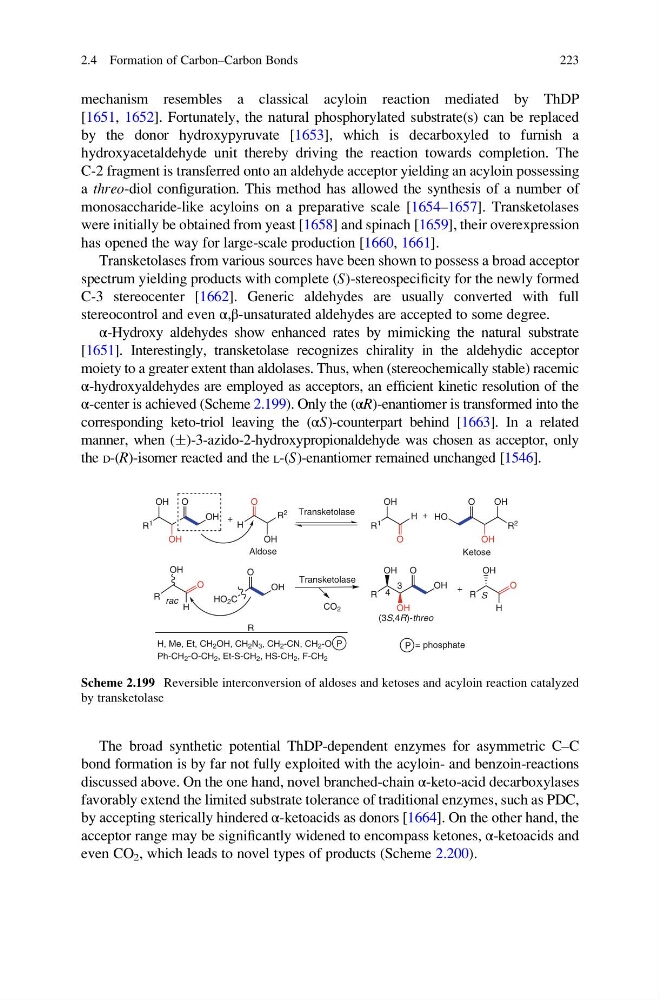
mechanism resembles a classical acyloin reaction mediated by ThDP
[1651, 1652]. Fortunately, the natural phosphorylated substrate(s) can be replaced
by the donor hydroxypyruvate [1653], which is decarboxyled to furnish a
hydroxyacetaldehyde unit thereby driving the reaction towards completion. The
C-2 fragment is transferred onto an aldehyde acceptor yielding an acyloin possessing
a threo-diol configuration. This method has allowed the synthesis of a number of
monosaccharide-like acyloins on a preparative scale [1654–1657]. Transketolases
were initially be obtained from yeast [1658] and spinach [1659], their overexpression
has opened the way for large-scale production [1660, 1661].
Transketolases from various sources have been shown to possess a broad acceptor
spectrum yielding products with complete (S)-stereospecificity for the newly formed
C-3 stereocenter [1662]. Generic aldehydes are usually converted with full
stereocontrol and even α,β-unsaturated aldehydes are accepted to some degree.
α-Hydroxy aldehydes show enhanced rates by mimicking the natural substrate
[1651]. Interestingly, transketolase recognizes chirality in the aldehydic acceptor
moiety to a greater extent than aldolases. Thus, when (stereochemically stable) racemic
α-hydroxyaldehydes are employed as acceptors, an efficient kinetic resolution of the
α-center is achieved (Scheme 2.199). Only the (αR)-enantiomer is transformed into the
corresponding keto-triol leaving the (αS)-counterpart behind [1663]. In a related
manner, when (Æ)-3-azido-2-hydroxypropionaldehyde was chosen as acceptor, only
the D-(R)-isomer reacted and the L-(S)-enantiomer remained unchanged [1546].
The broad synthetic potential ThDP-dependent enzymes for asymmetric C–C
bond formation is by far not fully exploited with the acyloin- and benzoin-reactions
discussed above. On the one hand, novel branched-chain α-keto-acid decarboxylases
favorably extend the limited substrate tolerance of traditional enzymes, such as PDC,
by accepting sterically hindered α-ketoacids as donors [1664]. On the other hand, the
acceptor range may be significantly widened to encompass ketones, α-ketoacids and
even CO 2 , which leads to novel types of products (Scheme 2.200).
O
OH
HO 2 C
O
OH
OH
OH
R
OH
H
O
R
OH
H
O
R
Transketolase
4
3
Ph-CH 2 -O-CH 2 , Et-S-CH 2 , HS-CH 2 , F-CH 2
H, Me, Et, CH 2 OH, CH 2 N 3 , CH 2 -CN, CH 2 -O
rac
(3S,4R)-threo
+
= phosphate
CO 2
S
P
R
P
O
OH
OH
OH
R
1
Transketolase
O
OH
R 2
H
O
OH
R
1
H
O
OH
OH
HO
R
2
Aldose
Ketose
+
+
Scheme 2.199 Reversible interconversion of aldoses and ketoses and acyloin reaction catalyzed
by transketolase
2.4 Formation of Carbon–Carbon Bonds
223
[1651, 1652]. Fortunately, the natural phosphorylated substrate(s) can be replaced
by the donor hydroxypyruvate [1653], which is decarboxyled to furnish a
hydroxyacetaldehyde unit thereby driving the reaction towards completion. The
C-2 fragment is transferred onto an aldehyde acceptor yielding an acyloin possessing
a threo-diol configuration. This method has allowed the synthesis of a number of
monosaccharide-like acyloins on a preparative scale [1654–1657]. Transketolases
were initially be obtained from yeast [1658] and spinach [1659], their overexpression
has opened the way for large-scale production [1660, 1661].
Transketolases from various sources have been shown to possess a broad acceptor
spectrum yielding products with complete (S)-stereospecificity for the newly formed
C-3 stereocenter [1662]. Generic aldehydes are usually converted with full
stereocontrol and even α,β-unsaturated aldehydes are accepted to some degree.
α-Hydroxy aldehydes show enhanced rates by mimicking the natural substrate
[1651]. Interestingly, transketolase recognizes chirality in the aldehydic acceptor
moiety to a greater extent than aldolases. Thus, when (stereochemically stable) racemic
α-hydroxyaldehydes are employed as acceptors, an efficient kinetic resolution of the
α-center is achieved (Scheme 2.199). Only the (αR)-enantiomer is transformed into the
corresponding keto-triol leaving the (αS)-counterpart behind [1663]. In a related
manner, when (Æ)-3-azido-2-hydroxypropionaldehyde was chosen as acceptor, only
the D-(R)-isomer reacted and the L-(S)-enantiomer remained unchanged [1546].
The broad synthetic potential ThDP-dependent enzymes for asymmetric C–C
bond formation is by far not fully exploited with the acyloin- and benzoin-reactions
discussed above. On the one hand, novel branched-chain α-keto-acid decarboxylases
favorably extend the limited substrate tolerance of traditional enzymes, such as PDC,
by accepting sterically hindered α-ketoacids as donors [1664]. On the other hand, the
acceptor range may be significantly widened to encompass ketones, α-ketoacids and
even CO 2 , which leads to novel types of products (Scheme 2.200).
O
OH
HO 2 C
O
OH
OH
OH
R
OH
H
O
R
OH
H
O
R
Transketolase
4
3
Ph-CH 2 -O-CH 2 , Et-S-CH 2 , HS-CH 2 , F-CH 2
H, Me, Et, CH 2 OH, CH 2 N 3 , CH 2 -CN, CH 2 -O
rac
(3S,4R)-threo
+
= phosphate
CO 2
S
P
R
P
O
OH
OH
OH
R
1
Transketolase
O
OH
R 2
H
O
OH
R
1
H
O
OH
OH
HO
R
2
Aldose
Ketose
+
+
Scheme 2.199 Reversible interconversion of aldoses and ketoses and acyloin reaction catalyzed
by transketolase
2.4 Formation of Carbon–Carbon Bonds
223