

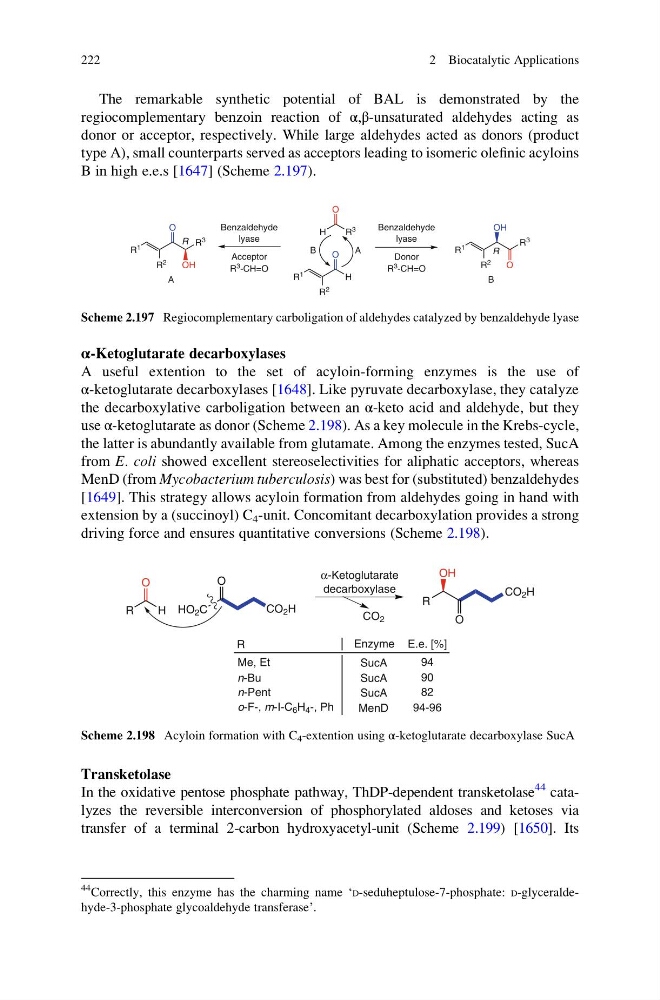
The remarkable synthetic potential of BAL is demonstrated by the
regiocomplementary benzoin reaction of α,β-unsaturated aldehydes acting as
donor or acceptor, respectively. While large aldehydes acted as donors (product
type A), small counterparts served as acceptors leading to isomeric olefinic acyloins
B in high e.e.s [1647] (Scheme 2.197).
α-Ketoglutarate decarboxylases
A useful extention to the set of acyloin-forming enzymes is the use of
α-ketoglutarate decarboxylases [1648]. Like pyruvate decarboxylase, they catalyze
the decarboxylative carboligation between an α-keto acid and aldehyde, but they
use α-ketoglutarate as donor (Scheme 2.198). As a key molecule in the Krebs-cycle,
the latter is abundantly available from glutamate. Among the enzymes tested, SucA
from E. coli showed excellent stereoselectivities for aliphatic acceptors, whereas
MenD (from Mycobacterium tuberculosis) was best for (substituted) benzaldehydes
[1649]. This strategy allows acyloin formation from aldehydes going in hand with
extension by a (succinoyl) C 4 -unit. Concomitant decarboxylation provides a strong
driving force and ensures quantitative conversions (Scheme 2.198).
Transketolase
In the oxidative pentose phosphate pathway, ThDP-dependent transketolase
44 catalyzes the reversible interconversion of phosphorylated aldoses and ketoses via
transfer of a terminal 2-carbon hydroxyacetyl-unit (Scheme 2.199) [1650]. Its
O
R
2
H
R 1
O
R
3
H
OH
R 3
O
R 2
R 1
O
R 3
OH
R 2
R 1
Benzaldehyde
lyase
Benzaldehyde
lyase
R 3 -CH=O
Donor
R 3 -CH=O
Acceptor
A
B
B
A
R
R
Scheme 2.197 Regiocomplementary carboligation of aldehydes catalyzed by benzaldehyde lyase
R
H
O
HO 2 C
CO 2 H
O
R
CO 2 H
OH
O
α-Ketoglutarate
decarboxylase
CO 2
R
Enzyme E.e. [%]
Me, Et
n-Bu
n-Pent
SucA
SucA
SucA
94
90
82
o-F-, m-I-C 6 H 4 -, Ph
MenD
94-96
Scheme 2.198 Acyloin formation with C 4 -extention using α-ketoglutarate decarboxylase SucA
44 Correctly, this enzyme has the charming name ‘D-seduheptulose-7-phosphate: D-glyceraldehyde-3-phosphate glycoaldehyde transferase’.
222
2 Biocatalytic Applications
regiocomplementary benzoin reaction of α,β-unsaturated aldehydes acting as
donor or acceptor, respectively. While large aldehydes acted as donors (product
type A), small counterparts served as acceptors leading to isomeric olefinic acyloins
B in high e.e.s [1647] (Scheme 2.197).
α-Ketoglutarate decarboxylases
A useful extention to the set of acyloin-forming enzymes is the use of
α-ketoglutarate decarboxylases [1648]. Like pyruvate decarboxylase, they catalyze
the decarboxylative carboligation between an α-keto acid and aldehyde, but they
use α-ketoglutarate as donor (Scheme 2.198). As a key molecule in the Krebs-cycle,
the latter is abundantly available from glutamate. Among the enzymes tested, SucA
from E. coli showed excellent stereoselectivities for aliphatic acceptors, whereas
MenD (from Mycobacterium tuberculosis) was best for (substituted) benzaldehydes
[1649]. This strategy allows acyloin formation from aldehydes going in hand with
extension by a (succinoyl) C 4 -unit. Concomitant decarboxylation provides a strong
driving force and ensures quantitative conversions (Scheme 2.198).
Transketolase
In the oxidative pentose phosphate pathway, ThDP-dependent transketolase
44 catalyzes the reversible interconversion of phosphorylated aldoses and ketoses via
transfer of a terminal 2-carbon hydroxyacetyl-unit (Scheme 2.199) [1650]. Its
O
R
2
H
R 1
O
R
3
H
OH
R 3
O
R 2
R 1
O
R 3
OH
R 2
R 1
Benzaldehyde
lyase
Benzaldehyde
lyase
R 3 -CH=O
Donor
R 3 -CH=O
Acceptor
A
B
B
A
R
R
Scheme 2.197 Regiocomplementary carboligation of aldehydes catalyzed by benzaldehyde lyase
R
H
O
HO 2 C
CO 2 H
O
R
CO 2 H
OH
O
α-Ketoglutarate
decarboxylase
CO 2
R
Enzyme E.e. [%]
Me, Et
n-Bu
n-Pent
SucA
SucA
SucA
94
90
82
o-F-, m-I-C 6 H 4 -, Ph
MenD
94-96
Scheme 2.198 Acyloin formation with C 4 -extention using α-ketoglutarate decarboxylase SucA
44 Correctly, this enzyme has the charming name ‘D-seduheptulose-7-phosphate: D-glyceraldehyde-3-phosphate glycoaldehyde transferase’.
222
2 Biocatalytic Applications