

Pyruvate Decarboxylase
In vivo, pyruvate decarboxylase [EC 4.1.1.1] catalyzes the nonoxidative decarboxylation of pyruvate to acetaldehyde and is thus a key enzyme in the fermentative
production of ethanol. The most well-studied PDCs are obtained from baker’s yeast
[1625, 1632, 1633] and from Zymomonas mobilis [1634].
From a synthetic viewpoint, however, its carboligation activity is more important [1635–1637]: All PDCs investigated so far prefer small aliphatic aldehydes
as donors, used either directly or applied in the form of the respective
α-ketocarboxylic acids [1638]. The latter are decarboxylated during the course of
the reaction, which drives the equilibrium towards carboligation. Straight-chain
α-ketoacids up to C-6 are good donors, whereas branched and aryl-aliphatic analogs
are less suitable. On the acceptor side, aromatic aldehydes are preferred, leading to
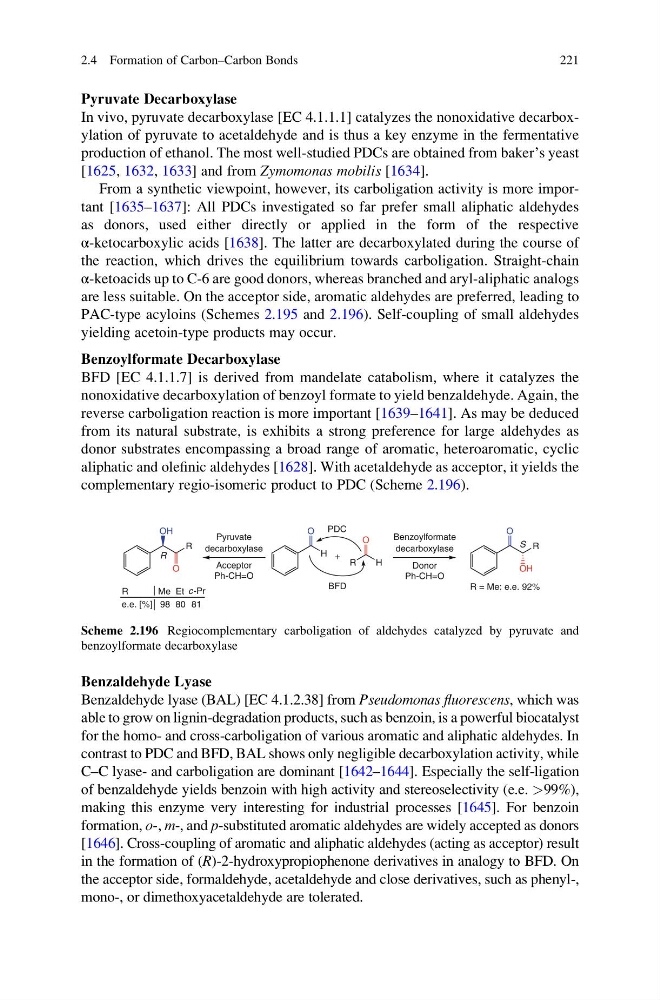
PAC-type acyloins (Schemes 2.195 and 2.196). Self-coupling of small aldehydes
yielding acetoin-type products may occur.
Benzoylformate Decarboxylase
BFD [EC 4.1.1.7] is derived from mandelate catabolism, where it catalyzes the
nonoxidative decarboxylation of benzoyl formate to yield benzaldehyde. Again, the
reverse carboligation reaction is more important [1639–1641]. As may be deduced
from its natural substrate, is exhibits a strong preference for large aldehydes as
donor substrates encompassing a broad range of aromatic, heteroaromatic, cyclic
aliphatic and olefinic aldehydes [1628]. With acetaldehyde as acceptor, it yields the
complementary regio-isomeric product to PDC (Scheme 2.196).
Benzaldehyde Lyase
Benzaldehyde lyase (BAL) [EC 4.1.2.38] from Pseudomonas fluorescens, which was
able to grow on lignin-degradation products, such as benzoin, is a powerful biocatalyst
for the homo- and cross-carboligation of various aromatic and aliphatic aldehydes. In
contrast to PDC and BFD, BAL shows only negligible decarboxylation activity, while
C–C lyase- and carboligation are dominant [1642–1644]. Especially the self-ligation
of benzaldehyde yields benzoin with high activity and stereoselectivity (e.e. >99%),
making this enzyme very interesting for industrial processes [1645]. For benzoin
formation, o-, m-, and p-substituted aromatic aldehydes are widely accepted as donors
[1646]. Cross-coupling of aromatic and aliphatic aldehydes (acting as acceptor) result
in the formation of (R)-2-hydroxypropiophenone derivatives in analogy to BFD. On
the acceptor side, formaldehyde, acetaldehyde and close derivatives, such as phenyl-,
mono-, or dimethoxyacetaldehyde are tolerated.
O
H
O
H
R
OH
R
O
O
R
OH
+
Benzoylformate
decarboxylase
Pyruvate
decarboxylase
R = Me: e.e. 92%
Ph-CH=O
Donor
Ph-CH=O
Acceptor
R
S
PDC
BFD
R
e.e. [%]
Me Et c-Pr
98 80 81
Scheme 2.196 Regiocomplementary carboligation of aldehydes catalyzed by pyruvate and
benzoylformate decarboxylase
2.4 Formation of Carbon–Carbon Bonds
221
In vivo, pyruvate decarboxylase [EC 4.1.1.1] catalyzes the nonoxidative decarboxylation of pyruvate to acetaldehyde and is thus a key enzyme in the fermentative
production of ethanol. The most well-studied PDCs are obtained from baker’s yeast
[1625, 1632, 1633] and from Zymomonas mobilis [1634].
From a synthetic viewpoint, however, its carboligation activity is more important [1635–1637]: All PDCs investigated so far prefer small aliphatic aldehydes
as donors, used either directly or applied in the form of the respective
α-ketocarboxylic acids [1638]. The latter are decarboxylated during the course of
the reaction, which drives the equilibrium towards carboligation. Straight-chain
α-ketoacids up to C-6 are good donors, whereas branched and aryl-aliphatic analogs
are less suitable. On the acceptor side, aromatic aldehydes are preferred, leading to
PAC-type acyloins (Schemes 2.195 and 2.196). Self-coupling of small aldehydes
yielding acetoin-type products may occur.
Benzoylformate Decarboxylase
BFD [EC 4.1.1.7] is derived from mandelate catabolism, where it catalyzes the
nonoxidative decarboxylation of benzoyl formate to yield benzaldehyde. Again, the
reverse carboligation reaction is more important [1639–1641]. As may be deduced
from its natural substrate, is exhibits a strong preference for large aldehydes as
donor substrates encompassing a broad range of aromatic, heteroaromatic, cyclic
aliphatic and olefinic aldehydes [1628]. With acetaldehyde as acceptor, it yields the
complementary regio-isomeric product to PDC (Scheme 2.196).
Benzaldehyde Lyase
Benzaldehyde lyase (BAL) [EC 4.1.2.38] from Pseudomonas fluorescens, which was
able to grow on lignin-degradation products, such as benzoin, is a powerful biocatalyst
for the homo- and cross-carboligation of various aromatic and aliphatic aldehydes. In
contrast to PDC and BFD, BAL shows only negligible decarboxylation activity, while
C–C lyase- and carboligation are dominant [1642–1644]. Especially the self-ligation
of benzaldehyde yields benzoin with high activity and stereoselectivity (e.e. >99%),
making this enzyme very interesting for industrial processes [1645]. For benzoin
formation, o-, m-, and p-substituted aromatic aldehydes are widely accepted as donors
[1646]. Cross-coupling of aromatic and aliphatic aldehydes (acting as acceptor) result
in the formation of (R)-2-hydroxypropiophenone derivatives in analogy to BFD. On
the acceptor side, formaldehyde, acetaldehyde and close derivatives, such as phenyl-,
mono-, or dimethoxyacetaldehyde are tolerated.
O
H
O
H
R
OH
R
O
O
R
OH
+
Benzoylformate
decarboxylase
Pyruvate
decarboxylase
R = Me: e.e. 92%
Ph-CH=O
Donor
Ph-CH=O
Acceptor
R
S
PDC
BFD
R
e.e. [%]
Me Et c-Pr
98 80 81
Scheme 2.196 Regiocomplementary carboligation of aldehydes catalyzed by pyruvate and
benzoylformate decarboxylase
2.4 Formation of Carbon–Carbon Bonds
221