

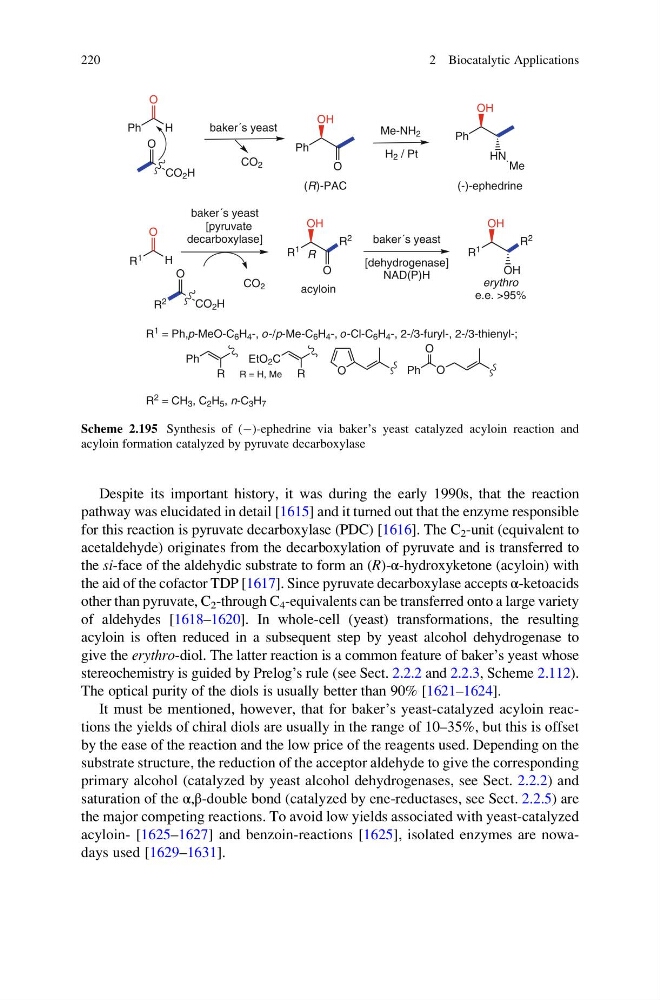
Despite its important history, it was during the early 1990s, that the reaction
pathway was elucidated in detail [1615] and it turned out that the enzyme responsible
for this reaction is pyruvate decarboxylase (PDC) [1616]. The C 2 -unit (equivalent to
acetaldehyde) originates from the decarboxylation of pyruvate and is transferred to
the si-face of the aldehydic substrate to form an (R)-α-hydroxyketone (acyloin) with
the aid of the cofactor TDP [1617]. Since pyruvate decarboxylase accepts α-ketoacids
other than pyruvate, C 2 -through C 4 -equivalents can be transferred onto a large variety
of aldehydes [1618–1620]. In whole-cell (yeast) transformations, the resulting
acyloin is often reduced in a subsequent step by yeast alcohol dehydrogenase to
give the erythro-diol. The latter reaction is a common feature of baker’s yeast whose
stereochemistry is guided by Prelog’s rule (see Sect. 2.2.2 and 2.2.3, Scheme 2.112).
The optical purity of the diols is usually better than 90% [1621–1624].
It must be mentioned, however, that for baker’s yeast-catalyzed acyloin reactions the yields of chiral diols are usually in the range of 10–35%, but this is offset
by the ease of the reaction and the low price of the reagents used. Depending on the
substrate structure, the reduction of the acceptor aldehyde to give the corresponding
primary alcohol (catalyzed by yeast alcohol dehydrogenases, see Sect. 2.2.2) and
saturation of the α,β-double bond (catalyzed by ene-reductases, see Sect. 2.2.5) are
the major competing reactions. To avoid low yields associated with yeast-catalyzed
acyloin- [1625–1627] and benzoin-reactions [1625], isolated enzymes are nowadays used [1629–1631].
O
H
R
1
OH
OH
R
2
R 1
CO 2 H
O
R 2
O
R
EtO 2 C
R
Ph
OH
O
R
2
R 1
O
H
Ph
O
CO 2 H
OH
O
Ph
Me
HN
OH
Ph
O
Ph O
H 2 / Pt
[dehydrogenase]
baker´s yeast
baker´s yeast
[pyruvate
decarboxylase]
acyloin
e.e. >95%
R 1 = Ph,p-MeO-C 6 H 4 -, o-/p-Me-C 6 H 4 -, o-Cl-C 6 H 4 -, 2-/3-furyl-, 2-/3-thienyl-;
R
2 = CH 3 , C 2 H 5 , n-C 3 H 7
(R)-PAC
(-)-ephedrine
baker´s yeast
R = H, Me
R
CO 2
CO 2
Me-NH 2
NAD(P)H
erythro
Scheme 2.195 Synthesis of (À)-ephedrine via baker’s yeast catalyzed acyloin reaction and
acyloin formation catalyzed by pyruvate decarboxylase
220
2 Biocatalytic Applications
pathway was elucidated in detail [1615] and it turned out that the enzyme responsible
for this reaction is pyruvate decarboxylase (PDC) [1616]. The C 2 -unit (equivalent to
acetaldehyde) originates from the decarboxylation of pyruvate and is transferred to
the si-face of the aldehydic substrate to form an (R)-α-hydroxyketone (acyloin) with
the aid of the cofactor TDP [1617]. Since pyruvate decarboxylase accepts α-ketoacids
other than pyruvate, C 2 -through C 4 -equivalents can be transferred onto a large variety
of aldehydes [1618–1620]. In whole-cell (yeast) transformations, the resulting
acyloin is often reduced in a subsequent step by yeast alcohol dehydrogenase to
give the erythro-diol. The latter reaction is a common feature of baker’s yeast whose
stereochemistry is guided by Prelog’s rule (see Sect. 2.2.2 and 2.2.3, Scheme 2.112).
The optical purity of the diols is usually better than 90% [1621–1624].
It must be mentioned, however, that for baker’s yeast-catalyzed acyloin reactions the yields of chiral diols are usually in the range of 10–35%, but this is offset
by the ease of the reaction and the low price of the reagents used. Depending on the
substrate structure, the reduction of the acceptor aldehyde to give the corresponding
primary alcohol (catalyzed by yeast alcohol dehydrogenases, see Sect. 2.2.2) and
saturation of the α,β-double bond (catalyzed by ene-reductases, see Sect. 2.2.5) are
the major competing reactions. To avoid low yields associated with yeast-catalyzed
acyloin- [1625–1627] and benzoin-reactions [1625], isolated enzymes are nowadays used [1629–1631].
O
H
R
1
OH
OH
R
2
R 1
CO 2 H
O
R 2
O
R
EtO 2 C
R
Ph
OH
O
R
2
R 1
O
H
Ph
O
CO 2 H
OH
O
Ph
Me
HN
OH
Ph
O
Ph O
H 2 / Pt
[dehydrogenase]
baker´s yeast
baker´s yeast
[pyruvate
decarboxylase]
acyloin
e.e. >95%
R 1 = Ph,p-MeO-C 6 H 4 -, o-/p-Me-C 6 H 4 -, o-Cl-C 6 H 4 -, 2-/3-furyl-, 2-/3-thienyl-;
R
2 = CH 3 , C 2 H 5 , n-C 3 H 7
(R)-PAC
(-)-ephedrine
baker´s yeast
R = H, Me
R
CO 2
CO 2
Me-NH 2
NAD(P)H
erythro
Scheme 2.195 Synthesis of (À)-ephedrine via baker’s yeast catalyzed acyloin reaction and
acyloin formation catalyzed by pyruvate decarboxylase
220
2 Biocatalytic Applications