

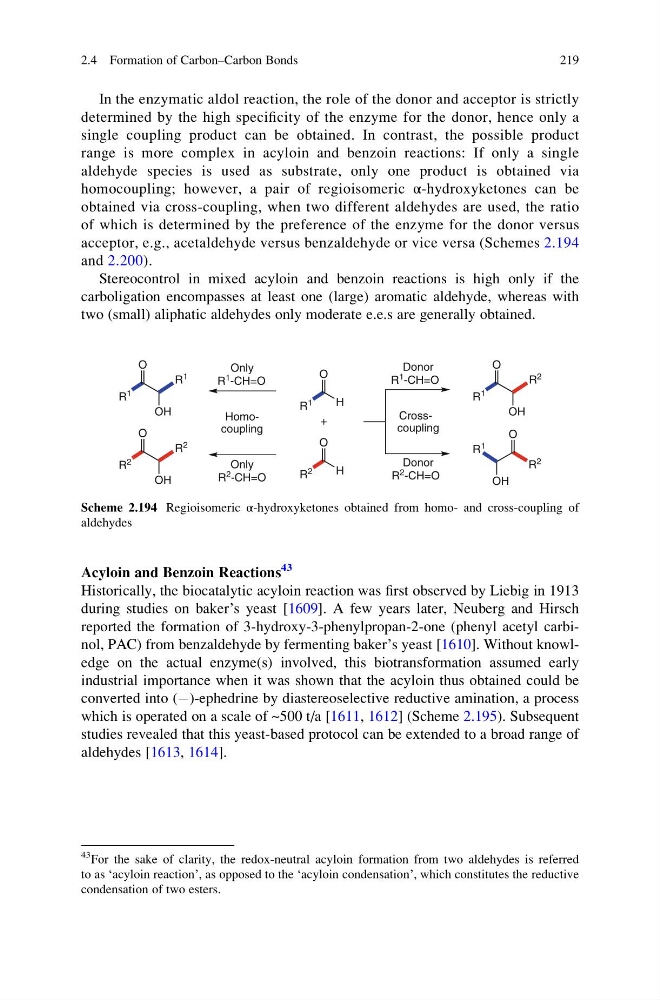
In the enzymatic aldol reaction, the role of the donor and acceptor is strictly
determined by the high specificity of the enzyme for the donor, hence only a
single coupling product can be obtained. In contrast, the possible product
range is more complex in acyloin and benzoin reactions: If only a single
aldehyde species is used as substrate, only one product is obtained via
homocoupling; however, a pair of regioisomeric α-hydroxyketones can be
obtained via cross-coupling, when two different aldehydes are used, the ratio
of which is determined by the preference of the enzyme for the donor versus
acceptor, e.g., acetaldehyde versus benzaldehyde or vice versa (Schemes 2.194
and 2.200).
Stereocontrol in mixed acyloin and benzoin reactions is high only if the
carboligation encompasses at least one (large) aromatic aldehyde, whereas with
two (small) aliphatic aldehydes only moderate e.e.s are generally obtained.
Acyloin and Benzoin Reactions
43
Historically, the biocatalytic acyloin reaction was first observed by Liebig in 1913
during studies on baker’s yeast [1609]. A few years later, Neuberg and Hirsch
reported the formation of 3-hydroxy-3-phenylpropan-2-one (phenyl acetyl carbinol, PAC) from benzaldehyde by fermenting baker’s yeast [1610]. Without knowledge on the actual enzyme(s) involved, this biotransformation assumed early
industrial importance when it was shown that the acyloin thus obtained could be
converted into (À)-ephedrine by diastereoselective reductive amination, a process
which is operated on a scale of ~500 t/a [1611, 1612] (Scheme 2.195). Subsequent
studies revealed that this yeast-based protocol can be extended to a broad range of
aldehydes [1613, 1614].
O
H
R
1
O
H
R
2
OH
O
R
2
R 1
OH
O
R 2
R
2
OH
O
R 1
R 2
OH
O
R
1
R 1
+
R
1
-CH=O
coupling
Homocoupling
R 1 -CH=O
R 2 -CH=O
Donor
Donor
R
2
-CH=O
Only
Only
Scheme 2.194 Regioisomeric α-hydroxyketones obtained from homo- and cross-coupling of
aldehydes
43 For the sake of clarity, the redox-neutral acyloin formation from two aldehydes is referred
to as ‘acyloin reaction’, as opposed to the ‘acyloin condensation’, which constitutes the reductive
condensation of two esters.
2.4 Formation of Carbon–Carbon Bonds
219
determined by the high specificity of the enzyme for the donor, hence only a
single coupling product can be obtained. In contrast, the possible product
range is more complex in acyloin and benzoin reactions: If only a single
aldehyde species is used as substrate, only one product is obtained via
homocoupling; however, a pair of regioisomeric α-hydroxyketones can be
obtained via cross-coupling, when two different aldehydes are used, the ratio
of which is determined by the preference of the enzyme for the donor versus
acceptor, e.g., acetaldehyde versus benzaldehyde or vice versa (Schemes 2.194
and 2.200).
Stereocontrol in mixed acyloin and benzoin reactions is high only if the
carboligation encompasses at least one (large) aromatic aldehyde, whereas with
two (small) aliphatic aldehydes only moderate e.e.s are generally obtained.
Acyloin and Benzoin Reactions
43
Historically, the biocatalytic acyloin reaction was first observed by Liebig in 1913
during studies on baker’s yeast [1609]. A few years later, Neuberg and Hirsch
reported the formation of 3-hydroxy-3-phenylpropan-2-one (phenyl acetyl carbinol, PAC) from benzaldehyde by fermenting baker’s yeast [1610]. Without knowledge on the actual enzyme(s) involved, this biotransformation assumed early
industrial importance when it was shown that the acyloin thus obtained could be
converted into (À)-ephedrine by diastereoselective reductive amination, a process
which is operated on a scale of ~500 t/a [1611, 1612] (Scheme 2.195). Subsequent
studies revealed that this yeast-based protocol can be extended to a broad range of
aldehydes [1613, 1614].
O
H
R
1
O
H
R
2
OH
O
R
2
R 1
OH
O
R 2
R
2
OH
O
R 1
R 2
OH
O
R
1
R 1
+
R
1
-CH=O
coupling
Homocoupling
R 1 -CH=O
R 2 -CH=O
Donor
Donor
R
2
-CH=O
Only
Only
Scheme 2.194 Regioisomeric α-hydroxyketones obtained from homo- and cross-coupling of
aldehydes
43 For the sake of clarity, the redox-neutral acyloin formation from two aldehydes is referred
to as ‘acyloin reaction’, as opposed to the ‘acyloin condensation’, which constitutes the reductive
condensation of two esters.
2.4 Formation of Carbon–Carbon Bonds
219