

Group III: Pyruvate-Dependent Aldolases
For thermodynamic reasons, pyruvate-dependent aldolases have catabolic functions in vivo, whereas their counterparts employing (energy-rich) phosphoenol
pyruvate as the donor are involved in the biosynthesis of keto-acids. However,
both types of enzymes can be used to synthesize α-keto-γ-hydroxy acids in vitro. In
these reactions, the equilibrium is less favorable and usually requires an excess of
pyruvate to achieve a reasonable conversion. However, product isolation is facilitated by enzymatic decomposition of excess pyruvate by pyruvate decarboxylase to
yield volatile CO 2 and acetaldehyde.
Sialic Acid Aldolase N-Acetylneuraminic acid (NeuAc, also termed sialic acid)
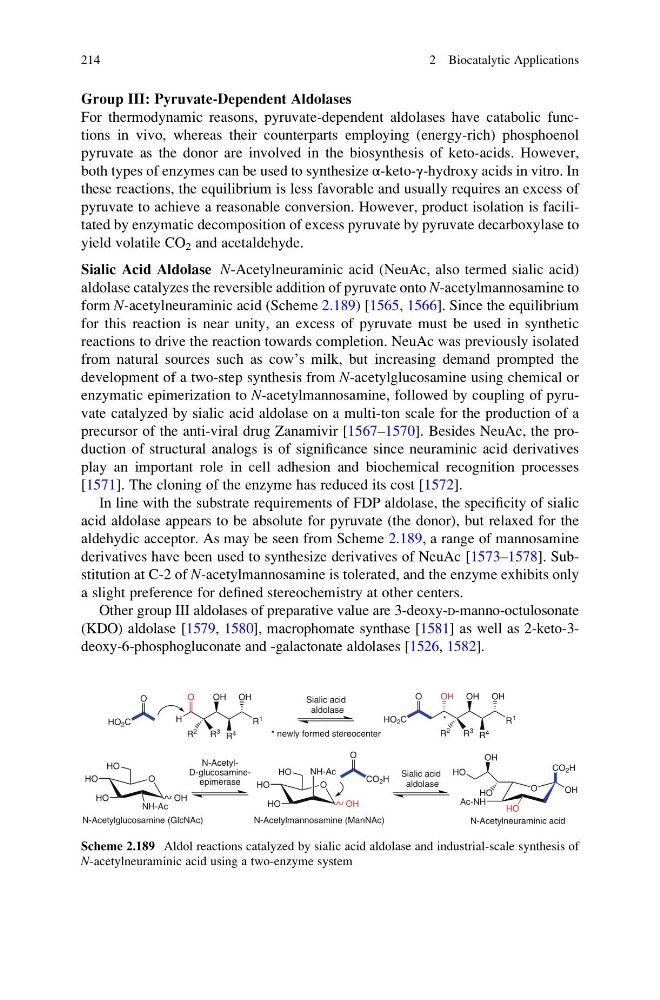
aldolase catalyzes the reversible addition of pyruvate onto N-acetylmannosamine to
form N-acetylneuraminic acid (Scheme 2.189) [1565, 1566]. Since the equilibrium
for this reaction is near unity, an excess of pyruvate must be used in synthetic
reactions to drive the reaction towards completion. NeuAc was previously isolated
from natural sources such as cow’s milk, but increasing demand prompted the
development of a two-step synthesis from N-acetylglucosamine using chemical or
enzymatic epimerization to N-acetylmannosamine, followed by coupling of pyruvate catalyzed by sialic acid aldolase on a multi-ton scale for the production of a
precursor of the anti-viral drug Zanamivir [1567–1570]. Besides NeuAc, the production of structural analogs is of significance since neuraminic acid derivatives
play an important role in cell adhesion and biochemical recognition processes
[1571]. The cloning of the enzyme has reduced its cost [1572].
In line with the substrate requirements of FDP aldolase, the specificity of sialic
acid aldolase appears to be absolute for pyruvate (the donor), but relaxed for the
aldehydic acceptor. As may be seen from Scheme 2.189, a range of mannosamine
derivatives have been used to synthesize derivatives of NeuAc [1573–1578]. Substitution at C-2 of N-acetylmannosamine is tolerated, and the enzyme exhibits only
a slight preference for defined stereochemistry at other centers.
Other group III aldolases of preparative value are 3-deoxy-D-manno-octulosonate
(KDO) aldolase [1579, 1580], macrophomate synthase [1581] as well as 2-keto-3deoxy-6-phosphogluconate and -galactonate aldolases [1526, 1582].
HO 2 C
R
1
O
OH OH
R 4
OH
R
2
R
3
R
2
R
3
OH
R
4
OH
O
R
1
H
O
HO 2 C
HO
HO
HO
NH-Ac
OH
O
NH-Ac
HO
HO
HO
OH
O
O
CO 2 H
HO
OH
HO
Ac-NH
HO
OH
CO 2 H
O
Sialic acid
aldolase
*
* newly formed stereocenter
N-Acetylepimerase
D-glucosamineSialic acid
aldolase
N-Acetylneuraminic acid
N-Acetylmannosamine (ManNAc)
N-Acetylglucosamine (GlcNAc)
Scheme 2.189 Aldol reactions catalyzed by sialic acid aldolase and industrial-scale synthesis of
N-acetylneuraminic acid using a two-enzyme system
214
2 Biocatalytic Applications
For thermodynamic reasons, pyruvate-dependent aldolases have catabolic functions in vivo, whereas their counterparts employing (energy-rich) phosphoenol
pyruvate as the donor are involved in the biosynthesis of keto-acids. However,
both types of enzymes can be used to synthesize α-keto-γ-hydroxy acids in vitro. In
these reactions, the equilibrium is less favorable and usually requires an excess of
pyruvate to achieve a reasonable conversion. However, product isolation is facilitated by enzymatic decomposition of excess pyruvate by pyruvate decarboxylase to
yield volatile CO 2 and acetaldehyde.
Sialic Acid Aldolase N-Acetylneuraminic acid (NeuAc, also termed sialic acid)
aldolase catalyzes the reversible addition of pyruvate onto N-acetylmannosamine to
form N-acetylneuraminic acid (Scheme 2.189) [1565, 1566]. Since the equilibrium
for this reaction is near unity, an excess of pyruvate must be used in synthetic
reactions to drive the reaction towards completion. NeuAc was previously isolated
from natural sources such as cow’s milk, but increasing demand prompted the
development of a two-step synthesis from N-acetylglucosamine using chemical or
enzymatic epimerization to N-acetylmannosamine, followed by coupling of pyruvate catalyzed by sialic acid aldolase on a multi-ton scale for the production of a
precursor of the anti-viral drug Zanamivir [1567–1570]. Besides NeuAc, the production of structural analogs is of significance since neuraminic acid derivatives
play an important role in cell adhesion and biochemical recognition processes
[1571]. The cloning of the enzyme has reduced its cost [1572].
In line with the substrate requirements of FDP aldolase, the specificity of sialic
acid aldolase appears to be absolute for pyruvate (the donor), but relaxed for the
aldehydic acceptor. As may be seen from Scheme 2.189, a range of mannosamine
derivatives have been used to synthesize derivatives of NeuAc [1573–1578]. Substitution at C-2 of N-acetylmannosamine is tolerated, and the enzyme exhibits only
a slight preference for defined stereochemistry at other centers.
Other group III aldolases of preparative value are 3-deoxy-D-manno-octulosonate
(KDO) aldolase [1579, 1580], macrophomate synthase [1581] as well as 2-keto-3deoxy-6-phosphogluconate and -galactonate aldolases [1526, 1582].
HO 2 C
R
1
O
OH OH
R 4
OH
R
2
R
3
R
2
R
3
OH
R
4
OH
O
R
1
H
O
HO 2 C
HO
HO
HO
NH-Ac
OH
O
NH-Ac
HO
HO
HO
OH
O
O
CO 2 H
HO
OH
HO
Ac-NH
HO
OH
CO 2 H
O
Sialic acid
aldolase
*
* newly formed stereocenter
N-Acetylepimerase
D-glucosamineSialic acid
aldolase
N-Acetylneuraminic acid
N-Acetylmannosamine (ManNAc)
N-Acetylglucosamine (GlcNAc)
Scheme 2.189 Aldol reactions catalyzed by sialic acid aldolase and industrial-scale synthesis of
N-acetylneuraminic acid using a two-enzyme system
214
2 Biocatalytic Applications