

phosphorylation of dihydroxyacetone at the expense of ATP and glycerol kinase
[588] (Sect. 2.1.4). Probably the most elegant and convenient method is the in situ
generation of DHAP from fructose-1,6-diphosphate (FDP) using FDP aldolase,
forming one molecule of DHAP as well as glyceraldehyde-3-phosphate. The latter
can be rearranged by triosephosphate isomerase to give a second DHAP molecule
[583]. This two-enzyme protocol has been further extended into a highly integrated
‘artificial metabolism’ derived from glycolysis to obtain DHAP from inexpensive
feedstocks, such as glucose or fructose (yielding two equivalents of DHAP) and
sucrose (four equivalents) via an enzymatic cascade consisting of up to seven
enzymes [1555]. The use of DHAP can be circumvented by in-situ formation of a
DHA borate ester, which is able to mimic DHAP with rhamnulose 1,6-diphosphate
aldolase [1556, 1557].
The presence of the phosphate group in the aldol adducts facilitates their
purification by precipitation as the corresponding barium salts or via
ion-exchange chromatography. Cleavage of phosphate esters is usually accomplished by enzymatic hydrolysis using acid or alkaline phosphatase (Sect. 2.1.4).
Group II: Dihydroxyacetone Dependent Aldolases
The recent discovery of D-fructose-6-phosphate aldolase from E. coli and the
structurally related transaldolase B variant F178Y has opened an elegant solution
to avoid the necessity for phosphorylated DHAP. Since the stereospecificity of
these enzymes is identical to that of fructose-1,6-diphosphate aldolase, it represents
a useful alternative to RAMA by avoiding the futile phosphorylation of the donor
and the dephosphorylation of the aldol product.
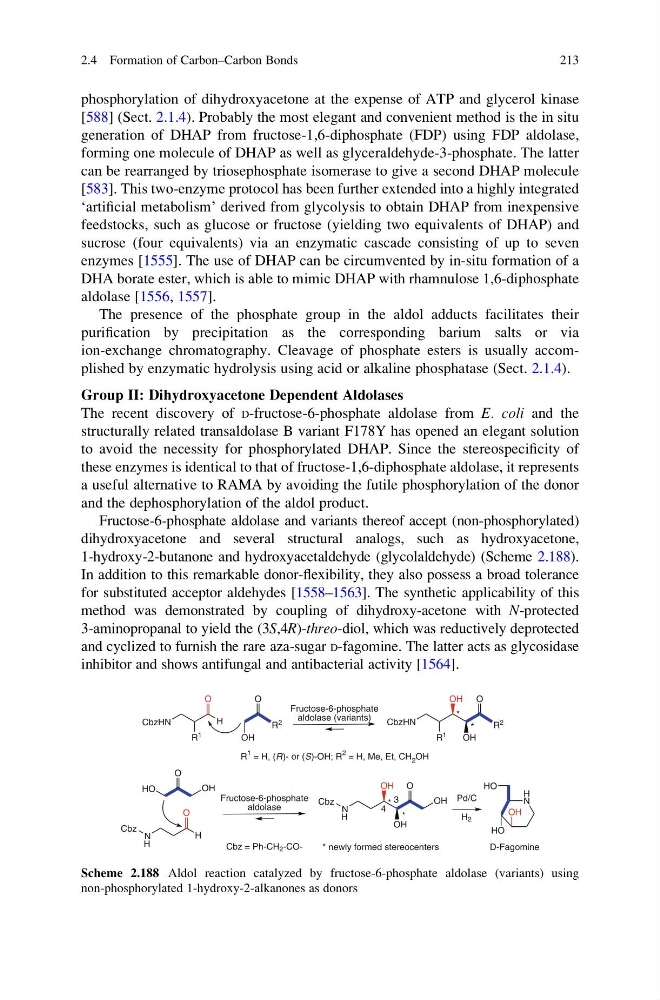
Fructose-6-phosphate aldolase and variants thereof accept (non-phosphorylated)
dihydroxyacetone and several structural analogs, such as hydroxyacetone,
1-hydroxy-2-butanone and hydroxyacetaldehyde (glycolaldehyde) (Scheme 2.188).
In addition to this remarkable donor-flexibility, they also possess a broad tolerance
for substituted acceptor aldehydes [1558–1563]. The synthetic applicability of this
method was demonstrated by coupling of dihydroxy-acetone with N-protected
3-aminopropanal to yield the (3S,4R)-threo-diol, which was reductively deprotected
and cyclized to furnish the rare aza-sugar D-fagomine. The latter acts as glycosidase
inhibitor and shows antifungal and antibacterial activity [1564].
Cbz
N
O
H
O
OH
HO
Cbz
N
O
OH
OH
OH
OH
HO
HO
H
N
4
3
* newly formed stereocenters
*
*
Fructose-6-phosphate
aldolase
Pd/C
D-Fagomine
H
H
H
2
Cbz = Ph-CH 2 -COR 1
O
OH
O
R 2
R
1
OH
OH
O
R 2
R
1 = H, (R)- or (S)-OH; R
2 = H, Me, Et, CH 2 OH
CbzHN
CbzHN
H
Fructose-6-phosphate
aldolase (variants)
*
*
Scheme 2.188 Aldol reaction catalyzed by fructose-6-phosphate aldolase (variants) using
non-phosphorylated 1-hydroxy-2-alkanones as donors
2.4 Formation of Carbon–Carbon Bonds
213
[588] (Sect. 2.1.4). Probably the most elegant and convenient method is the in situ
generation of DHAP from fructose-1,6-diphosphate (FDP) using FDP aldolase,
forming one molecule of DHAP as well as glyceraldehyde-3-phosphate. The latter
can be rearranged by triosephosphate isomerase to give a second DHAP molecule
[583]. This two-enzyme protocol has been further extended into a highly integrated
‘artificial metabolism’ derived from glycolysis to obtain DHAP from inexpensive
feedstocks, such as glucose or fructose (yielding two equivalents of DHAP) and
sucrose (four equivalents) via an enzymatic cascade consisting of up to seven
enzymes [1555]. The use of DHAP can be circumvented by in-situ formation of a
DHA borate ester, which is able to mimic DHAP with rhamnulose 1,6-diphosphate
aldolase [1556, 1557].
The presence of the phosphate group in the aldol adducts facilitates their
purification by precipitation as the corresponding barium salts or via
ion-exchange chromatography. Cleavage of phosphate esters is usually accomplished by enzymatic hydrolysis using acid or alkaline phosphatase (Sect. 2.1.4).
Group II: Dihydroxyacetone Dependent Aldolases
The recent discovery of D-fructose-6-phosphate aldolase from E. coli and the
structurally related transaldolase B variant F178Y has opened an elegant solution
to avoid the necessity for phosphorylated DHAP. Since the stereospecificity of
these enzymes is identical to that of fructose-1,6-diphosphate aldolase, it represents
a useful alternative to RAMA by avoiding the futile phosphorylation of the donor
and the dephosphorylation of the aldol product.
Fructose-6-phosphate aldolase and variants thereof accept (non-phosphorylated)
dihydroxyacetone and several structural analogs, such as hydroxyacetone,
1-hydroxy-2-butanone and hydroxyacetaldehyde (glycolaldehyde) (Scheme 2.188).
In addition to this remarkable donor-flexibility, they also possess a broad tolerance
for substituted acceptor aldehydes [1558–1563]. The synthetic applicability of this
method was demonstrated by coupling of dihydroxy-acetone with N-protected
3-aminopropanal to yield the (3S,4R)-threo-diol, which was reductively deprotected
and cyclized to furnish the rare aza-sugar D-fagomine. The latter acts as glycosidase
inhibitor and shows antifungal and antibacterial activity [1564].
Cbz
N
O
H
O
OH
HO
Cbz
N
O
OH
OH
OH
OH
HO
HO
H
N
4
3
* newly formed stereocenters
*
*
Fructose-6-phosphate
aldolase
Pd/C
D-Fagomine
H
H
H
2
Cbz = Ph-CH 2 -COR 1
O
OH
O
R 2
R
1
OH
OH
O
R 2
R
1 = H, (R)- or (S)-OH; R
2 = H, Me, Et, CH 2 OH
CbzHN
CbzHN
H
Fructose-6-phosphate
aldolase (variants)
*
*
Scheme 2.188 Aldol reaction catalyzed by fructose-6-phosphate aldolase (variants) using
non-phosphorylated 1-hydroxy-2-alkanones as donors
2.4 Formation of Carbon–Carbon Bonds
213