

Group IV: Acetaldehyde-Dependent Aldolases
2-Deoxyribose-5-Phosphate Aldolase One of the rare aldolases, which accepts
acetaldehyde as donor is 2-deoxyribose-5-phosphate (DER) aldolase. In vivo,
DER aldolase catalyzes the reversible aldol reaction of acetaldehyde and D-glyceraldehyde-3-phosphate to form 2-deoxyribose-5-phosphate (Scheme 2.190; R
1
¼ H,
R
2
¼ phosphate). This aldolase is unique in that it condenses two aldehydes (instead
of a ketone and an aldehyde) in a self- or cross-aldol reaction to form aldoses
(Schemes 2.179 and 2.190). Like fructose 6-phosphate aldolase, the enzyme (which
has been overproduced [1583]) shows a relaxed substrate specificity not only on the
acceptor side, but also on the donor side. Thus, besides acetaldehyde it accepts also
acetone, fluoroacetone and propionaldehyde as donors, albeit at a much slower rate.
Like other aldolases, it transforms a variety of aldehydic acceptors in addition to Dglyceraldehyde-3-phosphate. DERA provides access to β-hydroxy aldehydes and
-ketones with generation of a chiral center.
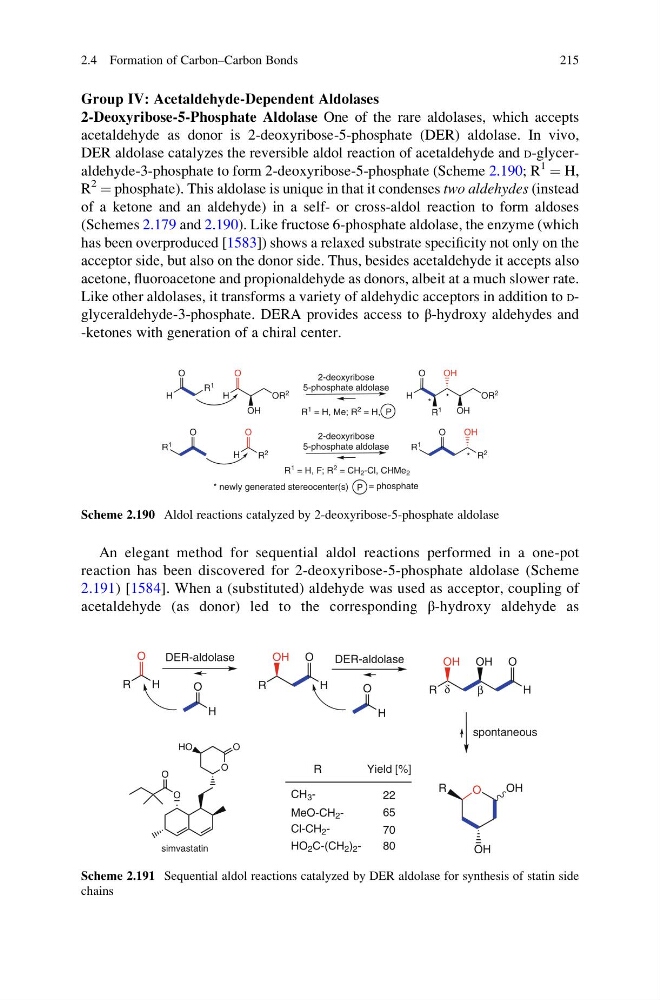
An elegant method for sequential aldol reactions performed in a one-pot
reaction has been discovered for 2-deoxyribose-5-phosphate aldolase (Scheme
2.191) [1584]. When a (substituted) aldehyde was used as acceptor, coupling of
acetaldehyde (as donor) led to the corresponding β-hydroxy aldehyde as
OH
O
H
OH
OR 2
OH
O
H
O R 2
O
R 2
H
O
H
2-deoxyribose
5-phosphate aldolase
= phosphate
* newly generated stereocenter(s)
*
P
P
R
1
R
1
R
1 = H, Me; R
2 = H,
O
R 1
OH
R 1
O
R
2
*
R 1 = H, F; R
2 = CH 2 -Cl, CHMe 2
2-deoxyribose
5-phosphate aldolase
*
Scheme 2.190 Aldol reactions catalyzed by 2-deoxyribose-5-phosphate aldolase
OH
R
O H
O
O
H
O
H
O
H
R
OH O
H
R
OH
H
O
OH
R δ
β
80
70
65
22
HO 2 C-(CH 2 ) 2 -
Yield [%]
spontaneous
DER-aldolase
DER-aldolase
CH 3 -
Cl-CH 2 -
R
MeO-CH 2 -
O
O
O
O
HO
simvastatin
Scheme 2.191 Sequential aldol reactions catalyzed by DER aldolase for synthesis of statin side
chains
2.4 Formation of Carbon–Carbon Bonds
215
2-Deoxyribose-5-Phosphate Aldolase One of the rare aldolases, which accepts
acetaldehyde as donor is 2-deoxyribose-5-phosphate (DER) aldolase. In vivo,
DER aldolase catalyzes the reversible aldol reaction of acetaldehyde and D-glyceraldehyde-3-phosphate to form 2-deoxyribose-5-phosphate (Scheme 2.190; R
1
¼ H,
R
2
¼ phosphate). This aldolase is unique in that it condenses two aldehydes (instead
of a ketone and an aldehyde) in a self- or cross-aldol reaction to form aldoses
(Schemes 2.179 and 2.190). Like fructose 6-phosphate aldolase, the enzyme (which
has been overproduced [1583]) shows a relaxed substrate specificity not only on the
acceptor side, but also on the donor side. Thus, besides acetaldehyde it accepts also
acetone, fluoroacetone and propionaldehyde as donors, albeit at a much slower rate.
Like other aldolases, it transforms a variety of aldehydic acceptors in addition to Dglyceraldehyde-3-phosphate. DERA provides access to β-hydroxy aldehydes and
-ketones with generation of a chiral center.
An elegant method for sequential aldol reactions performed in a one-pot
reaction has been discovered for 2-deoxyribose-5-phosphate aldolase (Scheme
2.191) [1584]. When a (substituted) aldehyde was used as acceptor, coupling of
acetaldehyde (as donor) led to the corresponding β-hydroxy aldehyde as
OH
O
H
OH
OR 2
OH
O
H
O R 2
O
R 2
H
O
H
2-deoxyribose
5-phosphate aldolase
= phosphate
* newly generated stereocenter(s)
*
P
P
R
1
R
1
R
1 = H, Me; R
2 = H,
O
R 1
OH
R 1
O
R
2
*
R 1 = H, F; R
2 = CH 2 -Cl, CHMe 2
2-deoxyribose
5-phosphate aldolase
*
Scheme 2.190 Aldol reactions catalyzed by 2-deoxyribose-5-phosphate aldolase
OH
R
O H
O
O
H
O
H
O
H
R
OH O
H
R
OH
H
O
OH
R δ
β
80
70
65
22
HO 2 C-(CH 2 ) 2 -
Yield [%]
spontaneous
DER-aldolase
DER-aldolase
CH 3 -
Cl-CH 2 -
R
MeO-CH 2 -
O
O
O
O
HO
simvastatin
Scheme 2.191 Sequential aldol reactions catalyzed by DER aldolase for synthesis of statin side
chains
2.4 Formation of Carbon–Carbon Bonds
215