

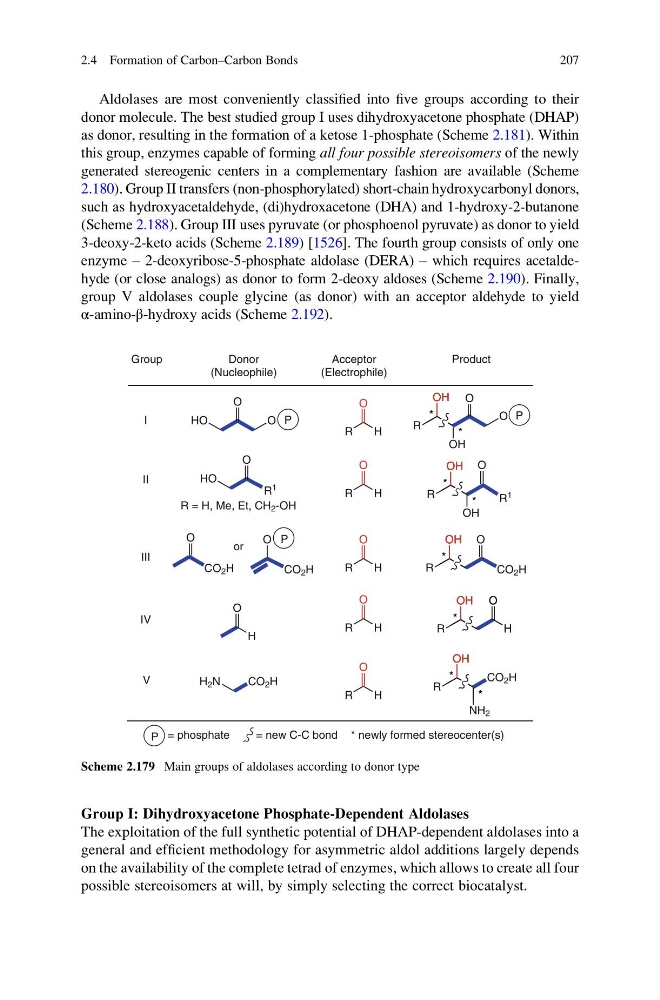
Aldolases are most conveniently classified into five groups according to their
donor molecule. The best studied group I uses dihydroxyacetone phosphate (DHAP)
as donor, resulting in the formation of a ketose 1-phosphate (Scheme 2.181). Within
this group, enzymes capable of forming all four possible stereoisomers of the newly
generated stereogenic centers in a complementary fashion are available (Scheme
2.180). Group II transfers (non-phosphorylated) short-chain hydroxycarbonyl donors,
such as hydroxyacetaldehyde, (di)hydroxacetone (DHA) and 1-hydroxy-2-butanone
(Scheme 2.188). Group III uses pyruvate (or phosphoenol pyruvate) as donor to yield
3-deoxy-2-keto acids (Scheme 2.189) [1526]. The fourth group consists of only one
enzyme – 2-deoxyribose-5-phosphate aldolase (DERA) – which requires acetaldehyde (or close analogs) as donor to form 2-deoxy aldoses (Scheme 2.190). Finally,
group V aldolases couple glycine (as donor) with an acceptor aldehyde to yield
α-amino-β-hydroxy acids (Scheme 2.192).
Group I: Dihydroxyacetone Phosphate-Dependent Aldolases
The exploitation of the full synthetic potential of DHAP-dependent aldolases into a
general and efficient methodology for asymmetric aldol additions largely depends
on the availability of the complete tetrad of enzymes, which allows to create all four
possible stereoisomers at will, by simply selecting the correct biocatalyst.
O
O
HO
OH
O
R
OH O
H
R
OH
CO 2 H
R
OH
NH 2
R
O
CO 2 H
O
H
R
O
H
R
O
H
R
O
H
R
O
CO 2 H
OH
OH
OH O
H
OH O
OH
CO 2 H
O
H
CO 2 H
H 2 N
*
*
*
*
*
*
= phosphate
= new C-C bond
Group
Donor
Acceptor
Product
(Nucleophile)
(Electrophile)
or
*
*
*
*
*
* newly formed stereocenter(s)
P
P
I
III
IV
V
P
P
II
O
R
1
HO
O
H
R
R = H, Me, Et, CH 2 -OH
OH
R 1
R
OH
OH
*
*
*
*
O
O
Scheme 2.179 Main groups of aldolases according to donor type
2.4 Formation of Carbon–Carbon Bonds
207
donor molecule. The best studied group I uses dihydroxyacetone phosphate (DHAP)
as donor, resulting in the formation of a ketose 1-phosphate (Scheme 2.181). Within
this group, enzymes capable of forming all four possible stereoisomers of the newly
generated stereogenic centers in a complementary fashion are available (Scheme
2.180). Group II transfers (non-phosphorylated) short-chain hydroxycarbonyl donors,
such as hydroxyacetaldehyde, (di)hydroxacetone (DHA) and 1-hydroxy-2-butanone
(Scheme 2.188). Group III uses pyruvate (or phosphoenol pyruvate) as donor to yield
3-deoxy-2-keto acids (Scheme 2.189) [1526]. The fourth group consists of only one
enzyme – 2-deoxyribose-5-phosphate aldolase (DERA) – which requires acetaldehyde (or close analogs) as donor to form 2-deoxy aldoses (Scheme 2.190). Finally,
group V aldolases couple glycine (as donor) with an acceptor aldehyde to yield
α-amino-β-hydroxy acids (Scheme 2.192).
Group I: Dihydroxyacetone Phosphate-Dependent Aldolases
The exploitation of the full synthetic potential of DHAP-dependent aldolases into a
general and efficient methodology for asymmetric aldol additions largely depends
on the availability of the complete tetrad of enzymes, which allows to create all four
possible stereoisomers at will, by simply selecting the correct biocatalyst.
O
O
HO
OH
O
R
OH O
H
R
OH
CO 2 H
R
OH
NH 2
R
O
CO 2 H
O
H
R
O
H
R
O
H
R
O
H
R
O
CO 2 H
OH
OH
OH O
H
OH O
OH
CO 2 H
O
H
CO 2 H
H 2 N
*
*
*
*
*
*
= phosphate
= new C-C bond
Group
Donor
Acceptor
Product
(Nucleophile)
(Electrophile)
or
*
*
*
*
*
* newly formed stereocenter(s)
P
P
I
III
IV
V
P
P
II
O
R
1
HO
O
H
R
R = H, Me, Et, CH 2 -OH
OH
R 1
R
OH
OH
*
*
*
*
O
O
Scheme 2.179 Main groups of aldolases according to donor type
2.4 Formation of Carbon–Carbon Bonds
207