

the two new chiral centers are formed stereospecifically in a threo- or erythroconfiguration depending on the enzyme. Finally, hydrolysis of the Schiff base
liberates the aldol product and regenerates the enzyme.
Type II aldolases are found predominantly in bacteria and fungi, and are Zn
2+ -
dependent enzymes
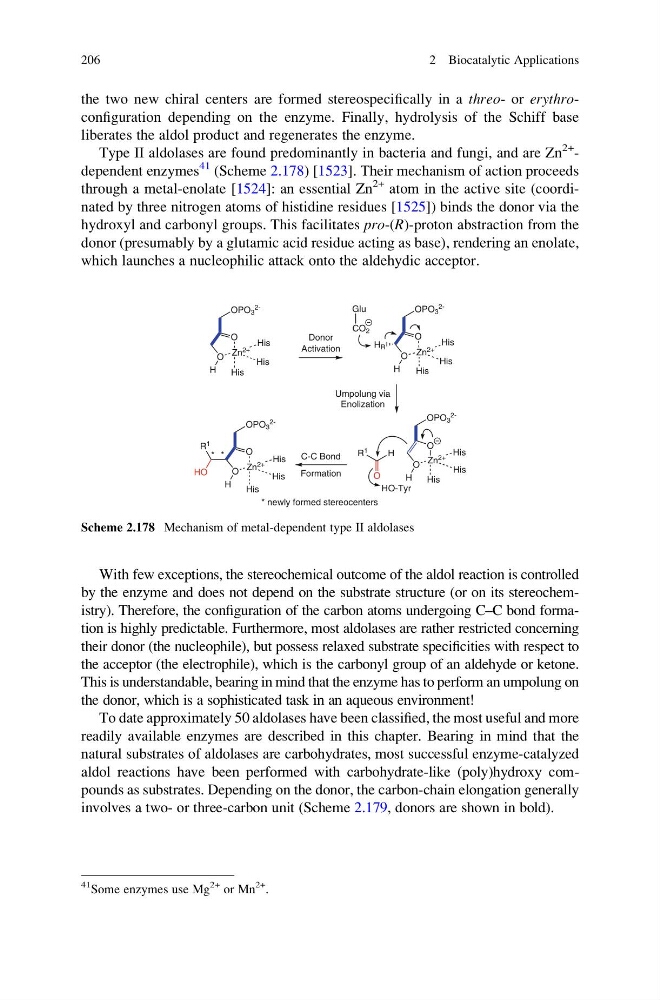
41 (Scheme 2.178) [1523]. Their mechanism of action proceeds
through a metal-enolate [1524]: an essential Zn
2+ atom in the active site (coordinated by three nitrogen atoms of histidine residues [1525]) binds the donor via the
hydroxyl and carbonyl groups. This facilitates pro-(R)-proton abstraction from the
donor (presumably by a glutamic acid residue acting as base), rendering an enolate,
which launches a nucleophilic attack onto the aldehydic acceptor.
With few exceptions, the stereochemical outcome of the aldol reaction is controlled
by the enzyme and does not depend on the substrate structure (or on its stereochemistry). Therefore, the configuration of the carbon atoms undergoing C–C bond formation is highly predictable. Furthermore, most aldolases are rather restricted concerning
their donor (the nucleophile), but possess relaxed substrate specificities with respect to
the acceptor (the electrophile), which is the carbonyl group of an aldehyde or ketone.
This is understandable, bearing in mind that the enzyme has to perform an umpolung on
the donor, which is a sophisticated task in an aqueous environment!
To date approximately 50 aldolases have been classified, the most useful and more
readily available enzymes are described in this chapter. Bearing in mind that the
natural substrates of aldolases are carbohydrates, most successful enzyme-catalyzed
aldol reactions have been performed with carbohydrate-like (poly)hydroxy compounds as substrates. Depending on the donor, the carbon-chain elongation generally
involves a two- or three-carbon unit (Scheme 2.179, donors are shown in bold).
H
R 1
O
H
OPO 3
2His
His
His
O
O
Zn
2+
H
OPO 3
2His
His
His
O
O
Zn 2+
CO 2
Glu
H R
H
OPO 3
2His
His
His
O
O
Zn 2+
R
1
HO
H
OPO 3
2His
His
His
O
O
Zn
2+
*
*
Donor
Formation
C-C Bond
Umpolung via
Enolization
Activation
* newly formed stereocenters
HO-Tyr
Scheme 2.178 Mechanism of metal-dependent type II aldolases
41 Some enzymes use Mg
2+ or Mn
2+ .
206
2 Biocatalytic Applications
liberates the aldol product and regenerates the enzyme.
Type II aldolases are found predominantly in bacteria and fungi, and are Zn
2+ -
dependent enzymes
41 (Scheme 2.178) [1523]. Their mechanism of action proceeds
through a metal-enolate [1524]: an essential Zn
2+ atom in the active site (coordinated by three nitrogen atoms of histidine residues [1525]) binds the donor via the
hydroxyl and carbonyl groups. This facilitates pro-(R)-proton abstraction from the
donor (presumably by a glutamic acid residue acting as base), rendering an enolate,
which launches a nucleophilic attack onto the aldehydic acceptor.
With few exceptions, the stereochemical outcome of the aldol reaction is controlled
by the enzyme and does not depend on the substrate structure (or on its stereochemistry). Therefore, the configuration of the carbon atoms undergoing C–C bond formation is highly predictable. Furthermore, most aldolases are rather restricted concerning
their donor (the nucleophile), but possess relaxed substrate specificities with respect to
the acceptor (the electrophile), which is the carbonyl group of an aldehyde or ketone.
This is understandable, bearing in mind that the enzyme has to perform an umpolung on
the donor, which is a sophisticated task in an aqueous environment!
To date approximately 50 aldolases have been classified, the most useful and more
readily available enzymes are described in this chapter. Bearing in mind that the
natural substrates of aldolases are carbohydrates, most successful enzyme-catalyzed
aldol reactions have been performed with carbohydrate-like (poly)hydroxy compounds as substrates. Depending on the donor, the carbon-chain elongation generally
involves a two- or three-carbon unit (Scheme 2.179, donors are shown in bold).
H
R 1
O
H
OPO 3
2His
His
His
O
O
Zn
2+
H
OPO 3
2His
His
His
O
O
Zn 2+
CO 2
Glu
H R
H
OPO 3
2His
His
His
O
O
Zn 2+
R
1
HO
H
OPO 3
2His
His
His
O
O
Zn
2+
*
*
Donor
Formation
C-C Bond
Umpolung via
Enolization
Activation
* newly formed stereocenters
HO-Tyr
Scheme 2.178 Mechanism of metal-dependent type II aldolases
41 Some enzymes use Mg
2+ or Mn
2+ .
206
2 Biocatalytic Applications