

successful nonbiological strategies have been developed [1496, 1497], most of
them are not without drawbacks. They are often stoichiometric in auxiliary reagent
and require the use of a chiral metal or organocatalytic enolate complex to achieve
stereoselectivity [1498–1501]. Due to the instability of such complexes in aqueous
solutions, aldol reactions usually must be carried out in organic solvents at low
temperature. Thus, for compounds containing polar functional groups, the employment of conventional aldol reactions requires extensive protection protocols in
order to make them lipophilic and to avoid undesired cross-reactions, which limits
the application of conventional aldol reactions in aqueous solution. On the other
hand, enzymatic aldol reactions catalyzed by aldolases, which are performed in
aqueous solution at neutral pH, can be achieved without extensive protection
methodology and have therefore attracted increasing interest [1502–1519].
Aldolases were first recognized some 70 years ago. At that time, it was believed
that they form an ubiquitous class of enzymes that catalyze a key step in glycolysis
by interconversion of hexoses into two three-carbon subunits [1520]. It is now
known that aldolases operate on a wide range of substrates including carbohydrates,
amino acids and hydroxy acids. A variety of enzymes has been described that add a
two- or three-carbon (donor) fragment onto a carbonyl group of an aldehyde or a
ketone with high stereospecificity. Since glycolysis and glyconeogenesis are a
fundamental pillar of life, almost all organisms possess aldolase enzymes.
Two distinct groups of aldolases, acting via different mechanisms during formation
of the (donor) carbanion, have been recognized [1521]. Both of the mechanisms are
closely related to conventional aldol reactions, i.e., carbanion formation (umpolung) is
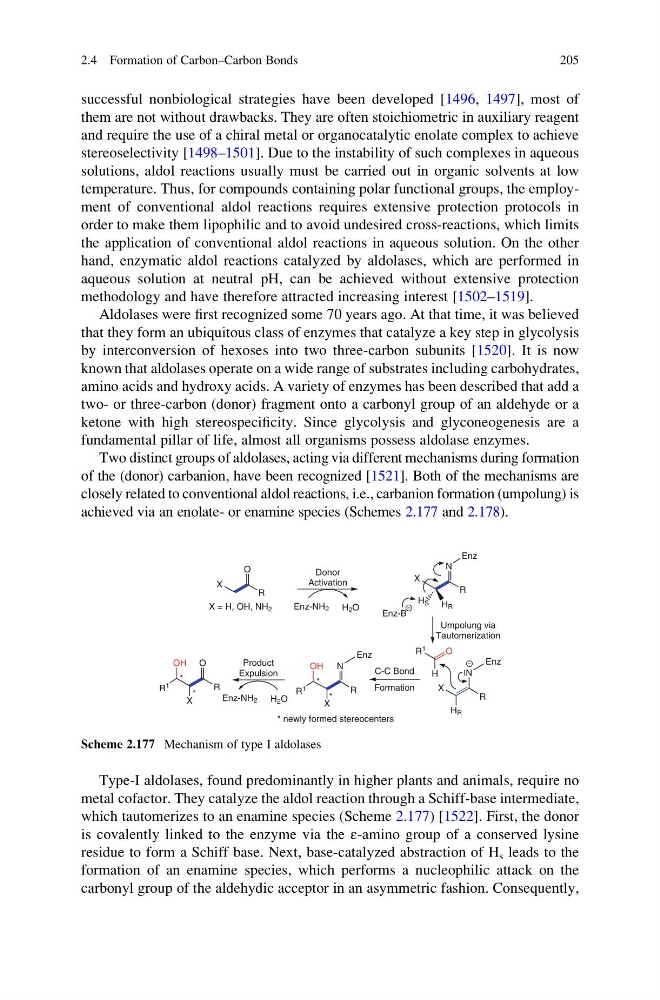
achieved via an enolate- or enamine species (Schemes 2.177 and 2.178).
Type-I aldolases, found predominantly in higher plants and animals, require no
metal cofactor. They catalyze the aldol reaction through a Schiff-base intermediate,
which tautomerizes to an enamine species (Scheme 2.177) [1522]. First, the donor
is covalently linked to the enzyme via the ε-amino group of a conserved lysine
residue to form a Schiff base. Next, base-catalyzed abstraction of H s leads to the
formation of an enamine species, which performs a nucleophilic attack on the
carbonyl group of the aldehydic acceptor in an asymmetric fashion. Consequently,
O
R
X
H R
Enz
N
R
X
R
1
O
H
OH
X
Enz
N
R 1
R
O
OH
X
R 1
R
H S H R
Enz
N
R
X
Product
Expulsion
Donor
Activation
Formation
C-C Bond
Umpolung via
Tautomerization
Enz-NH 2
X = H, OH, NH 2
* newly formed stereocenters
*
*
Enz-B
H 2 O
*
*
Enz-NH 2 H 2 O
Scheme 2.177 Mechanism of type I aldolases
2.4 Formation of Carbon–Carbon Bonds
205
them are not without drawbacks. They are often stoichiometric in auxiliary reagent
and require the use of a chiral metal or organocatalytic enolate complex to achieve
stereoselectivity [1498–1501]. Due to the instability of such complexes in aqueous
solutions, aldol reactions usually must be carried out in organic solvents at low
temperature. Thus, for compounds containing polar functional groups, the employment of conventional aldol reactions requires extensive protection protocols in
order to make them lipophilic and to avoid undesired cross-reactions, which limits
the application of conventional aldol reactions in aqueous solution. On the other
hand, enzymatic aldol reactions catalyzed by aldolases, which are performed in
aqueous solution at neutral pH, can be achieved without extensive protection
methodology and have therefore attracted increasing interest [1502–1519].
Aldolases were first recognized some 70 years ago. At that time, it was believed
that they form an ubiquitous class of enzymes that catalyze a key step in glycolysis
by interconversion of hexoses into two three-carbon subunits [1520]. It is now
known that aldolases operate on a wide range of substrates including carbohydrates,
amino acids and hydroxy acids. A variety of enzymes has been described that add a
two- or three-carbon (donor) fragment onto a carbonyl group of an aldehyde or a
ketone with high stereospecificity. Since glycolysis and glyconeogenesis are a
fundamental pillar of life, almost all organisms possess aldolase enzymes.
Two distinct groups of aldolases, acting via different mechanisms during formation
of the (donor) carbanion, have been recognized [1521]. Both of the mechanisms are
closely related to conventional aldol reactions, i.e., carbanion formation (umpolung) is
achieved via an enolate- or enamine species (Schemes 2.177 and 2.178).
Type-I aldolases, found predominantly in higher plants and animals, require no
metal cofactor. They catalyze the aldol reaction through a Schiff-base intermediate,
which tautomerizes to an enamine species (Scheme 2.177) [1522]. First, the donor
is covalently linked to the enzyme via the ε-amino group of a conserved lysine
residue to form a Schiff base. Next, base-catalyzed abstraction of H s leads to the
formation of an enamine species, which performs a nucleophilic attack on the
carbonyl group of the aldehydic acceptor in an asymmetric fashion. Consequently,
O
R
X
H R
Enz
N
R
X
R
1
O
H
OH
X
Enz
N
R 1
R
O
OH
X
R 1
R
H S H R
Enz
N
R
X
Product
Expulsion
Donor
Activation
Formation
C-C Bond
Umpolung via
Tautomerization
Enz-NH 2
X = H, OH, NH 2
* newly formed stereocenters
*
*
Enz-B
H 2 O
*
*
Enz-NH 2 H 2 O
Scheme 2.177 Mechanism of type I aldolases
2.4 Formation of Carbon–Carbon Bonds
205