

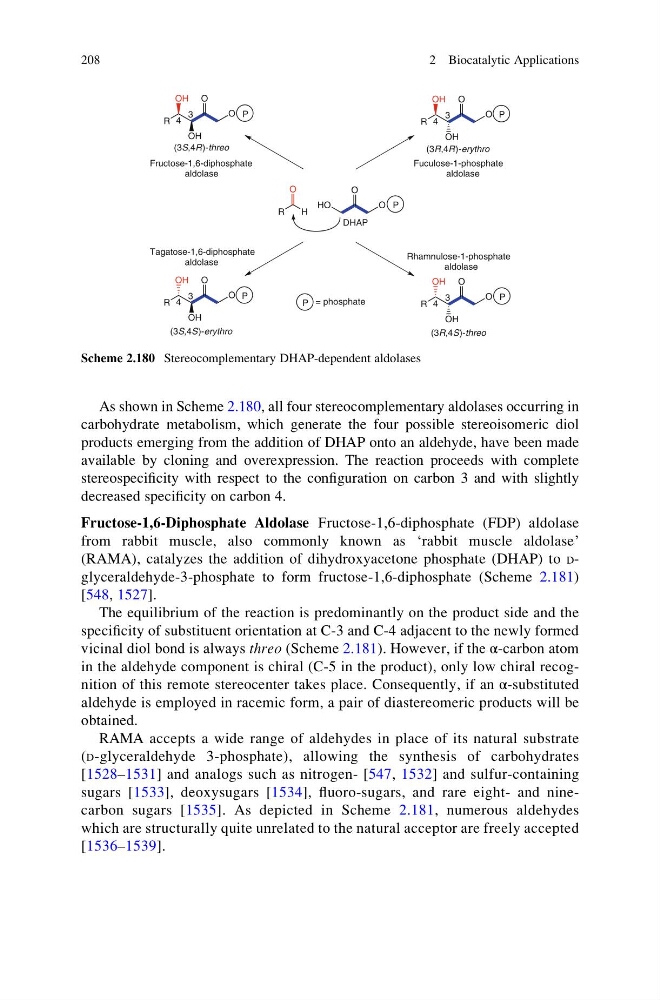
As shown in Scheme 2.180, all four stereocomplementary aldolases occurring in
carbohydrate metabolism, which generate the four possible stereoisomeric diol
products emerging from the addition of DHAP onto an aldehyde, have been made
available by cloning and overexpression. The reaction proceeds with complete
stereospecificity with respect to the configuration on carbon 3 and with slightly
decreased specificity on carbon 4.
Fructose-1,6-Diphosphate Aldolase Fructose-1,6-diphosphate (FDP) aldolase
from rabbit muscle, also commonly known as ‘rabbit muscle aldolase’
(RAMA), catalyzes the addition of dihydroxyacetone phosphate (DHAP) to Dglyceraldehyde-3-phosphate to form fructose-1,6-diphosphate (Scheme 2.181)
[548, 1527].
The equilibrium of the reaction is predominantly on the product side and the
specificity of substituent orientation at C-3 and C-4 adjacent to the newly formed
vicinal diol bond is always threo (Scheme 2.181). However, if the α-carbon atom
in the aldehyde component is chiral (C-5 in the product), only low chiral recognition of this remote stereocenter takes place. Consequently, if an α-substituted
aldehyde is employed in racemic form, a pair of diastereomeric products will be
obtained.
RAMA accepts a wide range of aldehydes in place of its natural substrate
(D-glyceraldehyde 3-phosphate), allowing the synthesis of carbohydrates
[1528–1531] and analogs such as nitrogen- [547, 1532] and sulfur-containing
sugars [1533], deoxysugars [1534], fluoro-sugars, and rare eight- and ninecarbon sugars [1535]. As depicted in Scheme 2.181, numerous aldehydes
which are structurally quite unrelated to the natural acceptor are freely accepted
[1536–1539].
O
H
R
O
O
HO
OH
OH O
O
R
OH
OH O
O
R
OH
OH O
O
R
OH
OH O
O
R
Tagatose-1,6-diphosphate
aldolase
Rhamnulose-1-phosphate
aldolase
Fuculose-1-phosphate
aldolase
Fructose-1,6-diphosphate
aldolase
(3R,4S)-threo
(3S,4S)-erythro
(3R,4R)-erythro
(3S,4R)-threo
DHAP
3
4
3
4
3
4
3
4
= phosphate
P
P
P
P
P
P
Scheme 2.180 Stereocomplementary DHAP-dependent aldolases
208
2 Biocatalytic Applications
carbohydrate metabolism, which generate the four possible stereoisomeric diol
products emerging from the addition of DHAP onto an aldehyde, have been made
available by cloning and overexpression. The reaction proceeds with complete
stereospecificity with respect to the configuration on carbon 3 and with slightly
decreased specificity on carbon 4.
Fructose-1,6-Diphosphate Aldolase Fructose-1,6-diphosphate (FDP) aldolase
from rabbit muscle, also commonly known as ‘rabbit muscle aldolase’
(RAMA), catalyzes the addition of dihydroxyacetone phosphate (DHAP) to Dglyceraldehyde-3-phosphate to form fructose-1,6-diphosphate (Scheme 2.181)
[548, 1527].
The equilibrium of the reaction is predominantly on the product side and the
specificity of substituent orientation at C-3 and C-4 adjacent to the newly formed
vicinal diol bond is always threo (Scheme 2.181). However, if the α-carbon atom
in the aldehyde component is chiral (C-5 in the product), only low chiral recognition of this remote stereocenter takes place. Consequently, if an α-substituted
aldehyde is employed in racemic form, a pair of diastereomeric products will be
obtained.
RAMA accepts a wide range of aldehydes in place of its natural substrate
(D-glyceraldehyde 3-phosphate), allowing the synthesis of carbohydrates
[1528–1531] and analogs such as nitrogen- [547, 1532] and sulfur-containing
sugars [1533], deoxysugars [1534], fluoro-sugars, and rare eight- and ninecarbon sugars [1535]. As depicted in Scheme 2.181, numerous aldehydes
which are structurally quite unrelated to the natural acceptor are freely accepted
[1536–1539].
O
H
R
O
O
HO
OH
OH O
O
R
OH
OH O
O
R
OH
OH O
O
R
OH
OH O
O
R
Tagatose-1,6-diphosphate
aldolase
Rhamnulose-1-phosphate
aldolase
Fuculose-1-phosphate
aldolase
Fructose-1,6-diphosphate
aldolase
(3R,4S)-threo
(3S,4S)-erythro
(3R,4R)-erythro
(3S,4R)-threo
DHAP
3
4
3
4
3
4
3
4
= phosphate
P
P
P
P
P
P
Scheme 2.180 Stereocomplementary DHAP-dependent aldolases
208
2 Biocatalytic Applications