

2.3.3.4 Sulfoxidation Reactions
Chiral sulfoxides are not only common pharmacophores in active pharmaceutical
ingredients, but they have also been extensively employed as asymmetric auxiliary
group that assist stereoselective reactions. The sulfoxide functional group activates
adjacent carbon–hydrogen bonds to allow proton abstraction by bases, and the
corresponding anions can be alkylated [1321] or acylated [1322] with high
diastereoselectivity. Similarly, thermal elimination [1323] and reduction of
α-keto sulfoxides [1324] can proceed with transfer of chirality from sulfur to
carbon. In spite of this great potential as valuable chiral relay reagents, with rare
exceptions [1325], no general method is available for the synthesis of sulfoxides
possessing high enantiomeric purities.
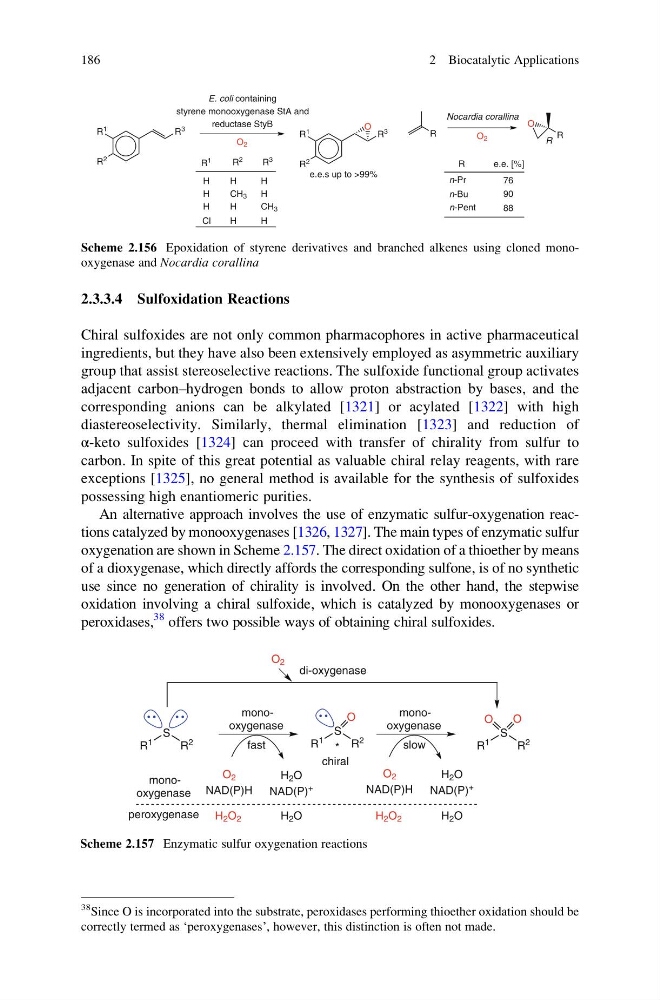
An alternative approach involves the use of enzymatic sulfur-oxygenation reactions catalyzed by monooxygenases [1326, 1327]. The main types of enzymatic sulfur
oxygenation are shown in Scheme 2.157. The direct oxidation of a thioether by means
of a dioxygenase, which directly affords the corresponding sulfone, is of no synthetic
use since no generation of chirality is involved. On the other hand, the stepwise
oxidation involving a chiral sulfoxide, which is catalyzed by monooxygenases or
peroxidases,
38 offers two possible ways of obtaining chiral sulfoxides.
R
O
R
R
2
R 3
R 1
R
1
O
R
2
R
3
Nocardia corallina
e.e.s up to >99%
e.e. [%]
76
90
88
n-Pent
E. coli containing
styrene monooxygenase StA and
reductase StyB
R
O 2
O 2
R
1
R 2
R 3
H
H
H
H
C H 3
H
H
H
C H 3
Cl
H
H
R
n-Pr
n-Bu
Scheme 2.156 Epoxidation of styrene derivatives and branched alkenes using cloned monooxygenase and Nocardia corallina
O
R
2
S
R 1
O
O
R 2
S
R 1
R 2
S
R 1
di-oxygenase
chiral
monooxygenase
NAD(P)H
NAD(P)
+
monooxygenase
NAD(P)H NAD(P) +
monooxygenase
peroxygenase
*
O 2
O 2
H 2 O
H 2 O 2
H 2 O
O 2
H 2 O
H 2 O 2
H 2 O
fast
slow
Scheme 2.157 Enzymatic sulfur oxygenation reactions
38 Since O is incorporated into the substrate, peroxidases performing thioether oxidation should be
correctly termed as ‘peroxygenases’, however, this distinction is often not made.
186
2 Biocatalytic Applications
Chiral sulfoxides are not only common pharmacophores in active pharmaceutical
ingredients, but they have also been extensively employed as asymmetric auxiliary
group that assist stereoselective reactions. The sulfoxide functional group activates
adjacent carbon–hydrogen bonds to allow proton abstraction by bases, and the
corresponding anions can be alkylated [1321] or acylated [1322] with high
diastereoselectivity. Similarly, thermal elimination [1323] and reduction of
α-keto sulfoxides [1324] can proceed with transfer of chirality from sulfur to
carbon. In spite of this great potential as valuable chiral relay reagents, with rare
exceptions [1325], no general method is available for the synthesis of sulfoxides
possessing high enantiomeric purities.
An alternative approach involves the use of enzymatic sulfur-oxygenation reactions catalyzed by monooxygenases [1326, 1327]. The main types of enzymatic sulfur
oxygenation are shown in Scheme 2.157. The direct oxidation of a thioether by means
of a dioxygenase, which directly affords the corresponding sulfone, is of no synthetic
use since no generation of chirality is involved. On the other hand, the stepwise
oxidation involving a chiral sulfoxide, which is catalyzed by monooxygenases or
peroxidases,
38 offers two possible ways of obtaining chiral sulfoxides.
R
O
R
R
2
R 3
R 1
R
1
O
R
2
R
3
Nocardia corallina
e.e.s up to >99%
e.e. [%]
76
90
88
n-Pent
E. coli containing
styrene monooxygenase StA and
reductase StyB
R
O 2
O 2
R
1
R 2
R 3
H
H
H
H
C H 3
H
H
H
C H 3
Cl
H
H
R
n-Pr
n-Bu
Scheme 2.156 Epoxidation of styrene derivatives and branched alkenes using cloned monooxygenase and Nocardia corallina
O
R
2
S
R 1
O
O
R 2
S
R 1
R 2
S
R 1
di-oxygenase
chiral
monooxygenase
NAD(P)H
NAD(P)
+
monooxygenase
NAD(P)H NAD(P) +
monooxygenase
peroxygenase
*
O 2
O 2
H 2 O
H 2 O 2
H 2 O
O 2
H 2 O
H 2 O 2
H 2 O
fast
slow
Scheme 2.157 Enzymatic sulfur oxygenation reactions
38 Since O is incorporated into the substrate, peroxidases performing thioether oxidation should be
correctly termed as ‘peroxygenases’, however, this distinction is often not made.
186
2 Biocatalytic Applications