

• The asymmetric monooxidation of a thioether leading to a chiral sulfoxide
resembles a desymmetrization of a prochiral substrate and is therefore of high
synthetic value.
• The kinetic resolution of a racemic sulfoxide during which one enantiomer is
oxidized to yield an achiral sulfone is feasible but it has been shown to proceed
with low selectivities.
The first asymmetric sulfur oxygenation using cells of Aspergillus niger was
reported in the early 1960s [1328]. Since this time it was shown that the enantiomeric excess and the absolute configuration of the sulfoxide not only depend on the
species but also on the strain of microorganism used [1329]. In general, the
formation of (R)-sulfoxides predominates.
Thioethers can be asymmetrically oxidized both by bacteria (e.g., Corynebacterium equi [1330], Rhodococcus equi [1331]) and fungi (e.g., Helminthosporium
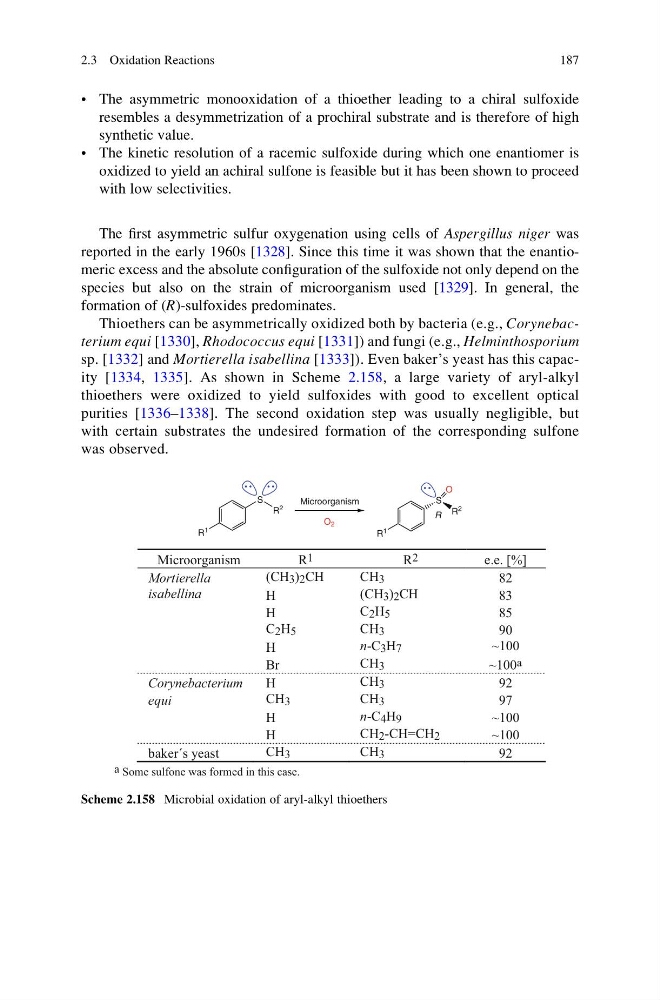
sp. [1332] and Mortierella isabellina [1333]). Even baker’s yeast has this capacity [1334, 1335]. As shown in Scheme 2.158, a large variety of aryl-alkyl
thioethers were oxidized to yield sulfoxides with good to excellent optical
purities [1336–1338]. The second oxidation step was usually negligible, but
with certain substrates the undesired formation of the corresponding sulfone
was observed.
R 1
S
R
2
R
1
S
R
2
O
Microorganism
O 2
R
Microorganism
R 1
R 2
e.e. [%]
Mortierella
(CH 3 ) 2 CH
CH 3
82
isabellina
H
(CH 3 ) 2 CH
83
H
C 2 H 5
85
C 2 H 5
CH 3
90
H
n-C 3 H 7
~100
Br
CH 3
~100 a
Corynebacterium
H
CH 3
92
equi
CH 3
CH 3
97
H
n-C 4 H 9
~100
H
CH 2 -CH=CH 2
~100
baker´s yeast
CH 3
CH 3
92
a Some sulfone was formed in this case.
Scheme 2.158 Microbial oxidation of aryl-alkyl thioethers
2.3 Oxidation Reactions
187
resembles a desymmetrization of a prochiral substrate and is therefore of high
synthetic value.
• The kinetic resolution of a racemic sulfoxide during which one enantiomer is
oxidized to yield an achiral sulfone is feasible but it has been shown to proceed
with low selectivities.
The first asymmetric sulfur oxygenation using cells of Aspergillus niger was
reported in the early 1960s [1328]. Since this time it was shown that the enantiomeric excess and the absolute configuration of the sulfoxide not only depend on the
species but also on the strain of microorganism used [1329]. In general, the
formation of (R)-sulfoxides predominates.
Thioethers can be asymmetrically oxidized both by bacteria (e.g., Corynebacterium equi [1330], Rhodococcus equi [1331]) and fungi (e.g., Helminthosporium
sp. [1332] and Mortierella isabellina [1333]). Even baker’s yeast has this capacity [1334, 1335]. As shown in Scheme 2.158, a large variety of aryl-alkyl
thioethers were oxidized to yield sulfoxides with good to excellent optical
purities [1336–1338]. The second oxidation step was usually negligible, but
with certain substrates the undesired formation of the corresponding sulfone
was observed.
R 1
S
R
2
R
1
S
R
2
O
Microorganism
O 2
R
Microorganism
R 1
R 2
e.e. [%]
Mortierella
(CH 3 ) 2 CH
CH 3
82
isabellina
H
(CH 3 ) 2 CH
83
H
C 2 H 5
85
C 2 H 5
CH 3
90
H
n-C 3 H 7
~100
Br
CH 3
~100 a
Corynebacterium
H
CH 3
92
equi
CH 3
CH 3
97
H
n-C 4 H 9
~100
H
CH 2 -CH=CH 2
~100
baker´s yeast
CH 3
CH 3
92
a Some sulfone was formed in this case.
Scheme 2.158 Microbial oxidation of aryl-alkyl thioethers
2.3 Oxidation Reactions
187