

• Cyclic, branched and internal olefins, aromatic compounds and alkene units
which are conjugated to an aromatic system are not epoxidized [1308].
• To avoid problems arising from the toxicity of the epoxide [1309] a waterimmiscible organic cosolvent such as hexane can be added [1310, 1311].
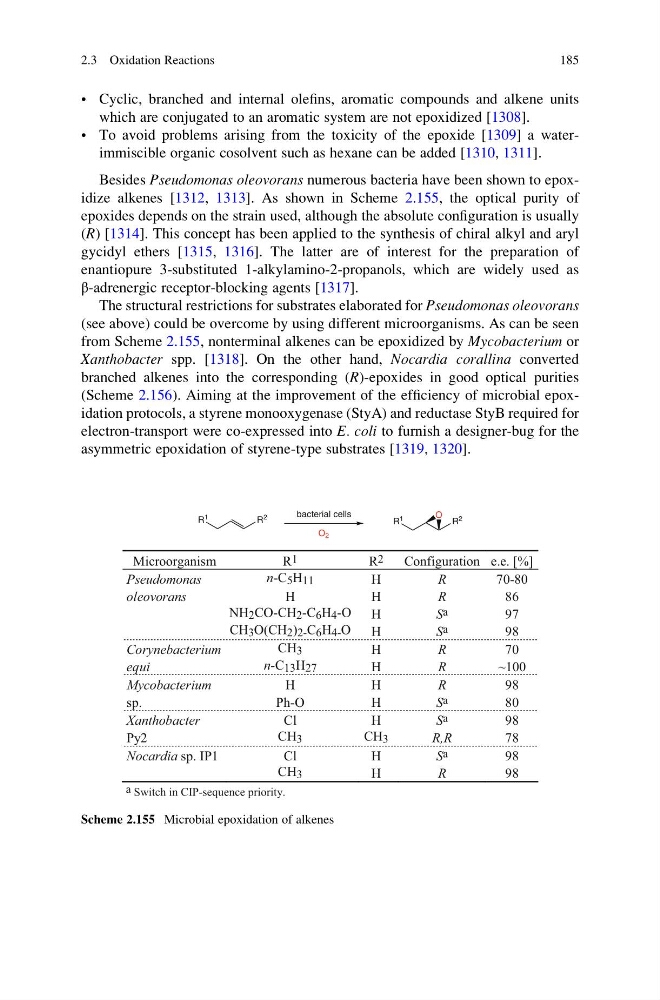
Besides Pseudomonas oleovorans numerous bacteria have been shown to epoxidize alkenes [1312, 1313]. As shown in Scheme 2.155, the optical purity of
epoxides depends on the strain used, although the absolute configuration is usually
(R) [1314]. This concept has been applied to the synthesis of chiral alkyl and aryl
gycidyl ethers [1315, 1316]. The latter are of interest for the preparation of
enantiopure 3-substituted 1-alkylamino-2-propanols, which are widely used as
β-adrenergic receptor-blocking agents [1317].
The structural restrictions for substrates elaborated for Pseudomonas oleovorans
(see above) could be overcome by using different microorganisms. As can be seen
from Scheme 2.155, nonterminal alkenes can be epoxidized by Mycobacterium or
Xanthobacter spp. [1318]. On the other hand, Nocardia corallina converted
branched alkenes into the corresponding (R)-epoxides in good optical purities
(Scheme 2.156). Aiming at the improvement of the efficiency of microbial epoxidation protocols, a styrene monooxygenase (StyA) and reductase StyB required for
electron-transport were co-expressed into E. coli to furnish a designer-bug for the
asymmetric epoxidation of styrene-type substrates [1319, 1320].
O R
2
R
1
R
2
R
1
bacterial cells
O 2
Microorganism
R 1
R 2
Configuration e.e. [%]
Pseudomonas
n-C 5 H 11
H
R
70-80
oleovorans
H
H
R
86
NH 2 CO-CH 2 -C 6 H 4 -O H
S a
97
CH 3 O(CH 2 ) 2- C 6 H 4- O
H
S a
98
Corynebacterium
CH 3
H
R
70
equi
n-C 13 H 27
H
R
~100
Mycobacterium
H
H
R
98
sp.
Ph-O
H
S a
80
Xanthobacter
Cl
H
S a
98
Py2
CH 3
CH 3
R,R
78
Nocardia sp. IP1
Cl
H
S a
98
CH 3
H
R
98
a Switch in CIP-sequence priority.
Scheme 2.155 Microbial epoxidation of alkenes
2.3 Oxidation Reactions
185
which are conjugated to an aromatic system are not epoxidized [1308].
• To avoid problems arising from the toxicity of the epoxide [1309] a waterimmiscible organic cosolvent such as hexane can be added [1310, 1311].
Besides Pseudomonas oleovorans numerous bacteria have been shown to epoxidize alkenes [1312, 1313]. As shown in Scheme 2.155, the optical purity of
epoxides depends on the strain used, although the absolute configuration is usually
(R) [1314]. This concept has been applied to the synthesis of chiral alkyl and aryl
gycidyl ethers [1315, 1316]. The latter are of interest for the preparation of
enantiopure 3-substituted 1-alkylamino-2-propanols, which are widely used as
β-adrenergic receptor-blocking agents [1317].
The structural restrictions for substrates elaborated for Pseudomonas oleovorans
(see above) could be overcome by using different microorganisms. As can be seen
from Scheme 2.155, nonterminal alkenes can be epoxidized by Mycobacterium or
Xanthobacter spp. [1318]. On the other hand, Nocardia corallina converted
branched alkenes into the corresponding (R)-epoxides in good optical purities
(Scheme 2.156). Aiming at the improvement of the efficiency of microbial epoxidation protocols, a styrene monooxygenase (StyA) and reductase StyB required for
electron-transport were co-expressed into E. coli to furnish a designer-bug for the
asymmetric epoxidation of styrene-type substrates [1319, 1320].
O R
2
R
1
R
2
R
1
bacterial cells
O 2
Microorganism
R 1
R 2
Configuration e.e. [%]
Pseudomonas
n-C 5 H 11
H
R
70-80
oleovorans
H
H
R
86
NH 2 CO-CH 2 -C 6 H 4 -O H
S a
97
CH 3 O(CH 2 ) 2- C 6 H 4- O
H
S a
98
Corynebacterium
CH 3
H
R
70
equi
n-C 13 H 27
H
R
~100
Mycobacterium
H
H
R
98
sp.
Ph-O
H
S a
80
Xanthobacter
Cl
H
S a
98
Py2
CH 3
CH 3
R,R
78
Nocardia sp. IP1
Cl
H
S a
98
CH 3
H
R
98
a Switch in CIP-sequence priority.
Scheme 2.155 Microbial epoxidation of alkenes
2.3 Oxidation Reactions
185