

2.3.3.2 Hydroxylation of Aromatic Compounds
Regiospecific hydroxylation of aromatic compounds by purely chemical methods is
notoriously difficult. There are reagents for o- and p-hydroxylation available
[1270, 1271], but some of them are explosive and byproducts are usually obtained
[1272]. The selective bio-hydroxylation of aromatics in the o- and p-position to
existing substituents can be achieved by using monooxygenases. In contrast, mhydroxylation is rarely observed for electronic reasons [1273]. Mechanistically, it
has been proposed that in eukaryotic cells (fungi, yeasts and higher organisms) the
reaction proceeds predominantly via epoxidation of the aromatic species which
leads to an unstable arene-oxide (Scheme 2.83) [1274]. Rearrangement of the latter
involving the migration of a hydride anion (NIH-shift) forms the phenolic
product [1275].
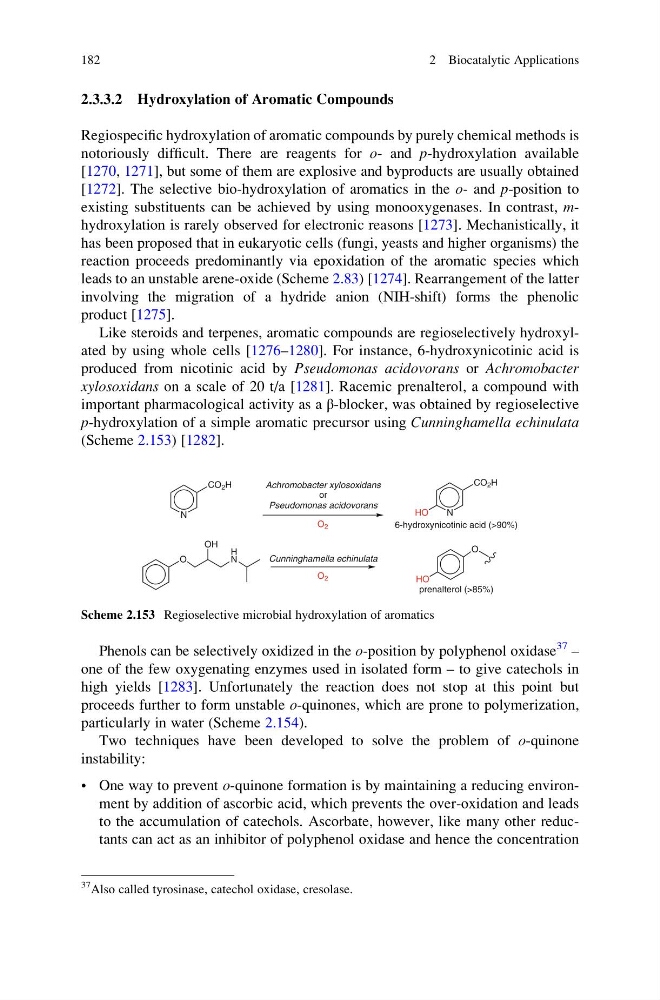
Like steroids and terpenes, aromatic compounds are regioselectively hydroxylated by using whole cells [1276–1280]. For instance, 6-hydroxynicotinic acid is
produced from nicotinic acid by Pseudomonas acidovorans or Achromobacter
xylosoxidans on a scale of 20 t/a [1281]. Racemic prenalterol, a compound with
important pharmacological activity as a β-blocker, was obtained by regioselective
p-hydroxylation of a simple aromatic precursor using Cunninghamella echinulata
(Scheme 2.153) [1282].
Phenols can be selectively oxidized in the o-position by polyphenol oxidase
37 –
one of the few oxygenating enzymes used in isolated form – to give catechols in
high yields [1283]. Unfortunately the reaction does not stop at this point but
proceeds further to form unstable o-quinones, which are prone to polymerization,
particularly in water (Scheme 2.154).
Two techniques have been developed to solve the problem of o-quinone
instability:
• One way to prevent o-quinone formation is by maintaining a reducing environment by addition of ascorbic acid, which prevents the over-oxidation and leads
to the accumulation of catechols. Ascorbate, however, like many other reductants can act as an inhibitor of polyphenol oxidase and hence the concentration
CO 2 H
N
HO
CO 2 H
N
HO
O
OH
O
H
N
Achromobacter xylosoxidans
or
prenalterol (>85%)
Cunninghamella echinulata
Pseudomonas acidovorans
6-hydroxynicotinic acid (>90%)
O 2
O 2
Scheme 2.153 Regioselective microbial hydroxylation of aromatics
37 Also called tyrosinase, catechol oxidase, cresolase.
182
2 Biocatalytic Applications
Regiospecific hydroxylation of aromatic compounds by purely chemical methods is
notoriously difficult. There are reagents for o- and p-hydroxylation available
[1270, 1271], but some of them are explosive and byproducts are usually obtained
[1272]. The selective bio-hydroxylation of aromatics in the o- and p-position to
existing substituents can be achieved by using monooxygenases. In contrast, mhydroxylation is rarely observed for electronic reasons [1273]. Mechanistically, it
has been proposed that in eukaryotic cells (fungi, yeasts and higher organisms) the
reaction proceeds predominantly via epoxidation of the aromatic species which
leads to an unstable arene-oxide (Scheme 2.83) [1274]. Rearrangement of the latter
involving the migration of a hydride anion (NIH-shift) forms the phenolic
product [1275].
Like steroids and terpenes, aromatic compounds are regioselectively hydroxylated by using whole cells [1276–1280]. For instance, 6-hydroxynicotinic acid is
produced from nicotinic acid by Pseudomonas acidovorans or Achromobacter
xylosoxidans on a scale of 20 t/a [1281]. Racemic prenalterol, a compound with
important pharmacological activity as a β-blocker, was obtained by regioselective
p-hydroxylation of a simple aromatic precursor using Cunninghamella echinulata
(Scheme 2.153) [1282].
Phenols can be selectively oxidized in the o-position by polyphenol oxidase
37 –
one of the few oxygenating enzymes used in isolated form – to give catechols in
high yields [1283]. Unfortunately the reaction does not stop at this point but
proceeds further to form unstable o-quinones, which are prone to polymerization,
particularly in water (Scheme 2.154).
Two techniques have been developed to solve the problem of o-quinone
instability:
• One way to prevent o-quinone formation is by maintaining a reducing environment by addition of ascorbic acid, which prevents the over-oxidation and leads
to the accumulation of catechols. Ascorbate, however, like many other reductants can act as an inhibitor of polyphenol oxidase and hence the concentration
CO 2 H
N
HO
CO 2 H
N
HO
O
OH
O
H
N
Achromobacter xylosoxidans
or
prenalterol (>85%)
Cunninghamella echinulata
Pseudomonas acidovorans
6-hydroxynicotinic acid (>90%)
O 2
O 2
Scheme 2.153 Regioselective microbial hydroxylation of aromatics
37 Also called tyrosinase, catechol oxidase, cresolase.
182
2 Biocatalytic Applications