

in order to firmly bind the substrate in the active site [1261]. Hydroxylation
occurs at a distance of 3.3–6.2 Å from the polar anchor group. With cycloalkane
rings of different size, hydroxylation preferentially occurred in the order
cycloheptyl > cyclohexyl > cyclopentyl.
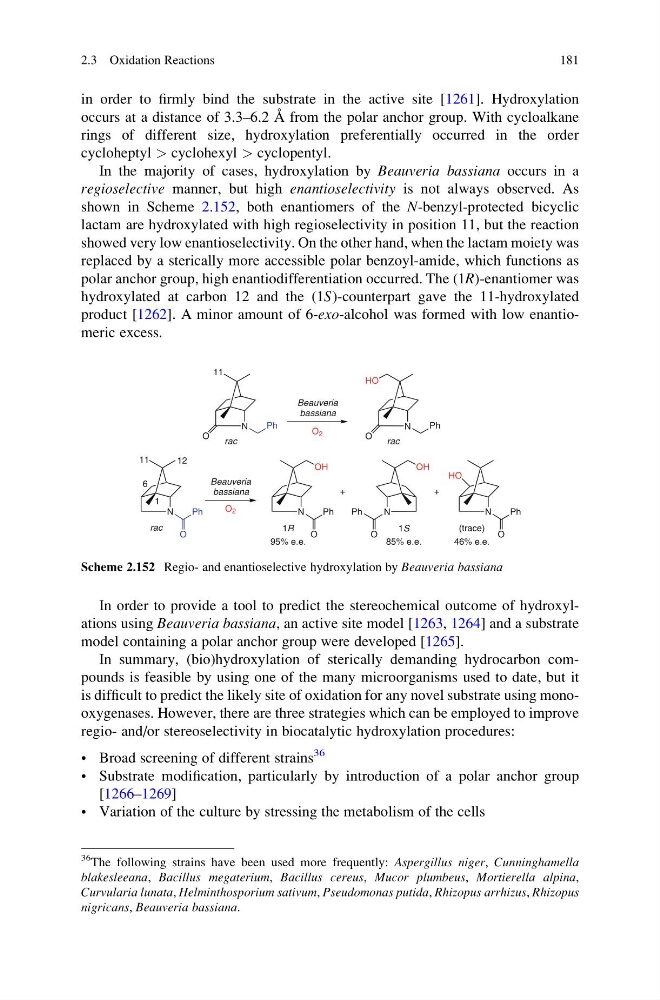
In the majority of cases, hydroxylation by Beauveria bassiana occurs in a
regioselective manner, but high enantioselectivity is not always observed. As
shown in Scheme 2.152, both enantiomers of the N-benzyl-protected bicyclic
lactam are hydroxylated with high regioselectivity in position 11, but the reaction
showed very low enantioselectivity. On the other hand, when the lactam moiety was
replaced by a sterically more accessible polar benzoyl-amide, which functions as
polar anchor group, high enantiodifferentiation occurred. The (1R)-enantiomer was
hydroxylated at carbon 12 and the (1S)-counterpart gave the 11-hydroxylated
product [1262]. A minor amount of 6-exo-alcohol was formed with low enantiomeric excess.
In order to provide a tool to predict the stereochemical outcome of hydroxylations using Beauveria bassiana, an active site model [1263, 1264] and a substrate
model containing a polar anchor group were developed [1265].
In summary, (bio)hydroxylation of sterically demanding hydrocarbon compounds is feasible by using one of the many microorganisms used to date, but it
is difficult to predict the likely site of oxidation for any novel substrate using monooxygenases. However, there are three strategies which can be employed to improve
regio- and/or stereoselectivity in biocatalytic hydroxylation procedures:
• Broad screening of different strains
36
• Substrate modification, particularly by introduction of a polar anchor group
[1266–1269]
• Variation of the culture by stressing the metabolism of the cells
O
Ph
N
HO
O
Ph
N
O
Ph
N
OH
O
Ph
N
OH
O
Ph
N
HO
O
Ph
N
12
11
6
1
rac
rac
11
rac
95% e.e.
85% e.e.
46% e.e.
+
+
Beauveria
bassiana
Beauveria
bassiana
1R
1S
(trace)
O 2
O 2
Scheme 2.152 Regio- and enantioselective hydroxylation by Beauveria bassiana
36 The following strains have been used more frequently: Aspergillus niger, Cunninghamella
blakesleeana, Bacillus megaterium, Bacillus cereus, Mucor plumbeus, Mortierella alpina,
Curvularia lunata, Helminthosporium sativum, Pseudomonas putida, Rhizopus arrhizus, Rhizopus
nigricans, Beauveria bassiana.
2.3 Oxidation Reactions
181
occurs at a distance of 3.3–6.2 Å from the polar anchor group. With cycloalkane
rings of different size, hydroxylation preferentially occurred in the order
cycloheptyl > cyclohexyl > cyclopentyl.
In the majority of cases, hydroxylation by Beauveria bassiana occurs in a
regioselective manner, but high enantioselectivity is not always observed. As
shown in Scheme 2.152, both enantiomers of the N-benzyl-protected bicyclic
lactam are hydroxylated with high regioselectivity in position 11, but the reaction
showed very low enantioselectivity. On the other hand, when the lactam moiety was
replaced by a sterically more accessible polar benzoyl-amide, which functions as
polar anchor group, high enantiodifferentiation occurred. The (1R)-enantiomer was
hydroxylated at carbon 12 and the (1S)-counterpart gave the 11-hydroxylated
product [1262]. A minor amount of 6-exo-alcohol was formed with low enantiomeric excess.
In order to provide a tool to predict the stereochemical outcome of hydroxylations using Beauveria bassiana, an active site model [1263, 1264] and a substrate
model containing a polar anchor group were developed [1265].
In summary, (bio)hydroxylation of sterically demanding hydrocarbon compounds is feasible by using one of the many microorganisms used to date, but it
is difficult to predict the likely site of oxidation for any novel substrate using monooxygenases. However, there are three strategies which can be employed to improve
regio- and/or stereoselectivity in biocatalytic hydroxylation procedures:
• Broad screening of different strains
36
• Substrate modification, particularly by introduction of a polar anchor group
[1266–1269]
• Variation of the culture by stressing the metabolism of the cells
O
Ph
N
HO
O
Ph
N
O
Ph
N
OH
O
Ph
N
OH
O
Ph
N
HO
O
Ph
N
12
11
6
1
rac
rac
11
rac
95% e.e.
85% e.e.
46% e.e.
+
+
Beauveria
bassiana
Beauveria
bassiana
1R
1S
(trace)
O 2
O 2
Scheme 2.152 Regio- and enantioselective hydroxylation by Beauveria bassiana
36 The following strains have been used more frequently: Aspergillus niger, Cunninghamella
blakesleeana, Bacillus megaterium, Bacillus cereus, Mucor plumbeus, Mortierella alpina,
Curvularia lunata, Helminthosporium sativum, Pseudomonas putida, Rhizopus arrhizus, Rhizopus
nigricans, Beauveria bassiana.
2.3 Oxidation Reactions
181