

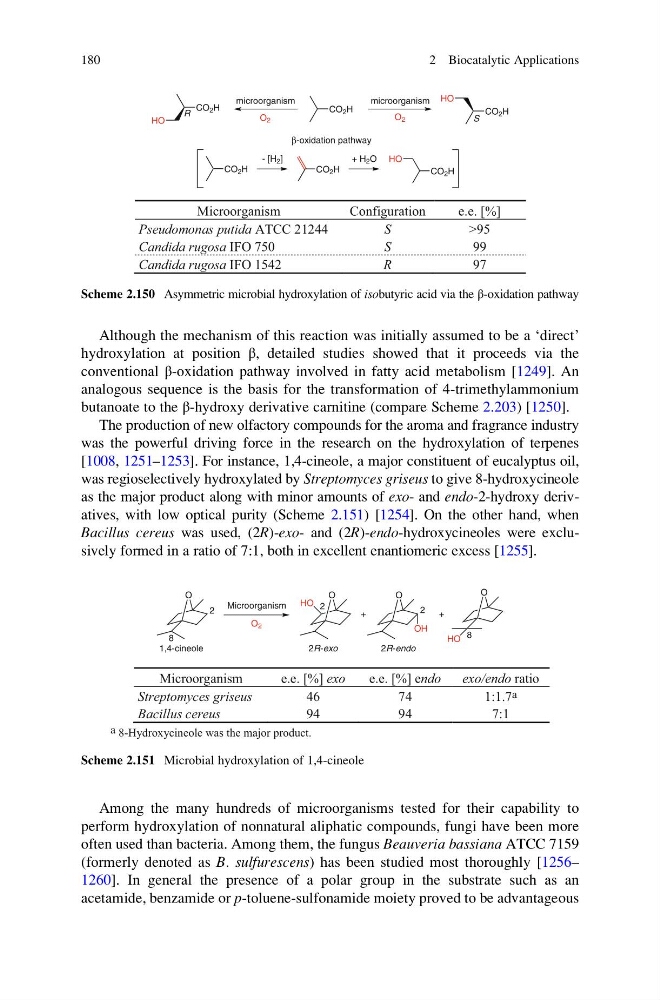
Although the mechanism of this reaction was initially assumed to be a ‘direct’
hydroxylation at position β, detailed studies showed that it proceeds via the
conventional β-oxidation pathway involved in fatty acid metabolism [1249]. An
analogous sequence is the basis for the transformation of 4-trimethylammonium
butanoate to the β-hydroxy derivative carnitine (compare Scheme 2.203) [1250].
The production of new olfactory compounds for the aroma and fragrance industry
was the powerful driving force in the research on the hydroxylation of terpenes
[1008, 1251–1253]. For instance, 1,4-cineole, a major constituent of eucalyptus oil,
was regioselectively hydroxylated by Streptomyces griseus to give 8-hydroxycineole
as the major product along with minor amounts of exo- and endo-2-hydroxy derivatives, with low optical purity (Scheme 2.151) [1254]. On the other hand, when
Bacillus cereus was used, (2R)-exo- and (2R)-endo-hydroxycineoles were exclusively formed in a ratio of 7:1, both in excellent enantiomeric excess [1255].
Among the many hundreds of microorganisms tested for their capability to
perform hydroxylation of nonnatural aliphatic compounds, fungi have been more
often used than bacteria. Among them, the fungus Beauveria bassiana ATCC 7159
(formerly denoted as B. sulfurescens) has been studied most thoroughly [1256–
1260]. In general the presence of a polar group in the substrate such as an
acetamide, benzamide or p-toluene-sulfonamide moiety proved to be advantageous
HO
CO 2 H
CO 2 H
CO 2 H
CO 2 H
HO
CO 2 H
HO
CO 2 H
+ H 2 O
- [H 2 ]
β-oxidation pathway
microorganism
microorganism
O 2
O 2
S
R
Microorganism
Configuration
e.e. [%]
Pseudomonas putida ATCC 21244
S
>95
Candida rugosa IFO 750
S
99
Candida rugosa IFO 1542
R
97
Scheme 2.150 Asymmetric microbial hydroxylation of isobutyric acid via the β-oxidation pathway
HO
O
OH
O
O
HO
O
2
2
2
8
+
1,4-cineole
Microorganism
2R-exo
2R-endo
+
8
O 2
Microorganism
e.e. [%] exo
e.e. [%] endo
exo/endo ratio
Streptomyces griseus
46
74
1:1.7 a
Bacillus cereus
94
94
7:1
a 8-Hydroxycineole was the major product.
Scheme 2.151 Microbial hydroxylation of 1,4-cineole
180
2 Biocatalytic Applications
hydroxylation at position β, detailed studies showed that it proceeds via the
conventional β-oxidation pathway involved in fatty acid metabolism [1249]. An
analogous sequence is the basis for the transformation of 4-trimethylammonium
butanoate to the β-hydroxy derivative carnitine (compare Scheme 2.203) [1250].
The production of new olfactory compounds for the aroma and fragrance industry
was the powerful driving force in the research on the hydroxylation of terpenes
[1008, 1251–1253]. For instance, 1,4-cineole, a major constituent of eucalyptus oil,
was regioselectively hydroxylated by Streptomyces griseus to give 8-hydroxycineole
as the major product along with minor amounts of exo- and endo-2-hydroxy derivatives, with low optical purity (Scheme 2.151) [1254]. On the other hand, when
Bacillus cereus was used, (2R)-exo- and (2R)-endo-hydroxycineoles were exclusively formed in a ratio of 7:1, both in excellent enantiomeric excess [1255].
Among the many hundreds of microorganisms tested for their capability to
perform hydroxylation of nonnatural aliphatic compounds, fungi have been more
often used than bacteria. Among them, the fungus Beauveria bassiana ATCC 7159
(formerly denoted as B. sulfurescens) has been studied most thoroughly [1256–
1260]. In general the presence of a polar group in the substrate such as an
acetamide, benzamide or p-toluene-sulfonamide moiety proved to be advantageous
HO
CO 2 H
CO 2 H
CO 2 H
CO 2 H
HO
CO 2 H
HO
CO 2 H
+ H 2 O
- [H 2 ]
β-oxidation pathway
microorganism
microorganism
O 2
O 2
S
R
Microorganism
Configuration
e.e. [%]
Pseudomonas putida ATCC 21244
S
>95
Candida rugosa IFO 750
S
99
Candida rugosa IFO 1542
R
97
Scheme 2.150 Asymmetric microbial hydroxylation of isobutyric acid via the β-oxidation pathway
HO
O
OH
O
O
HO
O
2
2
2
8
+
1,4-cineole
Microorganism
2R-exo
2R-endo
+
8
O 2
Microorganism
e.e. [%] exo
e.e. [%] endo
exo/endo ratio
Streptomyces griseus
46
74
1:1.7 a
Bacillus cereus
94
94
7:1
a 8-Hydroxycineole was the major product.
Scheme 2.151 Microbial hydroxylation of 1,4-cineole
180
2 Biocatalytic Applications