

In contrast, there are two main groups of hydrocarbon molecules, which can be
efficiently transformed by microbial hydroxylation – steroids and terpenoids. Their
common property is that they possess a large main framework, which impedes the
metabolic degradation of their hydroxylated products.
Intense research on the stereoselective hydroxylation of alkanes started in
the late 1940s in the steroid field, driven by the demand for pharmaceuticals
[1232–1237]. In the meantime, some of the hydroxylation processes, e.g., 9α- and
16α-hydroxylation of the steroid framework [1238, 1239], have been developed to
the scale of industrial production. Nowadays, virtually any center in a steroid can be
selectively hydroxylated by choosing the appropriate microorganism, for a comprehensive list see [1239]. For example, hydroxylation of progesterone in the
11α-position by Rhizopus arrhizus [1240] or Aspergillus niger [1241] made
roughly half of the 37 steps of the conventional chemical synthesis redundant and
made 11α-hydroxyprogesterone available for hormone therapy at a reasonable cost
(Scheme 2.148, bottom). A highly selective hydroxylation of lithiocholic acid in
position 7β was achieved by using Fusarium equiseti [1242]. The product
(ursodeoxycholic acid) is capable of dissolving cholesterol and thus can be used
in the therapy of gallstones.
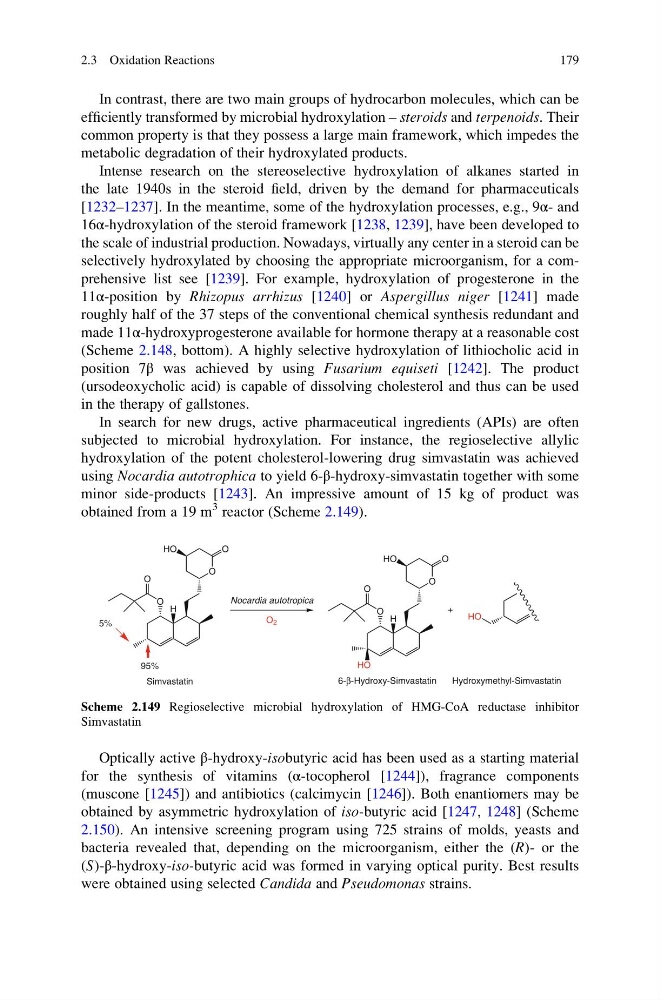
In search for new drugs, active pharmaceutical ingredients (APIs) are often
subjected to microbial hydroxylation. For instance, the regioselective allylic
hydroxylation of the potent cholesterol-lowering drug simvastatin was achieved
using Nocardia autotrophica to yield 6-β-hydroxy-simvastatin together with some
minor side-products [1243]. An impressive amount of 15 kg of product was
obtained from a 19 m
3 reactor (Scheme 2.149).
Optically active β-hydroxy-isobutyric acid has been used as a starting material
for the synthesis of vitamins (α-tocopherol [1244]), fragrance components
(muscone [1245]) and antibiotics (calcimycin [1246]). Both enantiomers may be
obtained by asymmetric hydroxylation of iso-butyric acid [1247, 1248] (Scheme
2.150). An intensive screening program using 725 strains of molds, yeasts and
bacteria revealed that, depending on the microorganism, either the (R)- or the
(S)-β-hydroxy-iso-butyric acid was formed in varying optical purity. Best results
were obtained using selected Candida and Pseudomonas strains.
HO
O
O
H
O
HO
O
HO
O
HO
O
H
O
O
Hydroxymethyl-Simvastatin
+
6-β-Hydroxy-Simvastatin
5%
95%
Nocardia autotropica
Simvastatin
O 2
Scheme 2.149 Regioselective microbial hydroxylation of HMG-CoA reductase inhibitor
Simvastatin
2.3 Oxidation Reactions
179
efficiently transformed by microbial hydroxylation – steroids and terpenoids. Their
common property is that they possess a large main framework, which impedes the
metabolic degradation of their hydroxylated products.
Intense research on the stereoselective hydroxylation of alkanes started in
the late 1940s in the steroid field, driven by the demand for pharmaceuticals
[1232–1237]. In the meantime, some of the hydroxylation processes, e.g., 9α- and
16α-hydroxylation of the steroid framework [1238, 1239], have been developed to
the scale of industrial production. Nowadays, virtually any center in a steroid can be
selectively hydroxylated by choosing the appropriate microorganism, for a comprehensive list see [1239]. For example, hydroxylation of progesterone in the
11α-position by Rhizopus arrhizus [1240] or Aspergillus niger [1241] made
roughly half of the 37 steps of the conventional chemical synthesis redundant and
made 11α-hydroxyprogesterone available for hormone therapy at a reasonable cost
(Scheme 2.148, bottom). A highly selective hydroxylation of lithiocholic acid in
position 7β was achieved by using Fusarium equiseti [1242]. The product
(ursodeoxycholic acid) is capable of dissolving cholesterol and thus can be used
in the therapy of gallstones.
In search for new drugs, active pharmaceutical ingredients (APIs) are often
subjected to microbial hydroxylation. For instance, the regioselective allylic
hydroxylation of the potent cholesterol-lowering drug simvastatin was achieved
using Nocardia autotrophica to yield 6-β-hydroxy-simvastatin together with some
minor side-products [1243]. An impressive amount of 15 kg of product was
obtained from a 19 m
3 reactor (Scheme 2.149).
Optically active β-hydroxy-isobutyric acid has been used as a starting material
for the synthesis of vitamins (α-tocopherol [1244]), fragrance components
(muscone [1245]) and antibiotics (calcimycin [1246]). Both enantiomers may be
obtained by asymmetric hydroxylation of iso-butyric acid [1247, 1248] (Scheme
2.150). An intensive screening program using 725 strains of molds, yeasts and
bacteria revealed that, depending on the microorganism, either the (R)- or the
(S)-β-hydroxy-iso-butyric acid was formed in varying optical purity. Best results
were obtained using selected Candida and Pseudomonas strains.
HO
O
O
H
O
HO
O
HO
O
HO
O
H
O
O
Hydroxymethyl-Simvastatin
+
6-β-Hydroxy-Simvastatin
5%
95%
Nocardia autotropica
Simvastatin
O 2
Scheme 2.149 Regioselective microbial hydroxylation of HMG-CoA reductase inhibitor
Simvastatin
2.3 Oxidation Reactions
179