

In Baeyer-Villiger oxidations, the peroxy-anion performs a nucleophilic attack
on the carbonyl group of the aldehyde or ketone substrate. The tetrahedral species
thus formed (corresponding to a Criegee-intermediate) collapses via rearrangement
of the carbon-framework forming the product ester or lactone, respectively. Finally,
water is eliminated from the FAD-4a-OH species to reform FAD. In addition to the
Baeyer-Villiger oxidation, the flavin-4a-hydroperoxy species can also mediate the
hydroxylation of aromatics [1210–1214], alkene epoxidation [1215, 1216] and
heteroatom-oxidation, desaturation and oxidative C–C coupling [1217–1219]. Put
simply, the FAD-OOH species resembles nature’s m-chloroperbenzoic acid and the
mechanism parallels the oxidation of organic compounds by peroxides or peracids
[1220]. Flavin-dependent monooxygenases, such as Baeyer-Villigerases, can be
used in isolated form together with a suitable nicotinamide-cofactor recycling
system.
2.3.3.1 Hydroxylation of Alkanes
The hydroxylation of nonactivated centers in hydrocarbons is one of the most useful
biotransformations [1175, 1221–1226] due to the fact that this process has only very
few counterparts in traditional organic synthesis [1227–1229]. In general, the
relative reactivity of carbon atoms in bio-hydroxylation reactions declines in the
order of secondary > tertiary > primary [1230], which is in contrast to radical
reactions (tertiary > secondary > primary) [1231].
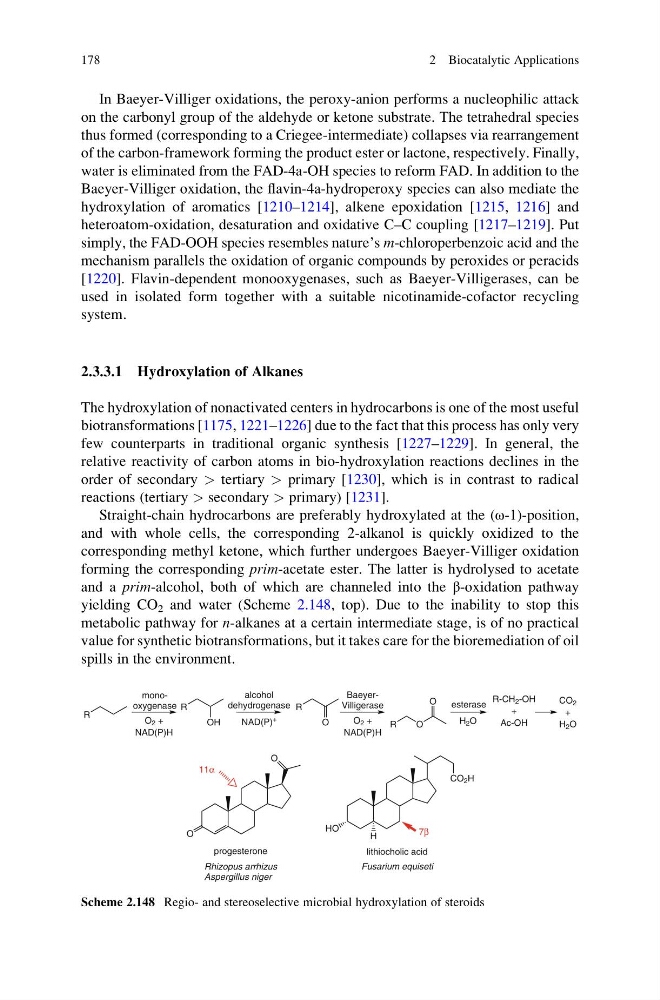
Straight-chain hydrocarbons are preferably hydroxylated at the (ω-1)-position,
and with whole cells, the corresponding 2-alkanol is quickly oxidized to the
corresponding methyl ketone, which further undergoes Baeyer-Villiger oxidation
forming the corresponding prim-acetate ester. The latter is hydrolysed to acetate
and a prim-alcohol, both of which are channeled into the β-oxidation pathway
yielding CO 2 and water (Scheme 2.148, top). Due to the inability to stop this
metabolic pathway for n-alkanes at a certain intermediate stage, is of no practical
value for synthetic biotransformations, but it takes care for the bioremediation of oil
spills in the environment.
CO 2 H
H
HO
O
O
Fusarium equiseti
Rhizopus arrhizus
Aspergillus niger
7β
11α
lithiocholic acid
progesterone
R
R
OH
R
O
R
O
O
R-CH 2 -OH
+
Ac-OH
monooxygenase
O 2 +
NAD(P)H
alcohol
dehydrogenase
NAD(P) +
O 2 +
NAD(P)H
BaeyerVilligerase
esterase
H 2 O
CO 2
+
H 2 O
Scheme 2.148 Regio- and stereoselective microbial hydroxylation of steroids
178
2 Biocatalytic Applications
on the carbonyl group of the aldehyde or ketone substrate. The tetrahedral species
thus formed (corresponding to a Criegee-intermediate) collapses via rearrangement
of the carbon-framework forming the product ester or lactone, respectively. Finally,
water is eliminated from the FAD-4a-OH species to reform FAD. In addition to the
Baeyer-Villiger oxidation, the flavin-4a-hydroperoxy species can also mediate the
hydroxylation of aromatics [1210–1214], alkene epoxidation [1215, 1216] and
heteroatom-oxidation, desaturation and oxidative C–C coupling [1217–1219]. Put
simply, the FAD-OOH species resembles nature’s m-chloroperbenzoic acid and the
mechanism parallels the oxidation of organic compounds by peroxides or peracids
[1220]. Flavin-dependent monooxygenases, such as Baeyer-Villigerases, can be
used in isolated form together with a suitable nicotinamide-cofactor recycling
system.
2.3.3.1 Hydroxylation of Alkanes
The hydroxylation of nonactivated centers in hydrocarbons is one of the most useful
biotransformations [1175, 1221–1226] due to the fact that this process has only very
few counterparts in traditional organic synthesis [1227–1229]. In general, the
relative reactivity of carbon atoms in bio-hydroxylation reactions declines in the
order of secondary > tertiary > primary [1230], which is in contrast to radical
reactions (tertiary > secondary > primary) [1231].
Straight-chain hydrocarbons are preferably hydroxylated at the (ω-1)-position,
and with whole cells, the corresponding 2-alkanol is quickly oxidized to the
corresponding methyl ketone, which further undergoes Baeyer-Villiger oxidation
forming the corresponding prim-acetate ester. The latter is hydrolysed to acetate
and a prim-alcohol, both of which are channeled into the β-oxidation pathway
yielding CO 2 and water (Scheme 2.148, top). Due to the inability to stop this
metabolic pathway for n-alkanes at a certain intermediate stage, is of no practical
value for synthetic biotransformations, but it takes care for the bioremediation of oil
spills in the environment.
CO 2 H
H
HO
O
O
Fusarium equiseti
Rhizopus arrhizus
Aspergillus niger
7β
11α
lithiocholic acid
progesterone
R
R
OH
R
O
R
O
O
R-CH 2 -OH
+
Ac-OH
monooxygenase
O 2 +
NAD(P)H
alcohol
dehydrogenase
NAD(P) +
O 2 +
NAD(P)H
BaeyerVilligerase
esterase
H 2 O
CO 2
+
H 2 O
Scheme 2.148 Regio- and stereoselective microbial hydroxylation of steroids
178
2 Biocatalytic Applications