

Bacterial and mitochondrial Cyt P-450 systems depend on three proteins: the
P-450 monooxygenase with its heme unit, which performs the actual oxygenation of
the substrate, a ferredoxin reductase, which accepts hydride equivalents from nicotinamide via an FAD cofactor and ferredoxin, which acts as electron shuttle between
them using an iron-sulfur cluster as electron carrier [1198]. The microsomal system is
somewhat simpler, as electron transfer occurs directly between the cytochrome P
reductase (possessing an FMN and FAD cofactor) and the Cyt P-450 enzyme and
thus does not require the ferredoxin. The minimal Cyt P-450 system BM-3 is derived
from Bacillus megaterium and it consists of a single (fusion) protein, which is made
up of two domains, a cytochrome P reductase (containing FMN and the FeS cluster)
and the P-450 enzyme. It is evident, that for its simplicity the latter system has been
the prime target of studies directed towards the development of enzymatic oxygenation systems for preparative-scale applications [1199–1201].
Due to their inherent complexity of the electron-transport chain [1202], Cyt
P450 monooxygenase-catalyzed systems are generally employed as whole microbial host cells (‘designer bugs’), which co-express all the required proteins, including those required for NAD(P)H-recycling, in particular when applied to large-scale
reactions [1203–1205].
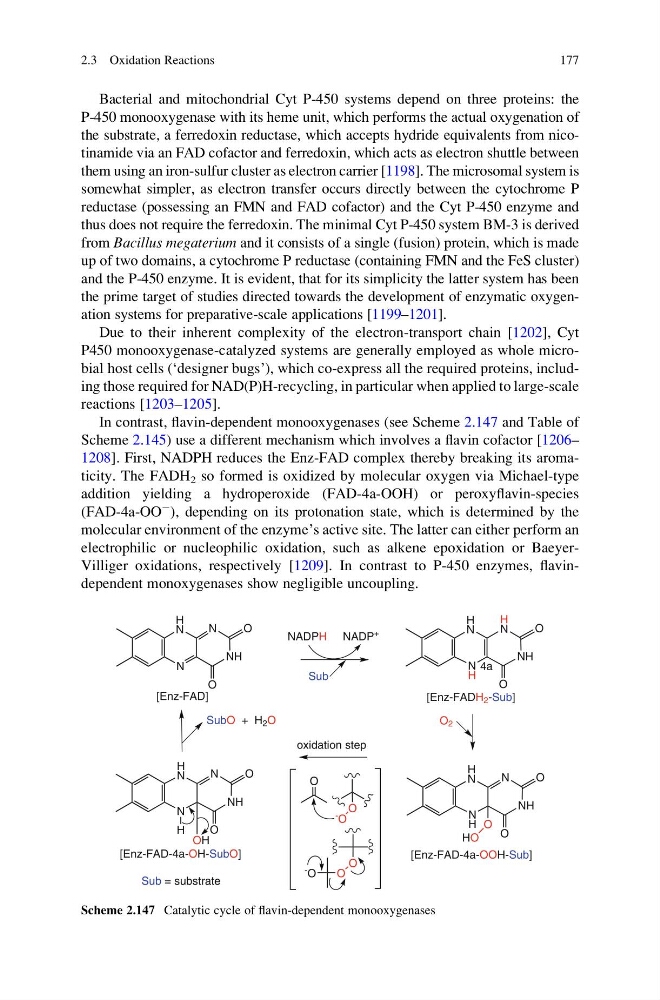
In contrast, flavin-dependent monooxygenases (see Scheme 2.147 and Table of
Scheme 2.145) use a different mechanism which involves a flavin cofactor [1206–
1208]. First, NADPH reduces the Enz-FAD complex thereby breaking its aromaticity. The FADH 2 so formed is oxidized by molecular oxygen via Michael-type
addition yielding a hydroperoxide (FAD-4a-OOH) or peroxyflavin-species
(FAD-4a-OO
À ), depending on its protonation state, which is determined by the
molecular environment of the enzyme’s active site. The latter can either perform an
electrophilic or nucleophilic oxidation, such as alkene epoxidation or BaeyerVilliger oxidations, respectively [1209]. In contrast to P-450 enzymes, flavindependent monoxygenases show negligible uncoupling.
-
O
O
O
O
-
O
O
H
OH
O
O
N
NH
H
N
N
HO
O
O
O
N
NH
H
N
N
H
O
O
H
N
NH
H
N
N
H
O
O
N
NH
H
N
N
4a
Sub = substrate
oxidation step
SubO + H 2 O
NADP +
NADPH
Sub
[Enz-FAD-4a-OH-SubO]
[Enz-FAD-4a-OOH-Sub]
[Enz-FADH 2 -Sub]
[Enz-FAD]
O 2
Scheme 2.147 Catalytic cycle of flavin-dependent monooxygenases
2.3 Oxidation Reactions
177
P-450 monooxygenase with its heme unit, which performs the actual oxygenation of
the substrate, a ferredoxin reductase, which accepts hydride equivalents from nicotinamide via an FAD cofactor and ferredoxin, which acts as electron shuttle between
them using an iron-sulfur cluster as electron carrier [1198]. The microsomal system is
somewhat simpler, as electron transfer occurs directly between the cytochrome P
reductase (possessing an FMN and FAD cofactor) and the Cyt P-450 enzyme and
thus does not require the ferredoxin. The minimal Cyt P-450 system BM-3 is derived
from Bacillus megaterium and it consists of a single (fusion) protein, which is made
up of two domains, a cytochrome P reductase (containing FMN and the FeS cluster)
and the P-450 enzyme. It is evident, that for its simplicity the latter system has been
the prime target of studies directed towards the development of enzymatic oxygenation systems for preparative-scale applications [1199–1201].
Due to their inherent complexity of the electron-transport chain [1202], Cyt
P450 monooxygenase-catalyzed systems are generally employed as whole microbial host cells (‘designer bugs’), which co-express all the required proteins, including those required for NAD(P)H-recycling, in particular when applied to large-scale
reactions [1203–1205].
In contrast, flavin-dependent monooxygenases (see Scheme 2.147 and Table of
Scheme 2.145) use a different mechanism which involves a flavin cofactor [1206–
1208]. First, NADPH reduces the Enz-FAD complex thereby breaking its aromaticity. The FADH 2 so formed is oxidized by molecular oxygen via Michael-type
addition yielding a hydroperoxide (FAD-4a-OOH) or peroxyflavin-species
(FAD-4a-OO
À ), depending on its protonation state, which is determined by the
molecular environment of the enzyme’s active site. The latter can either perform an
electrophilic or nucleophilic oxidation, such as alkene epoxidation or BaeyerVilliger oxidations, respectively [1209]. In contrast to P-450 enzymes, flavindependent monoxygenases show negligible uncoupling.
-
O
O
O
O
-
O
O
H
OH
O
O
N
NH
H
N
N
HO
O
O
O
N
NH
H
N
N
H
O
O
H
N
NH
H
N
N
H
O
O
N
NH
H
N
N
4a
Sub = substrate
oxidation step
SubO + H 2 O
NADP +
NADPH
Sub
[Enz-FAD-4a-OH-SubO]
[Enz-FAD-4a-OOH-Sub]
[Enz-FADH 2 -Sub]
[Enz-FAD]
O 2
Scheme 2.147 Catalytic cycle of flavin-dependent monooxygenases
2.3 Oxidation Reactions
177