

of the reducing agent must be kept at a minimum. In addition, a borate
buffer which leads to the formation of a catechol-borate complex is advantageous [1284].
• Polymerization, which requires the presence of water, can be avoided if the
reaction is performed in a lipophilic organic solvent such as chloroform (Sect.
3.1.6) [1285].
The following rules for phenol hydroxylation have been deduced for polyphenol
oxidase:
• A remarkable range of simple phenols are accepted, as long as the substituent R
is in the p-position; m- and o-derivatives are unreactive, some electron-rich
nonphenolic species such as p-toluidine are accepted.
• For electronic reasons, the reactivity decreases if the nature of the R group is
changed from electron-donating to electron-withdrawing.
• Bulky phenols (p-tert-butylphenol and 1- or 2-naphthols) are not substrates.
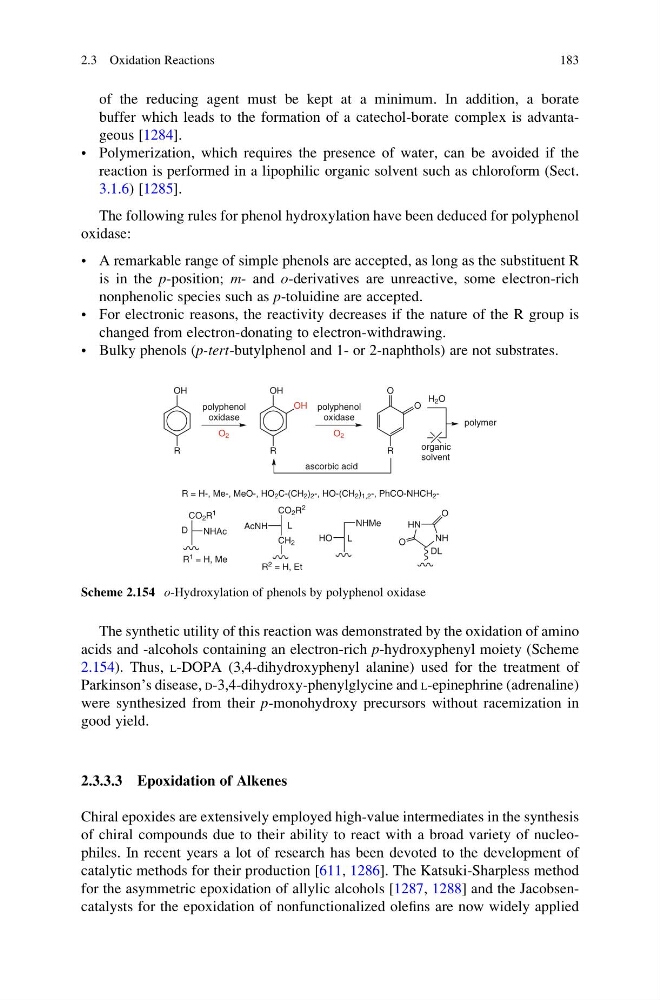
The synthetic utility of this reaction was demonstrated by the oxidation of amino
acids and -alcohols containing an electron-rich p-hydroxyphenyl moiety (Scheme
2.154). Thus, L-DOPA (3,4-dihydroxyphenyl alanine) used for the treatment of
Parkinson’s disease, D-3,4-dihydroxy-phenylglycine and L-epinephrine (adrenaline)
were synthesized from their p-monohydroxy precursors without racemization in
good yield.
2.3.3.3 Epoxidation of Alkenes
Chiral epoxides are extensively employed high-value intermediates in the synthesis
of chiral compounds due to their ability to react with a broad variety of nucleophiles. In recent years a lot of research has been devoted to the development of
catalytic methods for their production [611, 1286]. The Katsuki-Sharpless method
for the asymmetric epoxidation of allylic alcohols [1287, 1288] and the Jacobsencatalysts for the epoxidation of nonfunctionalized olefins are now widely applied
NHAc
CO 2 R
1
R
OH
OH
R
OH
O
R
O
O
O
NH
HN
NHMe
HO
AcNH
CH 2
CO 2 R
2
R
1 = H, Me
organic
solvent
polymer
ascorbic acid
R = H-, Me-, MeO-, HO 2 C-(CH 2 ) 2 -, HO-(CH 2 ) 1,2 -, PhCO-NHCH 2 -
oxidase
polyphenol
oxidase
polyphenol
DL
L
L
R
2 = H, Et
D
H 2 O
O 2
O 2
Scheme 2.154 o-Hydroxylation of phenols by polyphenol oxidase
2.3 Oxidation Reactions
183
buffer which leads to the formation of a catechol-borate complex is advantageous [1284].
• Polymerization, which requires the presence of water, can be avoided if the
reaction is performed in a lipophilic organic solvent such as chloroform (Sect.
3.1.6) [1285].
The following rules for phenol hydroxylation have been deduced for polyphenol
oxidase:
• A remarkable range of simple phenols are accepted, as long as the substituent R
is in the p-position; m- and o-derivatives are unreactive, some electron-rich
nonphenolic species such as p-toluidine are accepted.
• For electronic reasons, the reactivity decreases if the nature of the R group is
changed from electron-donating to electron-withdrawing.
• Bulky phenols (p-tert-butylphenol and 1- or 2-naphthols) are not substrates.
The synthetic utility of this reaction was demonstrated by the oxidation of amino
acids and -alcohols containing an electron-rich p-hydroxyphenyl moiety (Scheme
2.154). Thus, L-DOPA (3,4-dihydroxyphenyl alanine) used for the treatment of
Parkinson’s disease, D-3,4-dihydroxy-phenylglycine and L-epinephrine (adrenaline)
were synthesized from their p-monohydroxy precursors without racemization in
good yield.
2.3.3.3 Epoxidation of Alkenes
Chiral epoxides are extensively employed high-value intermediates in the synthesis
of chiral compounds due to their ability to react with a broad variety of nucleophiles. In recent years a lot of research has been devoted to the development of
catalytic methods for their production [611, 1286]. The Katsuki-Sharpless method
for the asymmetric epoxidation of allylic alcohols [1287, 1288] and the Jacobsencatalysts for the epoxidation of nonfunctionalized olefins are now widely applied
NHAc
CO 2 R
1
R
OH
OH
R
OH
O
R
O
O
O
NH
HN
NHMe
HO
AcNH
CH 2
CO 2 R
2
R
1 = H, Me
organic
solvent
polymer
ascorbic acid
R = H-, Me-, MeO-, HO 2 C-(CH 2 ) 2 -, HO-(CH 2 ) 1,2 -, PhCO-NHCH 2 -
oxidase
polyphenol
oxidase
polyphenol
DL
L
L
R
2 = H, Et
D
H 2 O
O 2
O 2
Scheme 2.154 o-Hydroxylation of phenols by polyphenol oxidase
2.3 Oxidation Reactions
183