

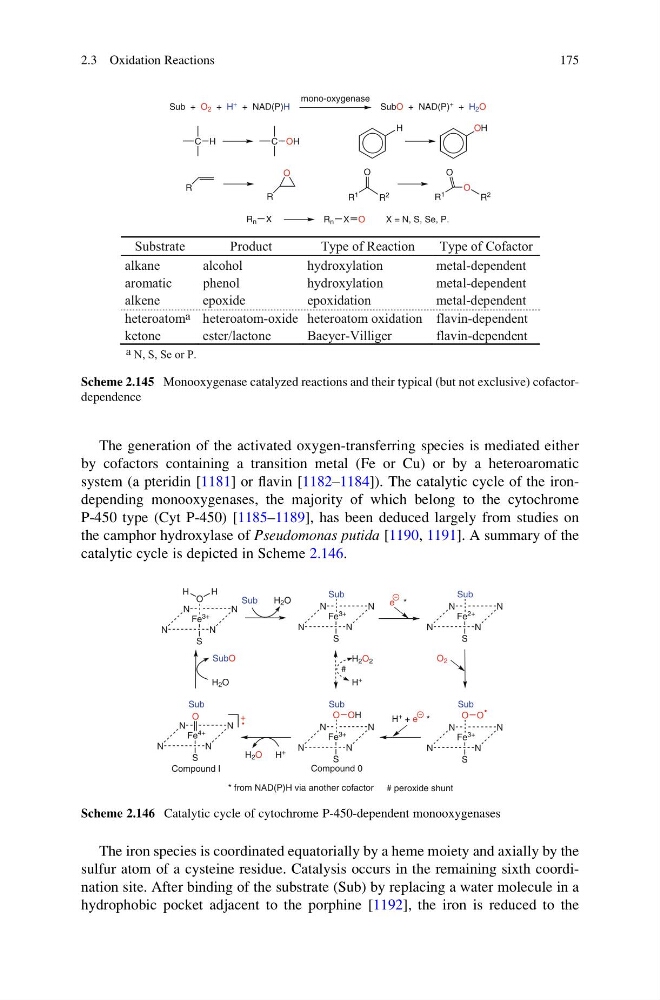
The generation of the activated oxygen-transferring species is mediated either
by cofactors containing a transition metal (Fe or Cu) or by a heteroaromatic
system (a pteridin [1181] or flavin [1182–1184]). The catalytic cycle of the irondepending monooxygenases, the majority of which belong to the cytochrome
P-450 type (Cyt P-450) [1185–1189], has been deduced largely from studies on
the camphor hydroxylase of Pseudomonas putida [1190, 1191]. A summary of the
catalytic cycle is depicted in Scheme 2.146.
The iron species is coordinated equatorially by a heme moiety and axially by the
sulfur atom of a cysteine residue. Catalysis occurs in the remaining sixth coordination site. After binding of the substrate (Sub) by replacing a water molecule in a
hydrophobic pocket adjacent to the porphine [1192], the iron is reduced to the
H
C
OH
C
R
O
R
H
OH
O
R 2
R
1
O
R
2
O
R 1
Sub + O 2 + H
+ + NAD(P)H
SubO + NAD(P)
+ + H 2 O
mono-oxygenase
X
R n
O
X
R n
X = N, S, Se, P.
Substrate
Product
Type of Reaction
Type of Cofactor
alkane
alcohol
hydroxylation
metal-dependent
aromatic
phenol
hydroxylation
metal-dependent
alkene
epoxide
epoxidation
metal-dependent
heteroatom a heteroatom-oxide heteroatom oxidation flavin-dependent
ketone
ester/lactone
Baeyer-Villiger
flavin-dependent
a N, S, Se or P.
Scheme 2.145 Monooxygenase catalyzed reactions and their typical (but not exclusive) cofactordependence
e *
* from NAD(P)H via another cofactor
Sub
Sub
Sub
Sub
SubO
H
+
H 2 O
H 2 O
O 2
H 2 O
H
+ + e *
+
Compound I
Compound 0
H
+
H 2 O 2
#
# peroxide shunt
H
H
O
S
Fe 3+
N
N
N
N
Sub
S
Fe 3+
N
N
N
N
Sub
S
Fe 2+
N
N
N
N
O
S
Fe
3+
N
N
N
N
O
O
S
Fe 3+
N
N
N
N
OH
O
S
Fe 4+
N
N
N
N
Scheme 2.146 Catalytic cycle of cytochrome P-450-dependent monooxygenases
2.3 Oxidation Reactions
175
by cofactors containing a transition metal (Fe or Cu) or by a heteroaromatic
system (a pteridin [1181] or flavin [1182–1184]). The catalytic cycle of the irondepending monooxygenases, the majority of which belong to the cytochrome
P-450 type (Cyt P-450) [1185–1189], has been deduced largely from studies on
the camphor hydroxylase of Pseudomonas putida [1190, 1191]. A summary of the
catalytic cycle is depicted in Scheme 2.146.
The iron species is coordinated equatorially by a heme moiety and axially by the
sulfur atom of a cysteine residue. Catalysis occurs in the remaining sixth coordination site. After binding of the substrate (Sub) by replacing a water molecule in a
hydrophobic pocket adjacent to the porphine [1192], the iron is reduced to the
H
C
OH
C
R
O
R
H
OH
O
R 2
R
1
O
R
2
O
R 1
Sub + O 2 + H
+ + NAD(P)H
SubO + NAD(P)
+ + H 2 O
mono-oxygenase
X
R n
O
X
R n
X = N, S, Se, P.
Substrate
Product
Type of Reaction
Type of Cofactor
alkane
alcohol
hydroxylation
metal-dependent
aromatic
phenol
hydroxylation
metal-dependent
alkene
epoxide
epoxidation
metal-dependent
heteroatom a heteroatom-oxide heteroatom oxidation flavin-dependent
ketone
ester/lactone
Baeyer-Villiger
flavin-dependent
a N, S, Se or P.
Scheme 2.145 Monooxygenase catalyzed reactions and their typical (but not exclusive) cofactordependence
e *
* from NAD(P)H via another cofactor
Sub
Sub
Sub
Sub
SubO
H
+
H 2 O
H 2 O
O 2
H 2 O
H
+ + e *
+
Compound I
Compound 0
H
+
H 2 O 2
#
# peroxide shunt
H
H
O
S
Fe 3+
N
N
N
N
Sub
S
Fe 3+
N
N
N
N
Sub
S
Fe 2+
N
N
N
N
O
S
Fe
3+
N
N
N
N
O
O
S
Fe 3+
N
N
N
N
OH
O
S
Fe 4+
N
N
N
N
Scheme 2.146 Catalytic cycle of cytochrome P-450-dependent monooxygenases
2.3 Oxidation Reactions
175