

not occur. Oxidases include flavoprotein oxidases (such as alcohol, amine and
nicotinamide oxidases), metallo-flavin oxidases (aldehyde oxidase) and hemeprotein oxidases (catalase, H 2 O 2 -specific peroxidases [1180]).
• In a related fashion, peroxidases catalyze two-electron oxidations at the expense
of hydrogen peroxide forming water.
• Peroxygenases incorporate O into a substrate from H 2 O 2 .
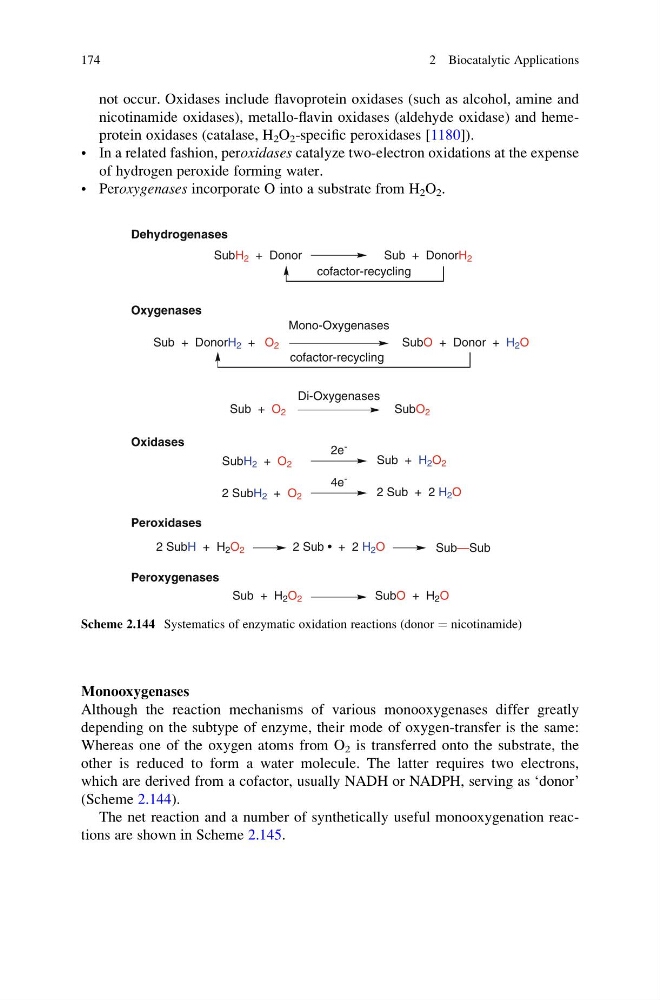
Monooxygenases
Although the reaction mechanisms of various monooxygenases differ greatly
depending on the subtype of enzyme, their mode of oxygen-transfer is the same:
Whereas one of the oxygen atoms from O 2 is transferred onto the substrate, the
other is reduced to form a water molecule. The latter requires two electrons,
which are derived from a cofactor, usually NADH or NADPH, serving as ‘donor’
(Scheme 2.144).
The net reaction and a number of synthetically useful monooxygenation reactions are shown in Scheme 2.145.
cofactor-recycling
SubO + Donor + H 2 O
Sub + DonorH 2 + O 2
Mono-Oxygenases
cofactor-recycling
Sub + DonorH 2
SubH 2 + Donor
SubO 2
Sub + O 2
Di-Oxygenases
Sub + H 2 O 2
SubH 2 + O 2
Sub—Sub
2 Sub • + 2 H 2 O
2 SubH + H 2 O 2
SubO + H 2 O
Sub + H 2 O 2
Peroxidases
Oxygenases
Dehydrogenases
Oxidases
2e
-
2 Sub + 2 H 2 O
2 SubH 2 + O 2
4e
-
Peroxygenases
Scheme 2.144 Systematics of enzymatic oxidation reactions (donor ¼ nicotinamide)
174
2 Biocatalytic Applications
nicotinamide oxidases), metallo-flavin oxidases (aldehyde oxidase) and hemeprotein oxidases (catalase, H 2 O 2 -specific peroxidases [1180]).
• In a related fashion, peroxidases catalyze two-electron oxidations at the expense
of hydrogen peroxide forming water.
• Peroxygenases incorporate O into a substrate from H 2 O 2 .
Monooxygenases
Although the reaction mechanisms of various monooxygenases differ greatly
depending on the subtype of enzyme, their mode of oxygen-transfer is the same:
Whereas one of the oxygen atoms from O 2 is transferred onto the substrate, the
other is reduced to form a water molecule. The latter requires two electrons,
which are derived from a cofactor, usually NADH or NADPH, serving as ‘donor’
(Scheme 2.144).
The net reaction and a number of synthetically useful monooxygenation reactions are shown in Scheme 2.145.
cofactor-recycling
SubO + Donor + H 2 O
Sub + DonorH 2 + O 2
Mono-Oxygenases
cofactor-recycling
Sub + DonorH 2
SubH 2 + Donor
SubO 2
Sub + O 2
Di-Oxygenases
Sub + H 2 O 2
SubH 2 + O 2
Sub—Sub
2 Sub • + 2 H 2 O
2 SubH + H 2 O 2
SubO + H 2 O
Sub + H 2 O 2
Peroxidases
Oxygenases
Dehydrogenases
Oxidases
2e
-
2 Sub + 2 H 2 O
2 SubH 2 + O 2
4e
-
Peroxygenases
Scheme 2.144 Systematics of enzymatic oxidation reactions (donor ¼ nicotinamide)
174
2 Biocatalytic Applications