

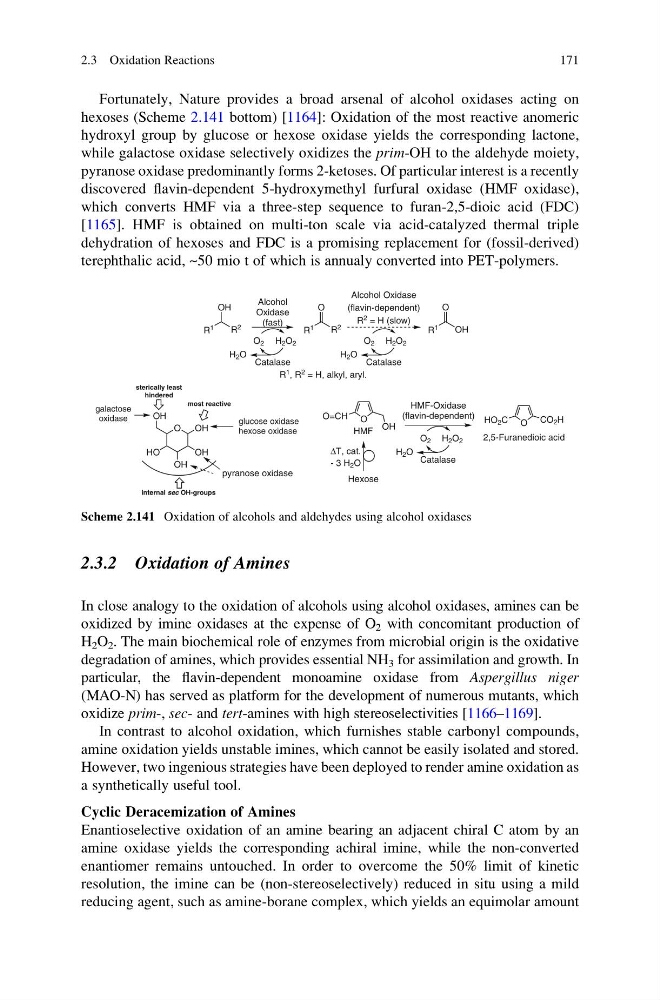
Fortunately, Nature provides a broad arsenal of alcohol oxidases acting on
hexoses (Scheme 2.141 bottom) [1164]: Oxidation of the most reactive anomeric
hydroxyl group by glucose or hexose oxidase yields the corresponding lactone,
while galactose oxidase selectively oxidizes the prim-OH to the aldehyde moiety,
pyranose oxidase predominantly forms 2-ketoses. Of particular interest is a recently
discovered flavin-dependent 5-hydroxymethyl furfural oxidase (HMF oxidase),
which converts HMF via a three-step sequence to furan-2,5-dioic acid (FDC)
[1165]. HMF is obtained on multi-ton scale via acid-catalyzed thermal triple
dehydration of hexoses and FDC is a promising replacement for (fossil-derived)
terephthalic acid, ~50 mio t of which is annualy converted into PET-polymers.
2.3.2 Oxidation of Amines
In close analogy to the oxidation of alcohols using alcohol oxidases, amines can be
oxidized by imine oxidases at the expense of O 2 with concomitant production of
H 2 O 2 . The main biochemical role of enzymes from microbial origin is the oxidative
degradation of amines, which provides essential NH 3 for assimilation and growth. In
particular, the flavin-dependent monoamine oxidase from Aspergillus niger
(MAO-N) has served as platform for the development of numerous mutants, which
oxidize prim-, sec- and tert-amines with high stereoselectivities [1166–1169].
In contrast to alcohol oxidation, which furnishes stable carbonyl compounds,
amine oxidation yields unstable imines, which cannot be easily isolated and stored.
However, two ingenious strategies have been deployed to render amine oxidation as
a synthetically useful tool.
Cyclic Deracemization of Amines
Enantioselective oxidation of an amine bearing an adjacent chiral C atom by an
amine oxidase yields the corresponding achiral imine, while the non-converted
enantiomer remains untouched. In order to overcome the 50% limit of kinetic
resolution, the imine can be (non-stereoselectively) reduced in situ using a mild
reducing agent, such as amine-borane complex, which yields an equimolar amount
R
1
R
2
OH
R
1
R
2
O
Alcohol
Oxidase
(fast)
H 2 O 2
O 2
Catalase
Alcohol Oxidase
(flavin-dependent)
R
2 = H (slow)
R
1
OH
O
R 1 , R 2 = H, alkyl, aryl.
H 2 O 2
O 2
H 2 O
Catalase
H 2 O
O
OH
OH
OH
HO
OH
galactose
oxidase
glucose oxidase
hexose oxidase
pyranose oxidase
sterically least
hindered
most reactive
internal sec OH-groups
O
O=CH
OH
O
HO 2 C
CO 2 H
HMF-Oxidase
(flavin-dependent)
H 2 O 2
O 2
Catalase
H 2 O
2,5-Furanedioic acid
Hexose
HMF
ΔT, cat.
- 3 H 2 O
Scheme 2.141 Oxidation of alcohols and aldehydes using alcohol oxidases
2.3 Oxidation Reactions
171
hexoses (Scheme 2.141 bottom) [1164]: Oxidation of the most reactive anomeric
hydroxyl group by glucose or hexose oxidase yields the corresponding lactone,
while galactose oxidase selectively oxidizes the prim-OH to the aldehyde moiety,
pyranose oxidase predominantly forms 2-ketoses. Of particular interest is a recently
discovered flavin-dependent 5-hydroxymethyl furfural oxidase (HMF oxidase),
which converts HMF via a three-step sequence to furan-2,5-dioic acid (FDC)
[1165]. HMF is obtained on multi-ton scale via acid-catalyzed thermal triple
dehydration of hexoses and FDC is a promising replacement for (fossil-derived)
terephthalic acid, ~50 mio t of which is annualy converted into PET-polymers.
2.3.2 Oxidation of Amines
In close analogy to the oxidation of alcohols using alcohol oxidases, amines can be
oxidized by imine oxidases at the expense of O 2 with concomitant production of
H 2 O 2 . The main biochemical role of enzymes from microbial origin is the oxidative
degradation of amines, which provides essential NH 3 for assimilation and growth. In
particular, the flavin-dependent monoamine oxidase from Aspergillus niger
(MAO-N) has served as platform for the development of numerous mutants, which
oxidize prim-, sec- and tert-amines with high stereoselectivities [1166–1169].
In contrast to alcohol oxidation, which furnishes stable carbonyl compounds,
amine oxidation yields unstable imines, which cannot be easily isolated and stored.
However, two ingenious strategies have been deployed to render amine oxidation as
a synthetically useful tool.
Cyclic Deracemization of Amines
Enantioselective oxidation of an amine bearing an adjacent chiral C atom by an
amine oxidase yields the corresponding achiral imine, while the non-converted
enantiomer remains untouched. In order to overcome the 50% limit of kinetic
resolution, the imine can be (non-stereoselectively) reduced in situ using a mild
reducing agent, such as amine-borane complex, which yields an equimolar amount
R
1
R
2
OH
R
1
R
2
O
Alcohol
Oxidase
(fast)
H 2 O 2
O 2
Catalase
Alcohol Oxidase
(flavin-dependent)
R
2 = H (slow)
R
1
OH
O
R 1 , R 2 = H, alkyl, aryl.
H 2 O 2
O 2
H 2 O
Catalase
H 2 O
O
OH
OH
OH
HO
OH
galactose
oxidase
glucose oxidase
hexose oxidase
pyranose oxidase
sterically least
hindered
most reactive
internal sec OH-groups
O
O=CH
OH
O
HO 2 C
CO 2 H
HMF-Oxidase
(flavin-dependent)
H 2 O 2
O 2
Catalase
H 2 O
2,5-Furanedioic acid
Hexose
HMF
ΔT, cat.
- 3 H 2 O
Scheme 2.141 Oxidation of alcohols and aldehydes using alcohol oxidases
2.3 Oxidation Reactions
171