

optical purity [878, 1157]. An analogous double-step oxidation of prim-alcohols
yielding carboxylic acids using a single ADH variant was recently reported [1158].
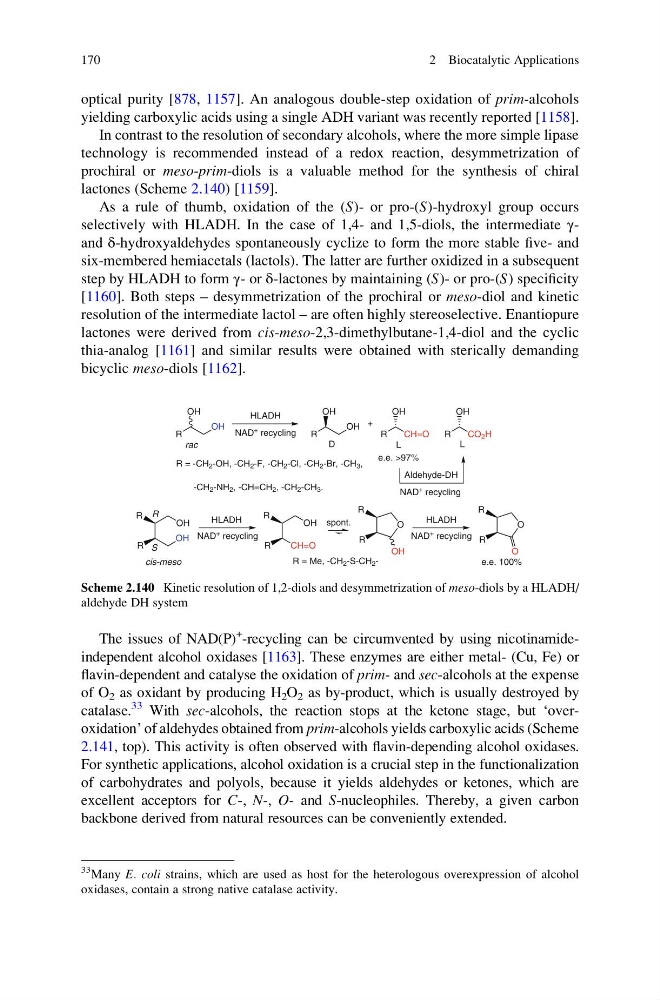
In contrast to the resolution of secondary alcohols, where the more simple lipase
technology is recommended instead of a redox reaction, desymmetrization of
prochiral or meso-prim-diols is a valuable method for the synthesis of chiral
lactones (Scheme 2.140) [1159].
As a rule of thumb, oxidation of the (S)- or pro-(S)-hydroxyl group occurs
selectively with HLADH. In the case of 1,4- and 1,5-diols, the intermediate γand δ-hydroxyaldehydes spontaneously cyclize to form the more stable five- and
six-membered hemiacetals (lactols). The latter are further oxidized in a subsequent
step by HLADH to form γ- or δ-lactones by maintaining (S)- or pro-(S) specificity
[1160]. Both steps – desymmetrization of the prochiral or meso-diol and kinetic
resolution of the intermediate lactol – are often highly stereoselective. Enantiopure
lactones were derived from cis-meso-2,3-dimethylbutane-1,4-diol and the cyclic
thia-analog [1161] and similar results were obtained with sterically demanding
bicyclic meso-diols [1162].
The issues of NAD(P)
+
-recycling can be circumvented by using nicotinamideindependent alcohol oxidases [1163]. These enzymes are either metal- (Cu, Fe) or
flavin-dependent and catalyse the oxidation of prim- and sec-alcohols at the expense
of O 2 as oxidant by producing H 2 O 2 as by-product, which is usually destroyed by
catalase.
33 With sec-alcohols, the reaction stops at the ketone stage, but ‘overoxidation’ of aldehydes obtained from prim-alcohols yields carboxylic acids (Scheme
2.141, top). This activity is often observed with flavin-depending alcohol oxidases.
For synthetic applications, alcohol oxidation is a crucial step in the functionalization
of carbohydrates and polyols, because it yields aldehydes or ketones, which are
excellent acceptors for C-, N-, O- and S-nucleophiles. Thereby, a given carbon
backbone derived from natural resources can be conveniently extended.
OH
R
OH
OH
R
OH
OH
R
CO 2 H
OH
R
CH=O
rac
e.e. >97%
R = -CH 2 -OH, -CH 2 -F, -CH 2 -Cl, -CH 2 -Br, -CH 3 ,
-CH 2 -NH 2 , -CH=CH 2 , -CH 2 -CH 3 .
L
L
NAD + recycling
Aldehyde-DH
HLADH
NAD
+ recycling
+
D
R
R
OH
OH
O
O
R
R
OH
O
R
R
R
R
OH
CH=O
HLADH
NAD
+ recycling
spont.
cis-meso
e.e. 100%
R = Me, -CH 2 -S-CH 2 -
HLADH
NAD
+ recycling
S
R
Scheme 2.140 Kinetic resolution of 1,2-diols and desymmetrization of meso-diols by a HLADH/
aldehyde DH system
33 Many E. coli strains, which are used as host for the heterologous overexpression of alcohol
oxidases, contain a strong native catalase activity.
170
2 Biocatalytic Applications
yielding carboxylic acids using a single ADH variant was recently reported [1158].
In contrast to the resolution of secondary alcohols, where the more simple lipase
technology is recommended instead of a redox reaction, desymmetrization of
prochiral or meso-prim-diols is a valuable method for the synthesis of chiral
lactones (Scheme 2.140) [1159].
As a rule of thumb, oxidation of the (S)- or pro-(S)-hydroxyl group occurs
selectively with HLADH. In the case of 1,4- and 1,5-diols, the intermediate γand δ-hydroxyaldehydes spontaneously cyclize to form the more stable five- and
six-membered hemiacetals (lactols). The latter are further oxidized in a subsequent
step by HLADH to form γ- or δ-lactones by maintaining (S)- or pro-(S) specificity
[1160]. Both steps – desymmetrization of the prochiral or meso-diol and kinetic
resolution of the intermediate lactol – are often highly stereoselective. Enantiopure
lactones were derived from cis-meso-2,3-dimethylbutane-1,4-diol and the cyclic
thia-analog [1161] and similar results were obtained with sterically demanding
bicyclic meso-diols [1162].
The issues of NAD(P)
+
-recycling can be circumvented by using nicotinamideindependent alcohol oxidases [1163]. These enzymes are either metal- (Cu, Fe) or
flavin-dependent and catalyse the oxidation of prim- and sec-alcohols at the expense
of O 2 as oxidant by producing H 2 O 2 as by-product, which is usually destroyed by
catalase.
33 With sec-alcohols, the reaction stops at the ketone stage, but ‘overoxidation’ of aldehydes obtained from prim-alcohols yields carboxylic acids (Scheme
2.141, top). This activity is often observed with flavin-depending alcohol oxidases.
For synthetic applications, alcohol oxidation is a crucial step in the functionalization
of carbohydrates and polyols, because it yields aldehydes or ketones, which are
excellent acceptors for C-, N-, O- and S-nucleophiles. Thereby, a given carbon
backbone derived from natural resources can be conveniently extended.
OH
R
OH
OH
R
OH
OH
R
CO 2 H
OH
R
CH=O
rac
e.e. >97%
R = -CH 2 -OH, -CH 2 -F, -CH 2 -Cl, -CH 2 -Br, -CH 3 ,
-CH 2 -NH 2 , -CH=CH 2 , -CH 2 -CH 3 .
L
L
NAD + recycling
Aldehyde-DH
HLADH
NAD
+ recycling
+
D
R
R
OH
OH
O
O
R
R
OH
O
R
R
R
R
OH
CH=O
HLADH
NAD
+ recycling
spont.
cis-meso
e.e. 100%
R = Me, -CH 2 -S-CH 2 -
HLADH
NAD
+ recycling
S
R
Scheme 2.140 Kinetic resolution of 1,2-diols and desymmetrization of meso-diols by a HLADH/
aldehyde DH system
33 Many E. coli strains, which are used as host for the heterologous overexpression of alcohol
oxidases, contain a strong native catalase activity.
170
2 Biocatalytic Applications