

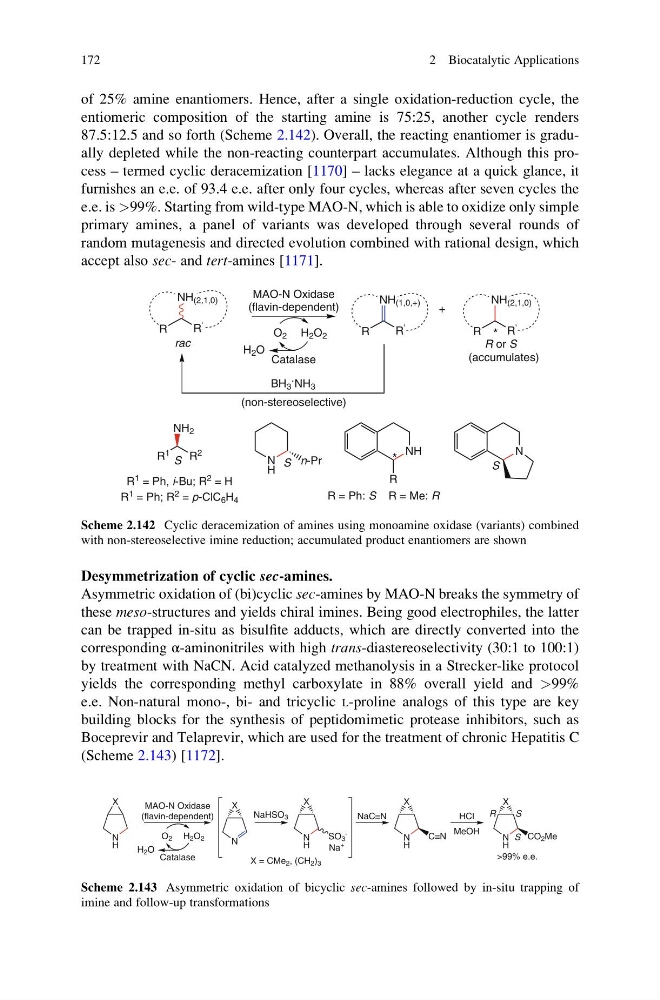
of 25% amine enantiomers. Hence, after a single oxidation-reduction cycle, the
entiomeric composition of the starting amine is 75:25, another cycle renders
87.5:12.5 and so forth (Scheme 2.142). Overall, the reacting enantiomer is gradually depleted while the non-reacting counterpart accumulates. Although this process – termed cyclic deracemization [1170] – lacks elegance at a quick glance, it
furnishes an e.e. of 93.4 e.e. after only four cycles, whereas after seven cycles the
e.e. is >99%. Starting from wild-type MAO-N, which is able to oxidize only simple
primary amines, a panel of variants was developed through several rounds of
random mutagenesis and directed evolution combined with rational design, which
accept also sec- and tert-amines [1171].
Desymmetrization of cyclic sec-amines.
Asymmetric oxidation of (bi)cyclic sec-amines by MAO-N breaks the symmetry of
these meso-structures and yields chiral imines. Being good electrophiles, the latter
can be trapped in-situ as bisulfite adducts, which are directly converted into the
corresponding α-aminonitriles with high trans-diastereoselectivity (30:1 to 100:1)
by treatment with NaCN. Acid catalyzed methanolysis in a Strecker-like protocol
yields the corresponding methyl carboxylate in 88% overall yield and >99%
e.e. Non-natural mono-, bi- and tricyclic L-proline analogs of this type are key
building blocks for the synthesis of peptidomimetic protease inhibitors, such as
Boceprevir and Telaprevir, which are used for the treatment of chronic Hepatitis C
(Scheme 2.143) [1172].
R
R '
NH (2,1,0)
MAO-N Oxidase
(flavin-dependent)
H 2 O 2
O 2
Catalase
H 2 O
rac
R
R
'
NH (1,0,+)
R
R
'
NH (2,1,0)
*
R or S
(accumulates)
+
BH 3
. NH 3
(non-stereoselective)
R
1
R
2
NH 2
S
R
1 = Ph, i-Bu; R
2 = H
R
1 = Ph; R
2 = p-ClC 6 H 4
NH
R
*
R = Ph: S R = Me: R
N
H
n-Pr
N
S
S
Scheme 2.142 Cyclic deracemization of amines using monoamine oxidase (variants) combined
with non-stereoselective imine reduction; accumulated product enantiomers are shown
MAO-N Oxidase
(flavin-dependent)
H 2 O 2
O 2
Catalase
H 2 O
N
H
X
N
X
NaHSO 3
N
H
X
SO 3
-
Na
+
NaC≡N
N
H
X
C≡N
HCl
MeOH
N
H
X
CO 2 Me
>99% e.e.
R
S
S
X = CMe 2 , (CH 2 ) 3
Scheme 2.143 Asymmetric oxidation of bicyclic sec-amines followed by in-situ trapping of
imine and follow-up transformations
172
2 Biocatalytic Applications
entiomeric composition of the starting amine is 75:25, another cycle renders
87.5:12.5 and so forth (Scheme 2.142). Overall, the reacting enantiomer is gradually depleted while the non-reacting counterpart accumulates. Although this process – termed cyclic deracemization [1170] – lacks elegance at a quick glance, it
furnishes an e.e. of 93.4 e.e. after only four cycles, whereas after seven cycles the
e.e. is >99%. Starting from wild-type MAO-N, which is able to oxidize only simple
primary amines, a panel of variants was developed through several rounds of
random mutagenesis and directed evolution combined with rational design, which
accept also sec- and tert-amines [1171].
Desymmetrization of cyclic sec-amines.
Asymmetric oxidation of (bi)cyclic sec-amines by MAO-N breaks the symmetry of
these meso-structures and yields chiral imines. Being good electrophiles, the latter
can be trapped in-situ as bisulfite adducts, which are directly converted into the
corresponding α-aminonitriles with high trans-diastereoselectivity (30:1 to 100:1)
by treatment with NaCN. Acid catalyzed methanolysis in a Strecker-like protocol
yields the corresponding methyl carboxylate in 88% overall yield and >99%
e.e. Non-natural mono-, bi- and tricyclic L-proline analogs of this type are key
building blocks for the synthesis of peptidomimetic protease inhibitors, such as
Boceprevir and Telaprevir, which are used for the treatment of chronic Hepatitis C
(Scheme 2.143) [1172].
R
R '
NH (2,1,0)
MAO-N Oxidase
(flavin-dependent)
H 2 O 2
O 2
Catalase
H 2 O
rac
R
R
'
NH (1,0,+)
R
R
'
NH (2,1,0)
*
R or S
(accumulates)
+
BH 3
. NH 3
(non-stereoselective)
R
1
R
2
NH 2
S
R
1 = Ph, i-Bu; R
2 = H
R
1 = Ph; R
2 = p-ClC 6 H 4
NH
R
*
R = Ph: S R = Me: R
N
H
n-Pr
N
S
S
Scheme 2.142 Cyclic deracemization of amines using monoamine oxidase (variants) combined
with non-stereoselective imine reduction; accumulated product enantiomers are shown
MAO-N Oxidase
(flavin-dependent)
H 2 O 2
O 2
Catalase
H 2 O
N
H
X
N
X
NaHSO 3
N
H
X
SO 3
-
Na
+
NaC≡N
N
H
X
C≡N
HCl
MeOH
N
H
X
CO 2 Me
>99% e.e.
R
S
S
X = CMe 2 , (CH 2 ) 3
Scheme 2.143 Asymmetric oxidation of bicyclic sec-amines followed by in-situ trapping of
imine and follow-up transformations
172
2 Biocatalytic Applications