

attractive targets for asymmetric synthesis. Established approaches for their preparation are the asymmetric addition of nucleophiles across imines (including the
famous Mannich and Strecker reactions), asymmetric C-H amination and
hydroamination and the asymmetric reduction of enamines and imines, which are
either pre-formed or occur as intermediates in reductive amination [1047, 1048].
In this context, the asymmetric reduction of imines using NAD(P)H-dependent
enzymes – imine reductases – represents an attractive option for biocatalysis
[1049–1051]. This reaction can, in theory, give access to almost any prim-, secand tert-amine while the imine (or iminium) substrate is either pre-formed in a
separate condensation step or is generated in-situ.
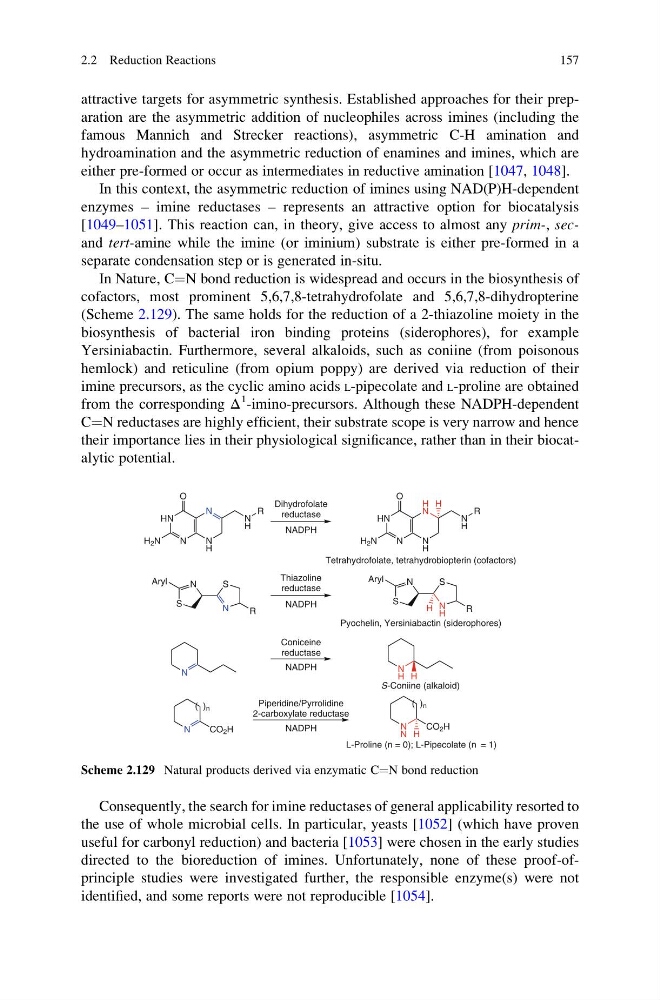
In Nature, C¼N bond reduction is widespread and occurs in the biosynthesis of
cofactors, most prominent 5,6,7,8-tetrahydrofolate and 5,6,7,8-dihydropterine
(Scheme 2.129). The same holds for the reduction of a 2-thiazoline moiety in the
biosynthesis of bacterial iron binding proteins (siderophores), for example
Yersiniabactin. Furthermore, several alkaloids, such as coniine (from poisonous
hemlock) and reticuline (from opium poppy) are derived via reduction of their
imine precursors, as the cyclic amino acids L-pipecolate and L-proline are obtained
from the corresponding Δ
1 -imino-precursors. Although these NADPH-dependent
C¼N reductases are highly efficient, their substrate scope is very narrow and hence
their importance lies in their physiological significance, rather than in their biocatalytic potential.
Consequently, the search for imine reductases of general applicability resorted to
the use of whole microbial cells. In particular, yeasts [1052] (which have proven
useful for carbonyl reduction) and bacteria [1053] were chosen in the early studies
directed to the bioreduction of imines. Unfortunately, none of these proof-ofprinciple studies were investigated further, the responsible enzyme(s) were not
identified, and some reports were not reproducible [1054].
Pyochelin, Yersiniabactin (siderophores)
N
H
S-Coniine (alkaloid)
HN
N
N
H
H
N
O
H 2 N
N
H
R
HN
N
N
H
N
O
H 2 N
N
H
R
Dihydrofolate
reductase
NADPH
Tetrahydrofolate, tetrahydrobiopterin (cofactors)
S
N
S
N
Aryl
R
Thiazoline
reductase
NADPH
S
N
H
S
N
Aryl
R
H
H
N
Coniceine
reductase
NADPH
H
N
CO 2 H
Piperidine/Pyrrolidine
2-carboxylate reductase
NADPH
N
N
CO 2 H
H
( ) n
( ) n
L-Proline (n = 0); L-Pipecolate (n = 1)
Scheme 2.129 Natural products derived via enzymatic C¼N bond reduction
2.2 Reduction Reactions
157
famous Mannich and Strecker reactions), asymmetric C-H amination and
hydroamination and the asymmetric reduction of enamines and imines, which are
either pre-formed or occur as intermediates in reductive amination [1047, 1048].
In this context, the asymmetric reduction of imines using NAD(P)H-dependent
enzymes – imine reductases – represents an attractive option for biocatalysis
[1049–1051]. This reaction can, in theory, give access to almost any prim-, secand tert-amine while the imine (or iminium) substrate is either pre-formed in a
separate condensation step or is generated in-situ.
In Nature, C¼N bond reduction is widespread and occurs in the biosynthesis of
cofactors, most prominent 5,6,7,8-tetrahydrofolate and 5,6,7,8-dihydropterine
(Scheme 2.129). The same holds for the reduction of a 2-thiazoline moiety in the
biosynthesis of bacterial iron binding proteins (siderophores), for example
Yersiniabactin. Furthermore, several alkaloids, such as coniine (from poisonous
hemlock) and reticuline (from opium poppy) are derived via reduction of their
imine precursors, as the cyclic amino acids L-pipecolate and L-proline are obtained
from the corresponding Δ
1 -imino-precursors. Although these NADPH-dependent
C¼N reductases are highly efficient, their substrate scope is very narrow and hence
their importance lies in their physiological significance, rather than in their biocatalytic potential.
Consequently, the search for imine reductases of general applicability resorted to
the use of whole microbial cells. In particular, yeasts [1052] (which have proven
useful for carbonyl reduction) and bacteria [1053] were chosen in the early studies
directed to the bioreduction of imines. Unfortunately, none of these proof-ofprinciple studies were investigated further, the responsible enzyme(s) were not
identified, and some reports were not reproducible [1054].
Pyochelin, Yersiniabactin (siderophores)
N
H
S-Coniine (alkaloid)
HN
N
N
H
H
N
O
H 2 N
N
H
R
HN
N
N
H
N
O
H 2 N
N
H
R
Dihydrofolate
reductase
NADPH
Tetrahydrofolate, tetrahydrobiopterin (cofactors)
S
N
S
N
Aryl
R
Thiazoline
reductase
NADPH
S
N
H
S
N
Aryl
R
H
H
N
Coniceine
reductase
NADPH
H
N
CO 2 H
Piperidine/Pyrrolidine
2-carboxylate reductase
NADPH
N
N
CO 2 H
H
( ) n
( ) n
L-Proline (n = 0); L-Pipecolate (n = 1)
Scheme 2.129 Natural products derived via enzymatic C¼N bond reduction
2.2 Reduction Reactions
157